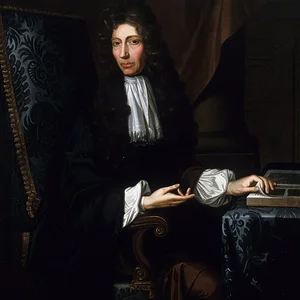

Irish physicist and chemist of the 17th century, regarded as one of the founders of modern chemistry and of the experimental method. He is famous for the law that bears his name on the compressibility of gases and for his work 'The Sceptical Chymist'.
Robert Boyle(1627 — 1691)
Robert Boyle
6 min read
Frequently asked questions
Key Facts
- Born in 1627 in Lismore (Ireland), died in 1691 in London
- Published 'The Sceptical Chymist' in 1661, a founding text of modern chemistry
- Stated around 1662 the Boyle-Mariotte law on the relationship between the pressure and volume of a gas
- Founding member of the Royal Society of London in 1660
- Carried out numerous experiments on the vacuum using an improved air pump
Works & Achievements
Presentation of his air-pump experiments on the vacuum and the elasticity of air. A founding work of the experimental physics of gases.
A critique of the theory of the four elements and of alchemy. It lays the groundwork for the modern definition of a chemical element.
The statement that, at constant temperature, the pressure of a gas is inversely proportional to its volume. One of the first quantitative laws in physics.
A defense of corpuscular philosophy, explaining the properties of bodies through the motion and arrangement of tiny particles.
Boyle takes part in the creation of England's first great scientific academy, which institutionalizes experimental research.
A work in which Boyle argues that the study of nature and the Christian faith reinforce one another, reflecting his deep religiosity.
Anecdotes
Robert Boyle was born into an extremely wealthy family: his father, the Earl of Cork, was one of the richest men in Ireland. This fortune allowed Boyle to fund his own research throughout his life, without ever depending on a patron or a university.
With the help of his assistant Robert Hooke, Boyle built an “air pump” capable of creating a vacuum. He placed birds, mice and even a candle inside it to show that without air the flame goes out and the animals suffocate: a spectacular demonstration of the role of air.
In his book “The Sceptical Chymist” (1661), Boyle attacked the ideas of the ancients who believed that everything was made of four elements (earth, water, air, fire). He put forward the modern idea that matter is composed of tiny “corpuscles,” an insight that foreshadows atoms.
Deeply religious, Boyle learned Hebrew, Greek and Aramaic to better read the Bible, and funded translations of the Scriptures into foreign languages. For him, studying nature was a way to better understand the work of God.
Boyle was one of the founding members of the Royal Society of London in 1660, one of the first great scientific academies. He even refused to become its president in 1680, because he did not want to take the official oath that was required.
Primary Sources
I now mean by elements certain primitive and simple, or perfectly unmingled bodies; which not being made of any other bodies, or of one another, are the ingredients of which all those called perfectly mixt bodies are immediately compounded.
Experiments teach us that the air has an elastic force, or spring, by which it tends to expand itself when it is compressed.
The pressure and expansion of the air are in reciprocal proportion: the more the air is compressed into a small space, the greater is its force of spring.
The study of nature leads the mind of the naturalist to acknowledge and admire the wisdom, power, and goodness of the Author of the world.
Key Places
Boyle's birthplace, the residence of his father the Earl of Cork. It was on this magnificent estate that he spent his early years.
The prestigious school where young Boyle was sent to study with his brother around the age of eight.
The city where Boyle settled in the 1650s and, together with Robert Hooke, carried out his experiments on the vacuum and air.
The scientific academy founded in 1660, of which Boyle was one of the founding members and a leading figure.
The district where Boyle lived with his sister Katherine during his final years and where he died in 1691.
The city where Boyle stayed during his grand educational tour of Europe, and where he discovered his vocation for study.
Typical Objects

A device built with Robert Hooke to draw the air out of a glass vessel and create a partial vacuum. Boyle carried out his most famous experiments on combustion and respiration with it.

A curved glass tube containing mercury, used by Boyle to measure how the volume of a gas decreases as pressure increases. It served to establish the law that bears his name.

A column of mercury used to measure air pressure. Boyle used it to study the “spring” and the weight of the atmosphere.

Glass vessels heated to distil and transform substances. Boyle used them for his rigorous chemical experiments.

Plant extracts, such as violet syrup, whose colour changes on contact with acids or bases. Boyle was a pioneer in using them to identify substances.

A notebook in which Boyle meticulously recorded each experiment, its conditions and its results, so that others could reproduce them. This rigour underpins the modern scientific method.
School Curriculum
Vocabulary & Tags
Key Vocabulary
Daily Life
Morning
Boyle, of fragile health, would rise without haste and often devoted his mornings to reading and prayer. A pious man, he frequently began the day by meditating on the Scriptures before heading to his study.
Afternoon
The afternoon was the time for experiments in his private laboratory, funded by his personal fortune. Surrounded by skilled assistants such as Robert Hooke, he directed the procedures and carefully recorded every result.
Evening
In the evening, Boyle would receive correspondents and scholars, exchanging letters and ideas throughout all of Europe. He also wrote his many treatises, both scientific and religious.
Food
Of delicate constitution, Boyle followed a temperate diet and watched what he ate, fearing the excesses he deemed harmful to his health. He consumed the usual fare of English high society: meats, bread, wine, and beer.
Clothing
As a 17th-century gentleman, Boyle wore dark, sober clothing — a doublet, a lace-collared shirt, and a wig in keeping with Restoration fashion. His attire reflected his restraint and seriousness rather than ostentation.
Housing
Boyle lived mainly in Oxford and then in London, with his sister Katherine Jones, in a comfortable residence on Pall Mall. His home housed a true laboratory, the central place of his existence.
Historical Timeline
Period Vocabulary
Liens externes & ressources
Références
Œuvres
New Experiments Physico-Mechanical, Touching the Spring of the Air
1660
The Sceptical Chymist (Le Chimiste sceptique)
1661
Loi de Boyle (loi de Boyle-Mariotte)
1662
The Origin of Forms and Qualities
1666
Membre fondateur de la Royal Society
1660
The Christian Virtuoso
1690