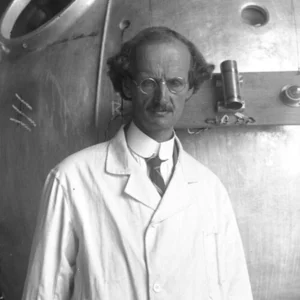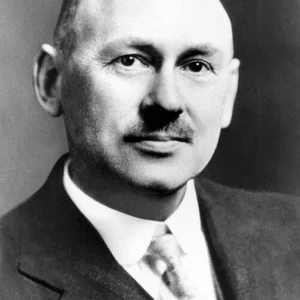

American engineer and physicist (1882–1945), pioneer of astronautics. He designed and launched the first liquid-fueled rocket in 1926, laying the foundations of modern space exploration.
Robert Goddard(1882 — 1945)
Robert Goddard
États-Unis
8 min read
Frequently asked questions
Famous Quotes
« It is difficult to say what is impossible, for the dream of yesterday is the hope of today and the reality of tomorrow.»
Key Facts
- 1882: born in Worcester, Massachusetts
- 1926: first successful launch of a liquid-fueled rocket (Auburn, Massachusetts)
- 1929: first rocket flight carrying a camera and barometer
- 214 patents filed over the course of his career
- 1945: died in Baltimore; his work would directly inspire the American space program
Works & Achievements
Scientific report published by the Smithsonian Institution, laying the theoretical foundations of reaction propulsion in a vacuum and calculating the possibility of reaching the Moon. Mocked upon publication, this text is today considered the founding act of modern astronautics.
Historic launch at Auburn, Massachusetts, of a rocket powered by liquid oxygen and gasoline. This 2.5-second flight constitutes the first practical demonstration of the principle that would, forty-three years later, send men to the Moon.
Goddard was the first to integrate an active gyroscope into a rocket to automatically correct its trajectory in flight — a principle adopted in all modern missiles and orbital launchers.
Second major report published by the Smithsonian, documenting the progress made at Roswell: rockets reaching over 2 km in altitude, regenerative nozzle cooling, turbopumps. This document directly influenced the engineers of post-war space programs.
Goddard filed more than 83 patents during his lifetime covering turbopumps, steerable nozzles, pressurized tanks, and guidance systems. In 1960, the U.S. government officially acknowledged their use by NASA and paid one million dollars to the inventor's estate.
Anecdotes
In 1920, the New York Times published a mocking editorial claiming that a rocket could never function in the vacuum of space, as it would have nothing to push against — an elementary error in Newtonian physics. Forty-nine years later, on July 17, 1969, the day after the launch of Apollo 11 toward the Moon, the newspaper published an official correction: “It is now definitely established that a rocket can function in a vacuum as well as in an atmosphere.”
On March 16, 1926, on his Aunt Effie's snow-covered farm in Auburn, Massachusetts, Goddard achieved the first successful launch of a liquid-fueled rocket in history. The device flew for only 2.5 seconds and traveled 56 meters, but this modest leap would go on to revolutionize space exploration. Goddard noted matter-of-factly in his notebook: 'The start was perfect.'
As a teenager, Goddard once climbed a cherry tree in his backyard in Worcester and imagined a device capable of launching itself toward Mars. It was October 19, 1899; he always considered this date the true beginning of his vocation and commemorated it each year in his private diary until the end of his life.
Diagnosed with tuberculosis as a university student, doctors gave him only two weeks to live in 1913. Goddard survived through sheer determination and a long forced rest, which he used to set down his first theories on reaction propulsion on paper. His illness, far from breaking him, seems to have strengthened his resolve to leave a mark on history.
After World War II, NASA examined Goddard's patents and found that the German V2 missiles had used several of them without authorization or compensation. In 1960, the U.S. government paid one million dollars to Goddard's estate in recognition of these borrowings — a belated vindication for an inventor who had been ridiculed during his lifetime.
Primary Sources
It is possible to send a mass to the Moon by means of a series of successive propulsive charges fired inside a long tube, provided that the ejection velocity is sufficiently high. Calculations show that with an appropriate fuel and a correctly designed vehicle, such an undertaking is physically feasible.
Fired rocket at 2.30 p.m. It rose 41 feet and went 184 feet, in 2.5 sec., after the lower half of the nozzle burned off. Diameter of propellant tanks was too large, and the tank supports could stand more improvement.
The first flight tests were conducted in New Mexico beginning in December 1930. A rocket ten centimeters in diameter reached an altitude of 600 meters and a speed of 800 km/h. Subsequent experiments achieved altitudes of more than two kilometers using a gyroscopic guidance system.
For several years I have been working on a method for raising scientific instruments to altitudes beyond those accessible by sounding balloon. I have developed a new type of reaction device capable of reaching heights never before attained.
Key Places
Goddard's hometown and home of Clark University, where he earned his doctorate and taught for many years while conducting his early research on propulsion.
Site of the first successful launch of a liquid-fueled rocket on March 16, 1926, considered the "Kitty Hawk" of the space age. A memorial marker now stands at the historic location.
Remote desert where Goddard set up his main laboratory from 1930 to 1942, taking advantage of the clear skies and isolation to conduct his experiments away from prying eyes and the press.
The university where Goddard defended his doctorate in 1911 and served as a professor of physics while continuing his rocket research, benefiting from the laboratories and institutional support.
The city where Goddard worked from 1942 on propulsion programs for the U.S. Navy, and where he died on August 10, 1945, of laryngeal cancer, at the age of 62.
Typical Objects

A cylindrical metal component where gasoline and liquid oxygen burn to produce thrust. Goddard designed and machined dozens of successive versions himself to optimize the performance of his rockets.

A flared conduit through which hot exhaust gases escape, converting heat into velocity and directing thrust. Goddard experimented with many nozzle geometries to maximize the efficiency of his vehicles.

A thermally insulated cylinder containing liquid oxygen at −183 °C, essential for combustion in a vacuum. Handling it represented one of the major technical and safety challenges in Goddard's experiments.

A rapidly spinning instrument that keeps the rocket on a stable vertical trajectory by automatically correcting deviations. Goddard was among the first to integrate this guidance system into a reaction-powered vehicle, as early as 1932.

Goddard systematically documented every launch with a camera to analyze the trajectory and performance of his rockets. These photographs now constitute irreplaceable historical archives of the early days of the space age.

Machine tools used to precisely machine the metal components of rockets. Goddard manufactured nearly all the parts for his vehicles himself in his small workshop in Roswell, ensuring complete control over quality.

Goddard kept meticulous logbooks recording every measurement, calculation, and incident during his experiments. These notebooks, preserved in the archives of Clark University and the Smithsonian, are a fundamental primary source for the history of astronautics.
School Curriculum
Vocabulary & Tags
Key Vocabulary
Tags
Daily Life
Morning
Goddard started his day early in his Roswell workshop, reviewing the previous day's calculations and inspecting machined parts. He personally supervised the assembly of components, insisting that every weld and every joint be perfect before any launch attempt.
Afternoon
Afternoons were often devoted to field tests in the New Mexico desert with his small team of a few assistants. After each launch — successful or not — he took detailed notes and photographs to analyze the results and plan improvements.
Evening
In the evenings, Goddard wrote up his logbooks and corresponded with the Smithsonian Institution or his patrons. An avid reader, he was as interested in theoretical physics as in the science-fiction stories that had inspired him in his youth, especially H.G. Wells.
Food
Goddard had fragile health due to tuberculosis contracted in his youth; his diet was simple and measured, typical of the American middle class of the 1920s–1940s. He avoided excess, well aware that his health was his most precious asset for carrying his research forward.
Clothing
In the laboratory or in the field, Goddard wore practical work clothes: sturdy overalls, a shirt, and a wide-brimmed hat to shield himself from the desert sun. For his rare public appearances or meetings with patrons such as Lindbergh, he put on a plain three-piece suit.
Housing
In Roswell, Goddard and his wife Esther lived on a modest ranch close to the laboratory. The isolation was deliberate: Goddard feared industrial espionage and wanted to work undisturbed. The house was functional rather than comfortable, reflecting the absolute priority he placed on his research.
Historical Timeline
Period Vocabulary
Liens externes & ressources
Références
Œuvres
A Method of Reaching Extreme Altitudes
1919
Premier lancement d'une fusée à carburant liquide
16 mars 1926
Système de guidage gyroscopique pour fusée
1932
Liquid Propellant Rocket Development
1936
214 brevets sur la technologie des fusées
1914–1956 (accordés en grande partie à titre posthume)