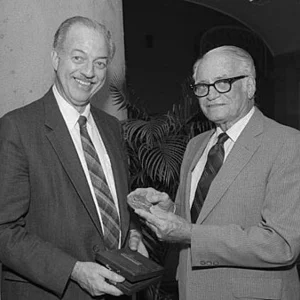

Robert Goldwater (1907–1973) was an American art historian specializing in primitive art and modern art. He founded the Museum of Primitive Art in New York in 1954 and was one of the first scholars to theorize primitivism in twentieth-century Western art.
Robert Goldwater(1907 — 1973)
Robert Goldwater
États-Unis
9 min read
Frequently asked questions
Key Facts
- Born in New York in 1907
- Published in 1938 'Primitivism in Modern Art', a foundational work on the subject
- Founded the Museum of Primitive Art in New York in 1954
- Professor of art history at the Institute of Fine Arts, New York University
- Died in 1973 in New York
Works & Achievements
Goldwater's masterwork and the first systematic analysis of the influence of African, Oceanic, and pre-Columbian arts on the European avant-gardes (Picasso, Matisse, Gauguin, the Expressionists). This pioneering book, drawn from his doctoral thesis, laid the theoretical foundations for an entire field of study.
An anthology of artists' writings on their own practice that became a classic teaching tool in American art history education. This publication reflects Goldwater's commitment to making artistic knowledge accessible to a broad audience.
A monograph devoted to the Mexican painter Rufino Tamayo, showcasing Goldwater's ability to analyze contemporary artists working at the crossroads of indigenous traditions and international modernism — extending his thinking on the relationship between non-Western arts and modernity.
A reference catalogue on Senufo sculpture (Côte d'Ivoire, Mali, Burkina Faso), produced to accompany an exhibition at the Museum of Primitive Art. Goldwater demonstrates his combined command of formal analysis and anthropological method applied to a specific corpus of African art.
An enriched version of his foundational work, incorporating thirty years of new research and the academic debates sparked by the first edition. This revision confirms the enduring relevance of his thinking and remains an indispensable reference in twentieth-century art history to this day.
Anecdotes
In 1938, Robert Goldwater published his revised doctoral dissertation under the title *Primitivism in Modern Painting* — the same year he married the sculptor Louise Bourgeois. This double milestone inaugurated an exceptional intellectual household in New York: their Manhattan studio apartment became a regular gathering place for artists, critics, and curators at the forefront of the American avant-garde.
When Nelson Rockefeller approached Goldwater to direct the brand-new Museum of Primitive Art in New York in 1954, he accepted on one condition: the institution must treat African, Oceanic, and pre-Columbian works as genuine works of art rather than mere ethnographic curiosities. This stance, revolutionary in the Western museum world at the time, permanently transformed the way cultural institutions regarded these civilizations.
Goldwater was one of the first art historians to rigorously analyze how artists such as Picasso, Matisse, and Kirchner had drawn inspiration from non-Western arts. He carefully distinguished several types of borrowing — formal, emotional, and intellectual — at a time when his contemporaries saw little more than a vague fascination with the exotic, earning him as many admirers as detractors in academic circles.
At his death in 1973, Goldwater left behind a flourishing institution whose collection would go on to enrich the Metropolitan Museum of Art. The Michael C. Rockefeller Wing, inaugurated in 1982, carried forward the vision he had championed throughout his life: that the arts of Africa, Oceania, and the Americas deserved to be displayed with the same care and rigor as the masterworks of European painting.
Primary Sources
The term 'primitivism' is used here to describe the attraction of the modern artist to the formal qualities of primitive art — an attraction that is at once aesthetic, emotional, and intellectual. The influence has been one of the chief stimulants of the modern movement in painting.
The modern artist who turns to primitive art does so not out of mere curiosity but because he finds there qualities — directness, intensity, formal economy — that he seeks in his own work. This is not imitation but a deeper recognition of shared expressive aims.
The Senufo sculptor achieves a combination of abstract design and intense expressiveness that makes his work immediately compelling to the Western eye. Its formal qualities — the tension between geometric reduction and organic vitality — reward the sustained attention of the viewer.
The artist's own words remain the most direct evidence of his intentions and his understanding of his work. To read what painters and sculptors have written about art is to enter into a dialogue that crosses centuries and styles.
Key Places
Robert Goldwater's birthplace and the center of his entire intellectual and museum career. In the 1940s–1970s, New York was the world capital of contemporary art, and Goldwater played a central role in the recognition of non-Western arts there.
The institution Goldwater directed from 1954 to 1973, originally located on West 54th Street in Manhattan. This museum was the first in the United States devoted entirely to African, Oceanic, and pre-Columbian arts, before its collection was absorbed into the Metropolitan Museum of Art.
Goldwater taught art history here for many years, training several generations of American historians and curators. NYU's IFA was one of the most prestigious centers for art history in the United States.
The Met began welcoming part of the Museum of Primitive Art's collection as early as 1969, and the Michael C. Rockefeller Wing (opened in 1982) carried on Goldwater's vision. Today this wing houses one of the most important collections of African, Oceanic, and Americas art in the world.
Typical Objects

A central object in the collections that Goldwater studied and championed, the African mask (notably Fang, Dan, or Senufo) was at once a ritual work and a major source of inspiration for the European avant-gardes. Goldwater was among the first to analyze its formal qualities outside any reductive framework.

Sculptures from Oceania (New Guinea, the Marquesas Islands) were among the masterworks of the Museum of Primitive Art. Goldwater saw in them a perfect example of formal and expressive power comparable to the great sculptures of Western art history.

A daily working tool for Goldwater, the illustrated monograph allowed scholarly analysis to reach a cultivated readership. His own book *Primitivism in Modern Art*, richly illustrated, was the first to systematically place primitive and modern Western works side by side.

As director of the Museum of Primitive Art, Goldwater oversaw the production of exhibition catalogues that were authoritative in the field. These academic publications helped legitimize the study of African and Oceanic arts in universities and museums around the world.

Photographs taken by ethnologists and travelers were an essential documentary source for art historians like Goldwater, making it possible to study objects in their original context before the era of accessible academic travel.

Specialist journals such as *The Art Bulletin* were the primary channel through which Goldwater's research reached the international scholarly community. He published landmark articles there on the relationship between modern art and non-Western arts.
School Curriculum
Vocabulary & Tags
Key Vocabulary
Tags
Daily Life
Morning
Robert Goldwater began his day in his Manhattan studio apartment, which he shared with Louise Bourgeois and their children. Mornings were devoted to reading specialist journals, academic correspondence with researchers and curators from around the world, and preparing his courses for NYU's Institute of Fine Arts.
Afternoon
Afternoons were often spent at the Museum of Primitive Art, of which he was director, supervising new acquisitions, preparing exhibitions, or meeting with dealers, collectors, and ethnologists. He also dedicated time to his own research in New York's libraries and archives.
Evening
For Goldwater, New York evenings in the 1950s and 1960s were often social affairs: gallery openings, dinners with artists like Mark Rothko or dealers like Leo Castelli, or late working sessions surrounded by photographs of African and Oceanic works. His home with Louise Bourgeois was a regular gathering point for the New York avant-garde.
Food
Like many New York intellectuals of his generation, Goldwater frequented Manhattan restaurants — neighborhood delicatessens, Midtown brasseries — but often ate simply at his desk during busy days of museum or university work.
Clothing
Goldwater favored the classic dress of the American professor and curator of the 1950s and 1960s: dark suit, tie, and thick-framed glasses. His sober, academic appearance stood in contrast to the sometimes flamboyant artistic circles he moved in day to day.
Housing
Goldwater and Louise Bourgeois lived in a Manhattan studio apartment that served as both family home and intellectual workspace. The apartment was filled with works of art, books, and non-Western objects — a reflection of the two worlds that intersected in their life together: the historian's academic rigor and the sculptor's creative practice.
Historical Timeline
Period Vocabulary
Liens externes & ressources
Références
Œuvres
Primitivism in Modern Painting
1938
Artists on Art from the XIV to the XX Century (co-édité avec Marco Treves)
1945
Rufino Tamayo
1960
Primitivism in Modern Art (édition révisée et augmentée)
1966