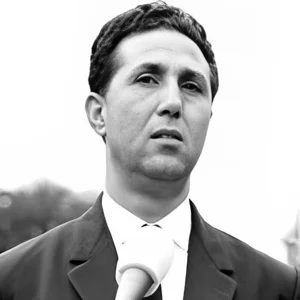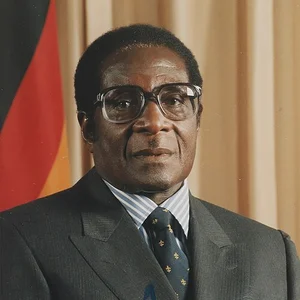

Robert Mugabe (1924-2019) was a Zimbabwean statesman and a leading figure in the struggle for independence against the Rhodesian regime. As Prime Minister and then President of Zimbabwe for nearly four decades, he led the country from 1980 to 2017, gradually shifting from a hero of liberation into an authoritarian ruler.
Robert Mugabe(1924 — 2019)
Robert Mugabe
Zimbabwe
6 min read
Frequently asked questions
Key Facts
- Imprisoned from 1964 to 1974 by the Rhodesian regime for his nationalist activism
- Led the ZANU guerrilla forces during Zimbabwe's (Rhodesia's) war of liberation
- Became Prime Minister of independent Zimbabwe in 1980
- President of the Republic of Zimbabwe from 1987 to 2017
- Launched a controversial land reform from 2000 onward, contributing to the country's economic collapse
- Forced to resign in November 2017 after a military intervention, and died in 2019
Works & Achievements
The culmination of the liberation struggle: the birth of a sovereign state replacing white-minority Rhodesia, with Mugabe at its head.
In the early years, his government dramatically expanded access to schooling and medical care, making Zimbabwe one of the most literate countries in Africa.
A call to move beyond racial divisions and to integrate the white minority into the new Zimbabwe, praised internationally.
The confiscation and redistribution of commercial farms owned by whites; a measure with disastrous economic consequences and highly controversial.
The concentration of power in Mugabe's hands, marking the slide toward an increasingly authoritarian regime.
The merger of the two major liberation movements into a single dominant party, ZANU-PF, following the repression in Matabeleland.
Anecdotes
Robert Mugabe was one of the most highly educated leaders in the world: he amassed seven university degrees, several of them earned by correspondence during his eleven years in prison (1964-1974) under the Rhodesian regime. He studied in his cell, turning his imprisonment into a university.
In 1980, after his party's victory in the first free elections, the world expected reprisals against the white minority. Mugabe surprised everyone with a speech of reconciliation, calling on his former enemies to stay: “If yesterday you were my enemy, today you have become a friend.” He was then hailed as a hero.
Queen Elizabeth II had made Mugabe an honorary knight (Knight Grand Cross) in 1994. In 2008, faced with the repression and the country's collapse, the United Kingdom stripped him of this honor — a rare symbolic rebuke for a head of state.
Around 2008, Zimbabwe experienced under Mugabe one of the worst hyperinflations in history: prices doubled within a few hours and the central bank ended up printing a one hundred trillion Zimbabwean dollar banknote. The currency became so worthless that it was abandoned in favor of the US dollar in 2009.
In November 2017, after 37 years in power, Mugabe was ousted by the army and his own party, ZANU-PF. Rather than a violent coup, it was a negotiated removal: he eventually resigned, and jubilant crowds paraded through the streets of Harare.
Primary Sources
If yesterday you fought me as an enemy, today you have become a friend, with the same national interest, the same loyalty, the same rights and the same duties as myself.
An agreement negotiated in London ending the liberation war and organising the transition of Rhodesia towards an independent Zimbabwe under universal suffrage.
The time has come to build a new nation, founded on unity and the end of the racial division that has so long torn our country apart.
My decision to resign is voluntary; it stems from my concern to ensure a peaceful and orderly transition of power.
Key Places
Mugabe's birthplace, where he was raised at a Catholic mission and received his primary education.
Capital of Zimbabwe and the center of Mugabe's power for nearly four decades. The scene of jubilant crowds when he fell in 2017.
A region in western Zimbabwe, home of the Ndebele people and the scene of the Gukurahundi massacres in the early 1980s.
The neighboring country from which Mugabe led ZANU's armed struggle in the 1970s, after his release from prison.
Site of the 1979 negotiations that ended the liberation war and arranged the transition to an independent Zimbabwe.
The city where Mugabe, being treated in a hospital, died in September 2019 at the age of 95.
Typical Objects

Iconic banknote from the 2008-2009 hyperinflation, a worldwide symbol of Zimbabwe's monetary collapse. Today a collector's item.

Mugabe almost always appeared in a neat dark suit, projecting the image of a cultured and formal statesman.

At ceremonies, Mugabe wore scarves or fabrics in the colors of the national flag (green, yellow, red, black), symbols of national unity.

Mugabe amassed seven degrees, several of them in law and economics earned by correspondence during his imprisonment. They embodied his image as an intellectual.

The emblematic weapon of ZANU guerrillas during the war of liberation against Rhodesia. It even appears on Zimbabwe's national emblem.

Commercial farms, long held by the white minority, were at the heart of the 2000 land reform. Their redistribution upended the rural economy.
School Curriculum
Vocabulary & Tags
Key Vocabulary
Daily Life
Morning
Renowned for his discipline and frugality, Mugabe rose early and exercised regularly. He often devoted his mornings to reading and office work, true to his image as a methodical intellectual.
Afternoon
His afternoons were structured around government meetings, official audiences and the affairs of the ZANU-PF party. He received diplomats and advisers in the presidential offices in Harare.
Evening
His evenings might be taken up with state dinners, speeches or the preparation of addresses. Mugabe often worked late, personally crafting his public remarks.
Food
Mugabe was known for his sober lifestyle: he did not smoke, did not drink alcohol and watched his diet. He was said to have a taste for simple food and a great concern for his physical fitness, even in old age.
Clothing
In public, he almost invariably wore dark, well-tailored Western suits with a tie. At national ceremonies, he sometimes sported scarves in the colours of the Zimbabwean flag.
Housing
As president, he lived in Harare and, in the 2000s, had a vast private residence built, nicknamed the “Blue Roof” because of its blue rooftops — a sprawling, Asian-style mansion surrounded by gardens.
Historical Timeline
Period Vocabulary
Liens externes & ressources
Références
Œuvres
Indépendance du Zimbabwe
1980
Politique d'expansion de l'éducation et de la santé
années 1980
Discours de réconciliation nationale
1980
Réforme agraire (redistribution des terres)
2000
Réforme constitutionnelle créant la présidence exécutive
1987
Accord d'unité ZANU-ZAPU
1987