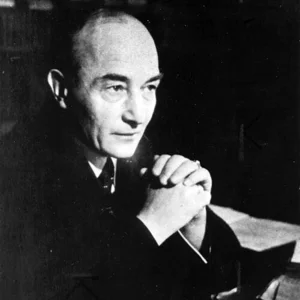

An Austrian writer and essayist, Robert Musil is the author of the unfinished novel The Man Without Qualities, a major work of European literary modernism. An engineer by training, he blends philosophical reflection and psychological analysis in prose of great precision.
Robert Musil(1880 — 1942)
Robert Musil
Autriche
6 min read
Frequently asked questions
Key Facts
- Born in 1880 in Klagenfurt, in Austria-Hungary
- Publishes his first novel The Confusions of Young Törless in 1906
- Releases the first volume of The Man Without Qualities in 1930, a novel that remained unfinished
- Goes into exile in Switzerland in 1938 after the Anschluss
- Dies in Geneva in 1942 in relative poverty
Works & Achievements
Musil's first novel, which made him famous. It depicts the cruelty and psychological turmoil of adolescents in a military boarding school.
A collection of two long, highly demanding short stories that explore inner life and desire.
A play by Musil, awarded the Kleist Prize, which examines passion and morality.
A collection of three refined short stories, regarded as high points of his short prose.
His unfinished masterpiece, a vast novel-essay about Austro-Hungarian society on the eve of 1914. A major work of European literary modernism.
A collection of short texts, prose pieces, and reflections, published by Musil himself under an ironic title.
Anecdotes
Before becoming a writer, Robert Musil was an engineer. During his studies in experimental psychology in Berlin, he designed a scientific instrument, a kind of spinning top with colored disks (the *Variationskreisel*), to study color perception. The engineer's precision never left him: he went on to write his novels with the same rigor as a technical blueprint.
His great novel, *The Man Without Qualities*, remained unfinished. Musil worked on it for more than twenty years, piling up thousands of pages of drafts and endlessly rewriting the same chapters. He said he preferred to write a single perfect sentence rather than ten quick pages, which explains why he was never able to “finish” his work.
In **1938**, when Nazi Germany annexed Austria (the *Anschluss*), Musil and his wife Martha, who was Jewish, had to flee. They went into exile in Switzerland, in **Geneva**, leaving almost everything behind. His books were banned in the Reich.
Musil died in **Geneva** in **1942**, poor and nearly forgotten by the general public. It is said that very few people attended his funeral. It was only decades later that he was recognized as one of the greatest European writers of the 20th century, on a par with **Proust** or **Joyce**.
An officer in the Austro-Hungarian army during the First World War, Musil was posted on the Italian front, in the mountains of Tyrol. This experience of violence and of the collapse of the Austro-Hungarian Empire deeply nourished his reflection on a society heading toward its own ruin without seeing it.
Primary Sources
A barometric low hung over the Atlantic, moving eastward toward a high-pressure area settled over Russia. [...] In a word that describes the situation quite well, even if it is a little old-fashioned: it was a fine August day in the year 1913.
If there is a sense of reality, there must also be a sense of possibility. Whoever possesses it does not say, for instance: here such and such has happened, will happen, must happen; he invents: here such a thing could, should happen.
There are two forms of stupidity: one honest and narrow-minded, the other pretentious, which takes itself for intelligence. It is this second form that is the most dangerous.
Key Places
Robert Musil's birthplace, in the south of the Austro-Hungarian Empire.
The city where Musil studied engineering at the Technical University and where his father taught.
The city where Musil studied philosophy and experimental psychology and defended his doctoral thesis.
The imperial and later republican capital where Musil lived and worked for much of his life, and which inspired the setting of *The Man Without Qualities*.
The city of exile where Musil took refuge after the Anschluss and where he died in 1942.
Liens externes & ressources
Références
Œuvres
Les Désarrois de l'élève Törless
1906
Unions (Vereinigungen)
1911
Les Exaltés (Die Schwärmer)
1921
Trois femmes (Drei Frauen)
1924
L'Homme sans qualités (Der Mann ohne Eigenschaften)
1930-1943
Œuvres posthumes de son vivant (Nachlass zu Lebzeiten)
1936