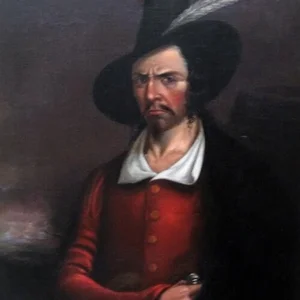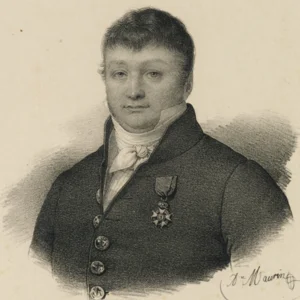

French Malouin privateer, shipowner and slave trader (1773-1827). Nicknamed the “King of Corsairs,” he led feared campaigns against British maritime trade in the Indian Ocean during the Revolutionary and Napoleonic Wars, before becoming a wealthy shipowner in Saint-Malo.
Robert Surcouf(1773 — 1827)
Robert Surcouf
France
7 min read
Frequently asked questions
Key Facts
- Born on 12 December 1773 in Saint-Malo into a family of Malouin shipowners
- Began his maritime career around 1789-1792 aboard slave and merchant ships bound for the Île de France (Indian Ocean)
- Captured the British ship Kent on 7 October 1800 in the Bay of Bengal, his most famous feat
- Became a powerful Saint-Malo shipowner and outfitted his own privateers under letter of marque during the Empire
- Died on 8 July 1827 in Saint-Malo, wealthy and ennobled as a Baron of the Empire
Works & Achievements
Bold seizure of a large English merchant ship with a small crew, the first brilliant exploit that established Surcouf's reputation in the Indian Ocean.
The boarding of a large East India Company ship by La Confiance, Surcouf's most famous feat, which earned him the nickname “King of the Corsairs”.
A series of captures targeting British commerce in the Indian Ocean that disrupted England's maritime links and considerably enriched the corsair.
Having become a shipowner, Surcouf financed and outfitted many privateering and merchant vessels, making him one of the wealthiest men in Brittany.
A distinction granted by Napoleon in recognition of his services and his fame as a corsair.
An imperial title of nobility crowning the social rise of a sailor's son who had become a wealthy notable.
Anecdotes
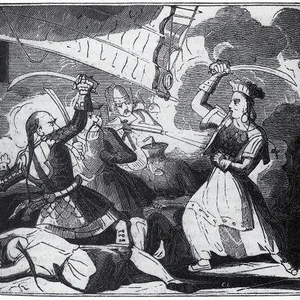
At just 27 years old, on 7 October 1800, Surcouf sent his ship La Confiance, armed with about 18 cannons and 150 men, to attack the Kent, a huge ship of the English East India Company that was far larger and better armed, carrying hundreds of passengers and soldiers. After a fierce boarding action in the Bay of Bengal, his sailors seized the British giant. This feat made Surcouf a legend and earned him his nickname “King of the Corsairs.”
As early as 1796, with his small ship L'Émilie, Surcouf had already captured the Triton, a large English merchant vessel, thanks to a daring surprise attack near the mouth of the Ganges. The governor of Île de France wanted to confiscate his prizes because his letter of marque was not in order. Surcouf went all the way to Paris to defend his rights and eventually won his case.
A famous exchange, reported by his 19th-century biographers, tells how a captured English officer taunted him that the French fought for money while the English fought for honour. Surcouf is said to have replied: “Each man fights for what he lacks.” True or embellished, this retort captures the reputation for wit and panache of the corsair from Saint-Malo.
His fame was such that Napoleon offered him a command in the imperial war navy. Surcouf declined, preferring to keep his freedom as a corsair and later as an independent shipowner. The Emperor nevertheless made him a knight of the Legion of Honour in 1804, and he was raised to the rank of Baron of the Empire towards the end of his life.
Both before and after his fame as a corsair, Surcouf also took part in the slave trade: as a young officer, he sailed aboard slave ships between East Africa and Île de France (present-day Mauritius), and later, having become a wealthy shipowner, he continued to finance slaving expeditions even after the trade was banned in 1815. Historians recall this dark side of a fortune built in part on the trafficking of human beings.
Primary Sources
“You French fight for money, while we English fight for honour. — Each man fights for what he lacks.”
A biography based on the Surcouf family archives, reproducing extracts from the logbook of La Confiance and the privateer's correspondence with the authorities of the Île de France.
A report recording the capture of the Company's ship the Kent by the French privateer La Confiance and the death of her captain Rivington during the boarding.
Key Places
Breton privateer city where Surcouf was born, grew up, and died. After his campaigns, he built up a shipowner's fortune there and became one of the town's most famous figures.
Major French base for privateering in the Indian Ocean and Surcouf's home port. It was from there that he fitted out his ships and brought back his prizes.
A vast maritime area between India and the Indochinese peninsula, a route for British trade. It was here that Surcouf carried out his most famous hunts, including the capture of the Kent.
A coastal region near Calcutta where the wealthy ships of the East India Company sailed. Surcouf captured the Triton there in 1796.
The capital, where Surcouf went to defend his rights over his prizes and where his fame caught the attention of Napoleon, who decorated him.
Typical Objects

Short, broad blade, sturdy and easy to wield in the cramped spaces of a ship's deck. It was the supreme weapon of hand-to-hand fighting during corsair boardings.

Single-shot handgun firearm, often carried in pairs on the belt. The sailor would fire an opening shot before pressing the fight with his cutlass.

Iron hook attached to a rope, thrown to catch the enemy ship and draw it closer. It allowed corsairs to leap aboard the opposing vessel.

Official document issued by the State authorizing a private captain to attack enemy ships. It legally distinguished the privateer from the pirate.

Navigation instrument used to measure the height of the sun or the stars in order to calculate the ship's position. Indispensable for crossing the Indian Ocean.

Telescope used to spot the sails of a merchant ship in the distance. Surcouf used it to track his prey before an attack.

A fast, well-armed corsair ship that Surcouf commanded during his campaigns in the Indian Ocean. It was aboard her that he captured the Kent in 1800.
School Curriculum
Vocabulary & Tags
Key Vocabulary
Daily Life
Morning
On campaign, the day begins before dawn with the watch and an inspection of the rigging and sails. The captain studies the charts, takes a reading with the sextant, and scans the horizon through the spyglass, on the lookout for a sail in the distance.
Afternoon
The afternoon is spent maneuvering to gain the position for the chase, drilling the crew in the handling of the cannon and the cutlass, and keeping the ship's log up to date. When a prize is spotted, the entire crew is called to clear for action.
Evening
In the evening, sail is shortened for the night, the watches are relieved, and the meal is shared. Surcouf, reputed to be demanding but fair, would discuss the captured prizes and how to share them with his officers by the light of the lanterns.
Food
On board, the food was mostly preserved provisions: ship's biscuit, salted meat and fish, and dried vegetables, washed down with rationed water and wine or rum. Stops at the islands made it possible to restock on fruit, poultry, and fresh water.
Clothing
The captain wore a blue woolen coat, waistcoat, breeches, and boots, sometimes with a bicorne hat, setting him apart from the sailors in their pea jackets and canvas trousers. A cutlass and pistols completed his outfit in battle.
Housing
At sea, Surcouf lodged in the ship's stern cabin, modest but private, furnished with a bunk, a chart table, and sea chests. Ashore, having become a shipowner, he lived in a wealthy bourgeois townhouse in Saint-Malo, close to the harbor.
Historical Timeline
Period Vocabulary
Liens externes & ressources
Références
Œuvres
Capture du Triton
1796
Capture du Kent
1800
Campagnes de course sur La Confiance
1798-1801
Maison d'armement de Saint-Malo
à partir de 1809
Chevalier de la Légion d'honneur
1804
Baron de l'Empire
1827