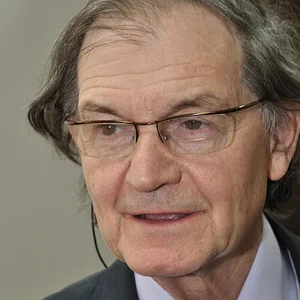

British physicist and mathematician born in 1931, Roger Penrose is known for his work on gravitational singularities, black holes, and cosmology. Winner of the 2020 Nobel Prize in Physics, he also developed controversial theories on consciousness and quantum mechanics.
Roger Penrose(1931 — ?)
Roger Penrose
Royaume-Uni
10 min read
Frequently asked questions
Famous Quotes
« Consciousness is something that cannot be simulated by a computer.»
« Mathematics is not invented, it is discovered.»
Key Facts
- Born on 8 August 1931 in Colchester, England
- 1965: proves, together with Stephen Hawking, the singularity theorems for black holes
- Invents Penrose aperiodic tilings (1974), used in crystallography
- Publishes *The Emperor's New Mind* (1989) on consciousness
- 2020 Nobel Prize in Physics for the discovery that black hole formation is a robust prediction of general relativity
Works & Achievements
The first mathematical result to rigorously prove that black holes — regions of spacetime where gravity is so strong that nothing can escape — are an inevitable consequence of general relativity. This theorem transformed black holes from an exotic hypothesis into a solid physical prediction, and earned Penrose the Nobel Prize in Physics in 2020.
A theoretical mechanism by which energy can be extracted from a rotating black hole (known as a Kerr black hole) by exploiting the region called the ergosphere. This process has major implications for understanding the long-term evolution of black holes and cosmic energy.
The discovery of two simple geometric shapes capable of covering an entire plane in a non-periodic way — never repeating exactly. These tilings, which display a fivefold rotational symmetry forbidden in ordinary crystals, foreshadowed the discovery of quasicrystals and opened a new field in mathematics and materials physics.
An original mathematical framework conceived by Penrose to reformulate the laws of physics by replacing ordinary spacetime with an abstract space of "twistors." Still actively explored today, this theory seeks to unify general relativity and quantum mechanics in a way radically different from conventional approaches.
A popular science book in which Penrose argues that human consciousness cannot be reproduced by a computer algorithm, because it draws on processes rooted in quantum mechanics. A worldwide bestseller, the book sparked vigorous debate among physicists, philosophers, and artificial intelligence researchers.
An encyclopedic work of over 1,000 pages setting out the complete mathematical and physical laws that govern the universe, from Euclidean geometry to string theory and quantum cosmology. Penrose also develops his criticisms of certain dominant paradigms, most notably the theory of cosmic inflation.
An original cosmological theory developed in *Cycles of Time*, proposing that our universe is merely one "aeon" in an infinite succession of universes: the heat death of each universe constitutes the Big Bang of the next. Still debated, this hypothesis offers a radically new perspective on the origin and ultimate fate of the universe.
Anecdotes
In 1965, Roger Penrose published a groundbreaking paper proving mathematically that black holes are an inevitable consequence of Einstein's general relativity, and not mere theoretical curiosities. This singularity theorem, developed in collaboration with Stephen Hawking, radically transformed the way physicists understand the universe. It is precisely this work that earned him the Nobel Prize in Physics in 2020, fifty-five years later.
In the 1970s, Penrose amused himself by solving a seemingly trivial geometric problem: how to tile a plane without repetition? He discovered that just two simple shapes — the 'kite' and the 'dart' — are enough to cover an infinite surface in a non-periodic way. These celebrated 'Penrose tilings' inspired artists and architects, and even found an unexpected scientific application in the structure of quasicrystals discovered in 1984.
Together with his father, geneticist Lionel Penrose, Roger devised in the 1950s the 'Penrose triangle' and the 'impossible staircase' — geometric figures that appear plausible in two dimensions but are physically unrealizable in three dimensions. Dutch artist M.C. Escher, fascinated by these illusions, drew direct inspiration from them for his celebrated prints 'Ascending and Descending' and 'Waterfall'. This unexpected collaboration between science and art illustrates the creative dimension of mathematical thinking.
In 1989, Penrose published 'The Emperor's New Mind', a book in which he argued a provocative thesis: human consciousness cannot be simulated by a computer, as it would involve quantum processes in neurons. This position, developed with anesthesiologist Stuart Hameroff under the name of the 'Orch OR' theory, is strongly contested by specialists in artificial intelligence but continues to fuel major philosophical debates about the nature of thought.
In October 2020, at the age of 89, Roger Penrose learned that he had been awarded the Nobel Prize in Physics — a recognition for work carried out more than half a century earlier. He became one of the oldest Nobel laureates in history. Penrose recounts that he initially thought it was a mistake when he received the call from Stockholm, so long had the wait been. This belated recognition illustrates the patience that fundamental science sometimes demands.
Primary Sources
It is shown that a singularity of space-time is an inevitable result of the present expanding state of the universe, given only (i) Einstein's equations, (ii) an inequality on the energy tensor, (iii) a global condition on causal structure.
I believe that the phenomenon of consciousness cannot be accommodated within the framework of present-day physical theory. The missing science of consciousness is not yet at hand, but it will be needed before we can properly understand what it is that makes for the difference between a 'mere' computation and genuine understanding.
The purpose of this book is to convey to the reader some feeling for what is surely one of the most important and exciting voyages of discovery that humanity has ever undertaken. This is the search for the deep principles that underlie all natural phenomena.
In this article I describe a remarkable set of aperiodic tiles which use just two shapes. They tile the entire plane but only in a non-periodic way.
I am postulating that a new aeon — a new universe — springs into being at the remote future conformal boundary of the previous one.
Key Places
Birthplace of Roger Penrose, born on 8 August 1931. His parents, both scientists, raised him in an intellectually stimulating environment where mathematics and science were part of everyday life from childhood.
Penrose completed and defended his doctorate in mathematics here in 1955. It was at this world-leading centre of theoretical physics that he met Dennis Sciama, an influential mentor, and entered the circles working on general relativity.
Penrose spent the majority of his academic career here, holding the Rouse Ball Professorship of Mathematics from 1973 to 1998. It was from Oxford that he published his major works on tilings, cosmology, and consciousness.
Penrose made several stays at this elite research centre, particularly during the 1950s and 1960s. These visits allowed him to connect with American physicists working on general relativity and to broaden his vision of theoretical physics.
The site of the Nobel Prize in Physics ceremony in December 2020. The event was held in an unprecedented format due to the COVID-19 pandemic: Penrose, aged 89, received his medal and diploma in a decentralised ceremony, but the global recognition was undiminished.
Typical Objects

Like most mathematicians and theoretical physicists of his generation, Penrose works primarily at the blackboard. He draws complex geometric diagrams, curved spaces, and impossible figures by hand to visualize and share his ideas.

Penrose invented a special graphical representation for visualizing the causal structure of spacetime around a black hole on a finite sheet of paper. These diagrams, now fundamental tools of theoretical physics, appear throughout his lectures and publications.

The two asymmetric tiles invented by Penrose — the 'kite' and the 'dart' — are his working tools for exploring aperiodic geometry. Physical models of these shapes sit on the desks of mathematicians around the world.

This apparently three-dimensional triangle, invented with his father in the 1950s, is a physically impossible geometric figure. A reproduction displayed in his office serves as a reminder of the human mind's ability to perceive structures that computers cannot detect as contradictory.

Penrose is renowned for his ability to fill entire pages with equations and geometric sketches during train or plane journeys. He himself describes his best moments of insight as coming while travelling, pen in hand.

Although a theoretical physicist, Penrose works in constant dialogue with astronomical observations. Images of active galactic nuclei and black hole candidates fuel his thinking on singularities and cosmology.
School Curriculum
Vocabulary & Tags
Key Vocabulary
Tags
Daily Life
Morning
Roger Penrose typically begins his day early, often with a coffee or tea — true to British habit. He dedicates his first hours, which he considers his most productive, to pure mathematical thinking: settled quietly at his desk in Oxford, he fills sheets of hand-drawn geometric sketches before so much as opening his post or emails.
Afternoon
His afternoons follow the rhythm of academic life: seminars, lectures, and meetings. Penrose is renowned for the accessibility of his talks, which he always illustrates with numerous diagrams on the blackboard. He enjoys debating at length with colleagues and students, sometimes losing all track of time.
Evening
Penrose's evenings are often spent reading, thinking informally, and talking with his family. A great lover of art, he keeps up a correspondence with artists and regularly visits museums. He is also known for having his best insights during train or plane journeys, notebook always within reach.
Food
Penrose leads a sober, rather typical life for the British intelligentsia of his generation: simple meals taken at an Oxford college or at home, with a clear preference for local eating habits. He takes little particular interest in food, preferring to direct his attention toward ideas.
Clothing
In public appearances and lectures, Penrose favours the classic British professor's look: a plain jacket, usually with a shirt and tie. His understated style stands in contrast to the flamboyance of some contemporary scientific celebrities. Since his formal retirement, he has adopted a more relaxed wardrobe while keeping the same quiet restraint.
Housing
Penrose has spent most of his academic life in and around Oxford, in college accommodation or the kind of residential houses typical of English university towns. His home study, like his university office, is cluttered with books, mathematical diagrams, and geometric models in paper or wood.
Historical Timeline
Period Vocabulary
Liens externes & ressources
Références
Œuvres
Théorème de singularité de Penrose
1965
Processus de Penrose
1969
Pavages apériodiques de Penrose
1974
Théorie des twisteurs
1967
L'Esprit, l'ordinateur et les lois de la physique (The Emperor's New Mind)
1989
La Route de la Réalité (The Road to Reality)
2004
Cosmologie conforme cyclique (CCC)
2010