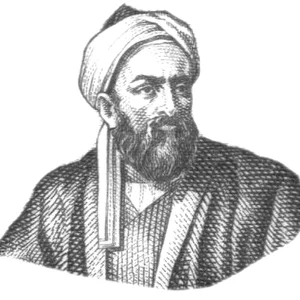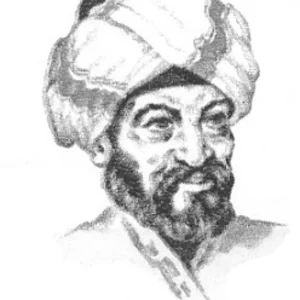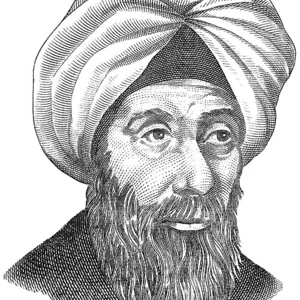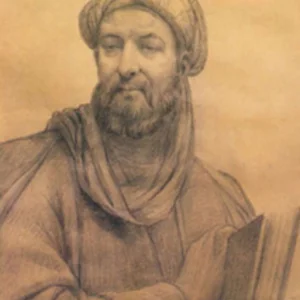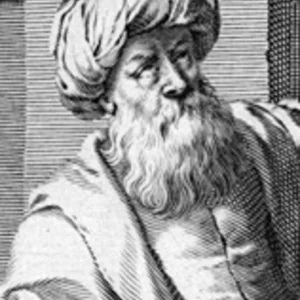

A mathematician, physicist, and Arab philosopher of the 11th century, Ibn al-Haytham is considered the father of modern optics. He was the first to demonstrate that vision results from light reflected by objects toward the eye, overturning the theories of antiquity.
Alhazen (Ibn al-Haytham)
Ibn al-Haytham (Alhazen)
9 min read
Frequently asked questions
Famous Quotes
« The seeker after truth is not one who studies the writings of the ancients and, following his natural disposition, puts his trust in them, but rather the one who suspects his faith in them.»
« Truth is sought for its own sake.»
Key Facts
- Born around 965 in Basra (present-day Iraq), died around 1040 in Cairo
- Wrote the Kitab al-Manazir (Book of Optics) around 1011–1021, translated into Latin in the 12th century under the title De aspectibus
- Refuted the extramission theory of vision (Euclid, Ptolemy) by proving that the eye receives light
- Described the workings of the camera obscura and explained the rectilinear propagation of light
- Pioneer of the scientific method: observation, hypothesis, experimentation, verification
Works & Achievements
A masterwork in seven volumes, considered the most important treatise on optics between Euclid and Newton. Ibn al-Haytham refutes the ancient theory of visual emission, describes the camera obscura, analyzes reflection and refraction, and lays the foundations of physiological optics.
A critical treatise in which Ibn al-Haytham identifies the physical inconsistencies in Ptolemy's astronomical model. This rigorous challenge to ancient authorities perfectly illustrates his scientific approach, grounded in reason and experimentation.
A cosmological work seeking to provide a realistic physical interpretation of Ptolemy's mathematical models. It exerted a lasting influence on Arab astronomers and medieval Latin translators who sought to reconcile mathematics with celestial physics.
A companion to the Book of Optics devoted to the nature and propagation of light. Ibn al-Haytham distinguishes between primary light (emitted by luminous sources) and secondary light (reflected by opaque bodies) — a fundamental distinction for all subsequent optical physics.
A study of atmospheric optical phenomena in which Ibn al-Haytham applies his principles of refraction and reflection. It is one of the earliest rigorous scientific attempts to explain the rainbow through the laws of light.
A collection of solutions to complex geometric problems, including the celebrated "Alhazen's problem" on reflection in a spherical mirror. Solved by Ibn al-Haytham using conic sections, this problem would not receive a complete algebraic solution until the 20th century.
Anecdotes
Commissioned by the Fatimid caliph Al-Hakim to regulate the flooding of the Nile, Ibn al-Haytham proposed an ambitious dam project in the Aswan region. After realizing on-site that the project was technically impossible, and fearing the wrath of a caliph notorious for his unpredictable and violent decisions, he chose to feign madness. He was placed under house arrest until the mysterious death of Al-Hakim in 1021, an event that restored his freedom.
It was during his years of house arrest in Cairo that Ibn al-Haytham wrote his masterpiece, the Kitab al-Manazir (Book of Optics). Deprived of freedom but not of books or instruments, he conducted systematic experiments on light using a handmade camera obscura, forerunner of the photographic camera. He demonstrated that vision results from light reflected by objects toward the eye, thereby overturning nine centuries of ancient theories.
Ibn al-Haytham was one of the first scholars to apply a rigorous experimental method close to what we call the scientific method today. Rather than taking the claims of the Ancients at face value, he subjected them to controlled and reproducible experiments, then built his theories from the observed results. This revolutionary approach has led some historians of science to regard him as the first true scientist in the modern sense of the word.
In his treatise on the moon, Ibn al-Haytham explained why the Moon appears larger at the horizon than at its zenith: it is an optical illusion linked to human perception, not a real physical phenomenon. This psychological explanation of the moon illusion, often attributed to modern scholars, was thus already precisely formulated in the 11th century.
Ibn al-Haytham laid the foundations of the famous 'Alhazen's problem': finding the point on a spherical mirror from which light emitted by a source reflects toward a given observer. This geometric problem, which he solved using an original method involving conic sections, resisted generations of mathematicians and was only fully solved algebraically in the 20th century.
Primary Sources
Light irritates the eyes and causes them pain when it is intense. [...] The eye perceives the form of visible objects through the light that emanates from them or is reflected off their surface toward the eye.
Vision is accomplished only by a form that arrives at the eye from visible objects; and that form is the light and color present in those objects, not a ray issuing from the eye.
Ptolemy assumes in the Almagest hypotheses that are contrary to what nature requires. [...] It is fitting to set out the doubts that may be raised about them, so that truth may be distinguished from error through the path of reasoning and experience.
The celestial bodies are solid spheres moving within concentric hollow spheres; their motions are real and physical, and not mere mathematical devices as some suppose.
There are two kinds of light: light by itself, which belongs to luminous bodies such as the sun and fire; and light by accident, which is the light that opaque bodies receive and reflect toward the eye.
Key Places
Ibn al-Haytham's birthplace, and at the time one of the great intellectual centers of the Abbasid Empire. He received his early education there in Islamic sciences, mathematics, and philosophy before traveling to Baghdad and Egypt.
The city where Ibn al-Haytham spent most of his adult life — first as a court scholar, then under house arrest by al-Hakim. It was here that he wrote the *Book of Optics* and continued working until his death, leaving a lasting mark on the Fatimid capital.
The intellectual capital of the Islamic world and home to the famous **House of Wisdom** (*Bayt al-Hikma*). Ibn al-Haytham spent time there and gained access to Arabic translations of works by Euclid, Aristotle, and Ptolemy that would underpin all of his subsequent research.
A library and academy founded by the Fatimids in **1005**, housing thousands of manuscripts. Ibn al-Haytham likely had access to it to consult the Greek and Islamic scientific texts essential to his work in optics and astronomy.
Typical Objects

Ibn al-Haytham was the first to describe and scientifically explain the camera obscura: a darkened room or box pierced by a small hole that projects an inverted image of the outside world onto the opposite wall. He used it to study the rectilinear propagation of light and to safely observe solar eclipses.

Curved mirrors were central instruments in Ibn al-Haytham's optical experiments. He precisely studied the formation and distortion of images produced by these mirrors, laying the foundations of catoptrics and formulating the famous geometric problem that bears his name.

Ibn al-Haytham used glass objects to study refraction — the bending of light as it passes from one medium to another. These experiments allowed him to calculate angles of refraction and explain phenomena such as the rainbow.

An engraved metal astronomical instrument used to measure the altitude of celestial bodies and solve problems in spherical geometry. Ibn al-Haytham employed it in his calculations on atmospheric refraction and to estimate the height of Earth's atmosphere.

The reed pen (*calame*) and paper — which had spread throughout the Islamic world since the 8th century — were the essential writing tools of the medieval scholar. It was with these instruments that Ibn al-Haytham wrote his more than two hundred scientific treatises.

Indispensable geometric tools for any mathematician, they enabled the precise constructions that illustrated theorems on light, mirrors, and conic sections. Ibn al-Haytham used them both for theoretical demonstrations and for designing his experimental apparatus.
School Curriculum
Vocabulary & Tags
Key Vocabulary
Tags
Daily Life
Morning
Ibn al-Haytham began his day with the dawn prayer (Fajr), a daily practice that provided structure in medieval Islamic society. He would then dedicate himself to reading and annotating Greek texts translated into Arabic — Euclid, Ptolemy, Aristotle — weighing their claims against his own reasoning before planning the day's experiments.
Afternoon
The afternoon was devoted to experimentation in his workroom, arranged to provide the darkness required for his optical observations. Armed with mirrors, prisms, and his handcrafted dark chamber, he methodically tested his hypotheses about light and took precise notes, recording both expected results and the anomalies that led him to revise his theories.
Evening
In the evening, Ibn al-Haytham wrote his treatises with a reed pen, turning his observations and geometric proofs into structured texts intended for posterity. He also conducted nocturnal astronomical observations — particularly of the Moon and stars — in connection with his work on atmospheric refraction and the measurement of the atmosphere's height.
Food
Following Islamic dietary laws (halal), Ibn al-Haytham subsisted on wheat bread, dried legumes (lentils, chickpeas, broad beans), seasonal fruits such as figs and dates, and lamb or poultry on special occasions. Water, pomegranate juice, and fruit drinks were his everyday beverages, alcohol being forbidden.
Clothing
Ibn al-Haytham wore the dress of a Cairene urban scholar: a long linen tunic (*qamis*) in summer, a woollen one in winter, covered by a loose outer garment, and a white turban on his head — a mark of erudition in medieval Islamic society. Under the Fatimid regime, court scholars could receive embroidered robes of honour (*khil'a*) gifted by the caliph, signalling their privileged status.
Housing
In Cairo, Ibn al-Haytham most likely lived in a courtyard house (*dar*) typical of Fatimid architecture, with a central fountain, rooms arranged in sequence, and a rooftop terrace accessible from the upper floors. His personal library of manuscripts held pride of place, complemented by a room specially darkened for the optical experiments that required precise control of light.
Historical Timeline
Period Vocabulary
Liens externes & ressources
Références
Œuvres
Kitab al-Manazir (Livre d'optique)
vers 1011-1021
Al-Shukuk 'ala Batlamyus (Doutes sur Ptolémée)
vers 1025-1028
Maqala fi Hay'at al-'alam (Traité sur la configuration du monde)
vers 1020
Maqala fi al-Daw' (Traité sur la lumière)
vers 1015-1021
Maqala fi al-Hala wa-Qaws Quzah (Traité sur le halo et l'arc-en-ciel)
vers 1021-1040
Maqala fi Tahlil al-Masa'il al-Handassiya (Traité d'analyse géométrique)
vers 1030