
Roland Moisan (1907-1987) was a French humorous cartoonist and caricaturist. He is famous for his long career at the Canard enchaîné, where he sketched the political figures of the Fourth and Fifth Republics.
Roland Moisan(1907 — 1987)
Roland Moisan
France
5 min read
Frequently asked questions
Key Facts
- Born in 1907, he became a humorous cartoonist in the French press.
- He was a long-standing contributor to the Canard enchaîné, a satirical weekly, from the postwar period onward.
- He caricatured the leading political figures of the Fourth and Fifth Republics, notably General de Gaulle.
- His style became emblematic of twentieth-century French satirical press cartoons.
- He died in 1987, leaving behind a significant body of work in the history of caricature.
Works & Achievements
Moisan's major body of work: thousands of weekly caricatures covering the political news of the Fourth and Fifth Republics.
A satirical series depicting de Gaulle as a monarch surrounded by courtiers, one of his most famous creations.
A gallery of sketched portraits from de Gaulle to Mitterrand, forming a genuine drawn chronicle of French power.
Drawings mocking the ministerial instability and the endless reshuffling of post-war governments.
Anecdotes
Roland Moisan joined Le Canard enchaîné in 1945 and stayed there for nearly forty years, becoming one of the most recognizable cartoonists of the satirical weekly. Week after week, he sketched the powerful figures of the Republic with a style that was both fierce and good-natured.
Under the presidency of General de Gaulle, Moisan created a series that became famous: “La Cour” (The Court). In it, he depicted de Gaulle as an absolute monarch, like a modern Sun King surrounded by courtiers — a way of mocking the very solemn, royal side of Gaullist power.
Moisan's style was unmistakable: chubby-cheeked characters, rounded silhouettes and dense drawings that recalled the caricatures of the 19th century. He placed his work within a long French tradition of the satirical press, that of Daumier and the illustrated newspapers.
Every week, Moisan had to follow political news very closely in order to turn a speech, a cabinet reshuffle or a crisis into a funny, telling image. His work demanded as much of a sense of observation as talent as a draftsman.
When he died in 1987, Moisan had chronicled in his drawings the entire political life of the Fourth and Fifth Republics, from the Liberation to the Mitterrand years. His caricatures today form a genuine illustrated chronicle of postwar France.
Primary Sources
Weekly cartoons by Moisan sketching the political figures of the Fourth and Fifth Republics, published in the pages of the satirical weekly.
A set of cartoons depicting General de Gaulle as a monarch surrounded by his court, satirizing the regal and solemn character of Gaullist power.
Key Places
The French capital and the heart of political life and the press. Moisan spent his entire career as a caricaturist there.
Located in Paris, this was where Moisan delivered his weekly drawings. It is the nerve center of French satire.
Residence of the President of the Republic, a recurring symbolic target of Moisan's political cartoons. The seat of power that he loved to ridicule.
The national setting of his work, whose political life he chronicled in drawings for over forty years.
Typical Objects

The caricaturist's basic tool, the pen dipped in black ink allowed for a nervous, expressive line. Moisan often added washes to it to give depth.

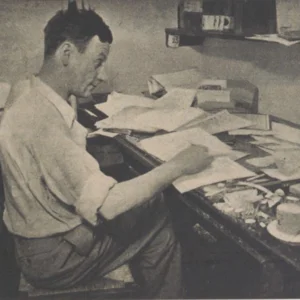
The tilted surface on which the cartoonist worked out his caricatures before sending them to the newspaper. It was his daily workstation.

The satirical weekly where Moisan's drawings appeared. This paper newspaper, free of advertising, is the main medium for his work.
📷 Domaine public · Wikimedia Commons ↗
Used for the preparatory sketch, it allowed the composition and expressions to be captured quickly before inking. A discreet but essential tool.

A recurring motif in the caricatures of the Fifth Republic, the kepi symbolized the general's figure all on its own. Cartoonists turned it into an instantly recognizable visual shorthand.

In the “La Cour” series, Moisan decked de Gaulle out with a monarch's attributes to mock the solemnity of power. These symbolic objects subverted the imagery of the Ancien Régime.
School Curriculum
Vocabulary & Tags
Key Vocabulary
Daily Life
Morning
The morning began with a careful reading of the newspapers and listening to the news to spot the political topic of the day. Moisan looked for the satirical angle that would hit home in the next issue.
Afternoon
The afternoon was devoted to work at the drawing board: pencil sketches, then inking with a pen. He had to keep up the newspaper's weekly pace, never missing the deadline.
Evening
The evening might be used to polish a drawing or to follow the late-breaking news. The political twists and turns of a single evening could force him to rework a caricature already begun.
Food
Like many Parisians of his time, he shared in classic French cuisine: bistro meals, bread, wine and slow-cooked dishes. Cafés were also places for conversation and observation.
Clothing
Moisan wore the plain, middle-class attire of mid-twentieth-century France: a suit, shirt and tie, the ordinary clothes of a press professional.
Housing
He lived and worked in Paris, in an urban dwelling typical of the period. His drawing studio was an integral part of his daily life.
Historical Timeline
Period Vocabulary
Liens externes & ressources
Références
Œuvres
Dessins pour Le Canard enchaîné
1945-1987
Série « La Cour »
années 1960
Caricatures des présidents de la Ve République
1958-1987
Caricatures de la vie politique de la IVe République
1946-1958