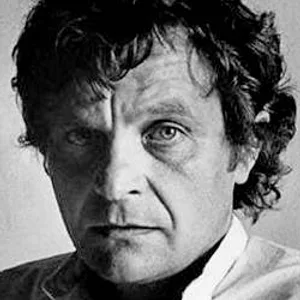

Jean Effel, whose real name was François Lejeune, was a French cartoonist, caricaturist and journalist of the 20th century. His pen name came from his initials F.L. pronounced “eff-el.” He is known worldwide for his poetic and humorous series “The Creation of the World.”
Jean Effel(1908 — 1982)
Jean Effel
France
4 min read
Frequently asked questions
Key Facts
- Born in 1908 in Paris under the name François Lejeune, he adopted the pen name “Effel” (F.L.)
- He published his drawings in numerous newspapers such as Le Canard enchaîné, L'Humanité and Marianne
- He created his famous series “The Creation of the World,” featuring a good-natured God and mischievous little angels
- Committed and pacifist, he received the Lenin Peace Prize in 1968
- He died in 1982, leaving behind a body of work admired for its tenderness and poetry
Works & Achievements
His most famous series, portraying a benevolent God who shapes the world with humor and poetry; adapted into animated films.
A volume devoted to the making of Adam and Eve, full of tenderness and mischief, popularized around the world.
An illustrated continuation of his biblical universe, reimagined with gentleness and irony.
Satirical press drawings championing peace and criticizing the powerful, in a soft, instantly recognizable graphic style.
Politically committed drawings reflecting his pacifist and progressive convictions.
Anecdotes
The pen name “Jean Effel” comes quite simply from his initials, F.L. (François Lejeune), pronounced “eff-el.” The cartoonist Frenchified the sound into “Effel” and added “Jean,” creating a short, easy-to-remember signature that would go on to become world-famous.
His best-known series, “The Creation of the World,” features a good-natured God — bearded and smiling — surrounded by mischievous little angels and an imp. These drawings, full of tenderness and humor, were adapted in 1958 into a Czechoslovak animated film using puppets.
Every Jean Effel character can be recognized by a little flower, often a daisy, tucked into the scenery: it was his secret graphic signature, a way to discreetly “sign” his drawings in addition to his name.
A committed cartoonist, Jean Effel worked extensively for the left-wing and pacifist press, such as “Le Canard enchaîné” and “L'Humanité.” His gentle, childlike line contrasted with the strength of his political convictions, which made his caricatures all the more effective.
In 1968, he received the Lenin Peace Prize, awarded by the Soviet Union. This honor reflects his pacifist commitment and the international recognition of his work, especially in Eastern Bloc countries where he was very popular.
Primary Sources
The Good Lord, bent over his workbench, shapes man with the same good-natured ease as a craftsman, while the angels comment on his handiwork.
Beneath a rounded, smiling line, the satire targets the powerful and champions peace among peoples.
The animated film faithfully recaptures the poetic universe of Effel's drawings, with its gardener God and his mischievous angels.
Key Places
Birthplace of Jean Effel and the heart of the French illustrated press, where he spent his entire career as a cartoonist.
One of the satirical newspapers for which he produced his politically committed, pacifist cartoons.
The Czechoslovak capital where the 1958 animated film adapting “The Creation of Man” was produced, a sign of his popularity in the East.
Typical Objects

The cartoonist's basic tool, allowing a fine, supple and expressive line. Effel used it for his rounded, recognizable outlines.

A slanted surface on which the artist laid his sheets to compose his press drawings and illustrations.

A small flower discreetly slipped into his drawings, serving as Jean Effel's personal graphic signature.

The medium for spreading his caricatures, such as Le Canard enchaîné, reaching a wide popular audience.

Water-based paints used to color his drawings and give his poetic world its soft, tender hues.
School Curriculum
Vocabulary & Tags
Key Vocabulary
Daily Life
Morning
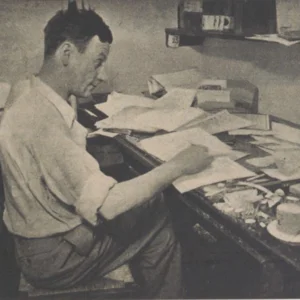
Like many editorial cartoonists, Jean Effel often began his day by reading the newspapers and the news, which fed the inspiration for his caricatures. He would then settle at his work table to sketch his first ideas in pen.
Afternoon
The afternoon was devoted to drawing itself, first in ink and then in color for his poetic works. He had to meet the tight deadlines set by the newspapers’ editorial offices.
Evening
In the evening, he frequented Parisian artistic and intellectual circles, exchanging ideas with writers, journalists, and pacifist activists who shared his views.
Food
He shared the lifestyle of a twentieth-century Parisian: meals taken in the capital’s cafés and brasseries, gathering places where artists and press people mingled.
Clothing
He wore the classic city attire of his time: a jacket, shirt, and tie, the usual outfit of Parisian journalists and intellectuals.
Housing
He lived and worked in Paris, in an apartment-studio where he kept his drawings, his inks, and his collections of sketches.
Historical Timeline
Period Vocabulary
Liens externes & ressources
Références
Œuvres
La Création de l'homme
1955
Le Roman d'Adam et Ève
1958
Caricatures pour Le Canard enchaîné
années 1930-1960
Illustrations pour L'Humanité et la presse de gauche
milieu du XXe siècle