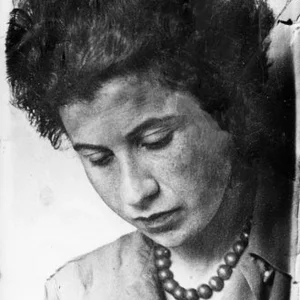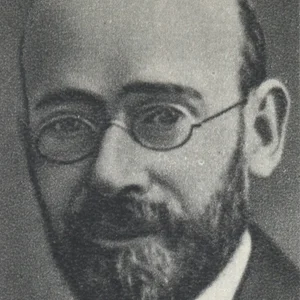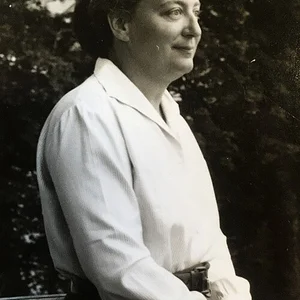

Romana Guarnieri (1913-2004) was an Italian historian and medievalist, a specialist in the religious spirituality of the Middle Ages. She is famous for having identified, in 1946, the author of the Mirror of Simple Souls: the mystic Marguerite Porete, burned at the stake in 1310.
Romana Guarnieri(1913 — 2004)
Romana Guarnieri
royaume d'Italie
5 min read
Frequently asked questions
Key Facts
- Born in 1913 in Florence (according to sources, sometimes London) and died in 2004 in Rome.
- In 1946, she identified Marguerite Porete as the author of the Mirror of Simple Annihilated Souls, a mystical treatise of the 13th–14th century.
- A specialist in medieval female spiritual movements (Beguines, pinzochere), she renewed the study of the mysticism of the Middle Ages.
- A longtime collaborator of the Church historian Hubert Jedin and a leading figure of Italian Catholic scholarship.
- Author of authoritative works on the movement of the Free Spirit (movimento del Libero Spirito), notably published in 1965.
Works & Achievements
A major discovery that restored to a mystical text — anonymous since the 14th century — the name of its author, a Beguine condemned in 1310.
A vast study of the spiritual movement of the Free Spirit, which became a standard reference for the history of medieval mysticism.
A scholarly edition of Marguerite Porete's text, the culmination of decades of philological research.
A body of work that won recognition for the place of lay female mystics in the history of medieval religion.
Participation, alongside Don Giuseppe De Luca, in a publishing house devoted to the history of piety and religious culture.
Anecdotes
In 1946, while leafing through manuscripts at the Vatican Library, Romana Guarnieri made a discovery that overturned the history of mysticism: in an anonymous text titled “The Mirror of Simple Souls,” she recognized the work of Marguerite Porete, a Beguine burned alive in Paris in 1310. For more than six centuries, the book had been read without anyone knowing who had written it.
The “Mirror of Simple Souls” had survived in a paradoxical way: condemned as heretical and burned along with its author, it had nonetheless continued to circulate anonymously in monasteries, sometimes copied out by religious figures who believed it was perfectly orthodox. Guarnieri was able to link these scattered copies to a single forgotten trial.
Romana Guarnieri shared her intellectual and spiritual life with the priest and historian Don Giuseppe De Luca, founder of the publishing house Edizioni di Storia e Letteratura. Their deep collaboration left its mark on an entire current of scholarship on Italian spirituality.
A specialist in the Beguine movement — those laywomen who lived in community without taking monastic vows — Guarnieri helped bring recognition to the importance of these female voices, long neglected by official religious history.
To identify the author of the Mirror, Guarnieri patiently compared the content of the manuscripts with the records of Marguerite Porete's inquisition trial: the passages condemned by the judges in 1310 corresponded exactly to sections of the anonymous book.
Primary Sources
Foundational study in which Guarnieri establishes the attribution of the 'Mirror of Simple Souls' to Marguerite Porete and publishes the edition of the Latin text.
Scholarly edition of the long-anonymous text, the fruit of decades of philological work on the manuscripts.
Collection of studies on the relationships between women, mysticism, and the ecclesiastical institution in the Middle Ages.
Key Places
Site of her decisive 1946 discovery: it was there, among the manuscripts, that she recognized the hand of Marguerite Porete.
The center of her intellectual life, built around the libraries and religious study circles of postwar Italy.
Holds manuscripts related to the “Mirror of Simple Souls” and the trial of Marguerite Porete, consulted for her critical edition.
Typical Objects

Volume copied by hand on parchment or paper, like the copies of the 'Mirror of Simple Souls' that she studied. It is the central object of the medievalist's work.

The philologist's instruments for deciphering ancient handwriting, abbreviations and faded passages. Indispensable for the collation of manuscripts.

Scholarly book that establishes the exact text from all the manuscripts, with notes and variants. Her edition of the 'Mirouer' is its most famous example.

Cards or sheets on which the scholar notes quotations, references and connections between sources. A classic method before computers.

Medieval judicial documents preserving the accusations against Marguerite Porete. Guarnieri compared them to the anonymous text to make her attribution.
School Curriculum
Vocabulary & Tags
Key Vocabulary
Daily Life
Morning
A medievalist's morning is often spent in the library, right from opening time, consulting manuscripts and microfilms reserved in advance. Time is precious, since some old documents can only be accessed for a few hours a day.
Afternoon
The afternoon is devoted to collation: comparing word by word the different copies of a single text to spot variants and copyists' errors. This painstaking work demands patience and concentration.
Evening
In the evening, she writes notes and articles, answers scholarly correspondence, and exchanges ideas with other researchers. The intellectual life of post-war Italy also thrives on long conversations.
Food
An ordinary 20th-century Italian diet: pasta, bread, vegetables, olive oil, cheese, and fruit, with coffee as the companion of long days of study.
Clothing
The plain, classic attire of a 20th-century academic: discreet dresses or suits, suited to the seriousness of the libraries and ecclesiastical circles she frequented.
Housing
A Roman apartment filled with books, offprints, and index cards, halfway between a home and a study, close to the city's great libraries.
Historical Timeline
Period Vocabulary
Liens externes & ressources
Références
Œuvres
Identification de Marguerite Porete comme auteure du 'Miroir des âmes simples'
1946
« Il movimento del Libero Spirito »
1965
Édition critique du « Mirouer des simples âmes »
1986
Études sur les béguines et la spiritualité féminine
1960-2004
Collaboration aux Edizioni di Storia e Letteratura
à partir des années 1940