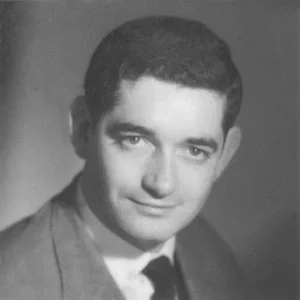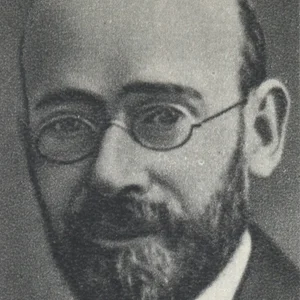

Polish pediatrician, educator, and writer of Jewish origin, a pioneer of children's rights. As director of orphanages in Warsaw, he developed a pedagogy founded on respect for the child. He refused to abandon the Jewish children in his care and was deported with them to Treblinka in 1942.
Janusz Korczak
Henryk Goldszmit, known as Janusz Korczak
6 min read
Frequently asked questions
Famous Quotes
« You cannot become a good educator unless you carry, deep in your heart, the smile of a child.»
« Children are not the people of tomorrow, they are people today.»
Key Facts
- Born in 1878 or 1879 in Warsaw under the name Henryk Goldszmit
- Founds and directs the Jewish orphanage Dom Sierot in Warsaw from 1912 onward
- Publishes “How to Love a Child” in 1919 and “The Child's Right to Respect” in 1929
- Hosts radio broadcasts under the name of the “Old Doctor” during the 1930s
- Deported with his orphans to the Treblinka extermination camp in August 1942, where he is murdered
Works & Achievements
A major pedagogical essay establishing the principle of full respect for the child as a person.
A children's novel, a classic of Polish literature, about a child-king who wants to give power to children.
The first newspaper written entirely by and for children, an unprecedented platform for children's voices.
A foundational text that later inspired the international Convention on the Rights of the Child (1989).
A laboratory institution where he applied his pedagogy: a children's court, a self-governance council, an internal newspaper.
Very popular radio broadcasts in which he addressed children with tenderness and humour.
His final writing, composed in the ghetto, a deeply moving testimony about children and human dignity.
Anecdotes
In August 1942, when the Nazis ordered the evacuation of the orphanage in the Warsaw ghetto, Korczak refused the offers of escape that were made to him. He himself led nearly 200 children to the Umschlagplatz, in calm rows, with one child carrying King Matt's green flag at the front. They were all deported to Treblinka.
In his orphanage, Korczak had created a genuine children's court where the residents could judge disputes according to a written code. Remarkably, the director himself agreed to be summoned and judged by the children, convinced that an adult should answer for his actions just as they did.
Under the name of the “Old Doctor” (Stary Doktor), Korczak hosted widely listened-to Polish radio programs in the 1930s. He spoke to children in a gentle, humorous voice, but his Jewish origins eventually cost him this platform.
In 1926, Korczak launched a newspaper written entirely by children, the “Mały Przegląd” (Little Review), a supplement to a major daily paper. Hundreds of young correspondents sent in articles and letters, giving children a voice in the adult press.
His novel “King Matt the First” tells the story of a child who becomes king and wants to give power to children. The book, immensely popular in Poland, is a kind of manifesto disguised as a tale about the rights and limits of childhood.
Primary Sources
I am being watered. The cockchafers, too, have a right to the watering can. But is there a single person who would ask: and what about the children?
There are no children, there are only human beings, but with a different scale of concepts, a different store of experience, different drives, a different play of feelings.
You say: “It is exhausting to be with children.” You are right. You add: “Because we must lower ourselves to their level, stoop, bend down.” But here you are mistaken. It is not that which exhausts us, but rather having to rise up to the level of their feelings.
Key Places
Korczak's birthplace and the heart of all his educational and literary work. He lived there under the Russian Empire, then independent Poland, and finally the Nazi occupation.
A home for Jewish orphans that he directed from 1912, a laboratory for his pedagogy of respect, complete with a children's court and newspaper.
The district where, from 1940, the Nazis confined the orphanage and its Jewish population in appalling conditions. There Korczak wrote his diary and struggled to feed his children.
A square in Warsaw from which the deportation trains departed for the camps. Korczak led his children there in August 1942.
The Nazi extermination camp where Korczak and the children of the orphanage were murdered in August 1942.
Typical Objects

The orphanage's banner, green with one side adorned with a four-leaf clover, a symbol of the children's hope. A child carried it at the head of the column led to the *Umschlagplatz*.

The instrument of the doctor he remained all his life, treating poor children for free. Medicine nourished his conviction that the child is a full human being.

A device where the children placed their messages, complaints, or confidences for the director. It gave concrete form to every child's right to be heard without interruption.

A panel displaying the verdicts of the residents' court, based on a written code. It embodied the idea of a justice in which adults and children were equals.

A small weekly newspaper written by and for children, founded by Korczak in 1926. It gave an unprecedented public platform to the voice of children.

The tool of his “Old Doctor” talks broadcast throughout Poland. His kind voice reached thousands of children until antisemitism drove him off the airwaves.
School Curriculum
Vocabulary & Tags
Key Vocabulary
Tags
Daily Life
Morning
Korczak rose early to make the medical rounds of the orphanage, taking the pulse and temperature of the sick children. A doctor above all, he watched over everyone's health like an attentive father.
Afternoon
The afternoon was divided between writing, patient observation of the children, and managing communal life: council meetings, sessions of the court, and reading the messages left in the mailbox.
Evening
In the evening, he wrote his books and articles, prepared his radio talks, or sat at the bedside of an anxious child. He slept in a simple room up in the attic, as close as possible to the dormitories.
Food
In pre-war Warsaw, the orphanage meals were frugal but regular, based on bread, soup, potatoes, and kasha (groats). In the ghetto, Korczak begged tirelessly for food to keep his children from starving to death.
Clothing
He wore the plain attire of a doctor and educator: a white coat, a simple suit, and round glasses. In his final years, he often appeared with a grey beard and a worn coat.
Housing
He lived in the orphanage itself, on Krochmalna Street, in a small room on the top floor. After 1940, like all the Jews of Warsaw, he was forced to move the institution inside the ghetto.
Historical Timeline
Period Vocabulary
Liens externes & ressources
Références
Œuvres
Comment aimer un enfant (Jak kochać dziecko)
1919
Le Roi Mathias Ier (Król Maciuś Pierwszy)
1923
Mały Przegląd (Petit Journal)
1926
Le droit de l'enfant au respect (Prawo dziecka do szacunku)
1929
Orphelinat Dom Sierot
1912
Causeries du Vieux Docteur (radio)
1934
Journal du ghetto (Pamiętnik)
1942