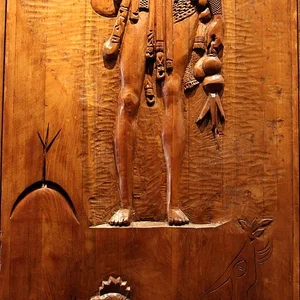

Rongo is a major deity of Polynesian mythology, venerated especially by the Māori of New Zealand. God of peace, agriculture, and cultivated plants, he is one of the great atua (gods) born of the union of Ranginui (the sky) and Papatūānuku (the earth). He symbolizes harmony and fertility, in contrast to his brother Tū, god of war.
Rongo
Rongo
9 min read
Frequently asked questions
Key Facts
- Rongo is one of the sons of Ranginui (sky) and Papatūānuku (earth), central figures of Māori cosmogony
- He is the patron god of the kumara (sweet potato), a fundamental food crop throughout Polynesia
- His equivalents in other Polynesian traditions are Lono (Hawaiʻi) and Ro'o (Tahiti), reflecting a shared mythology across the Pacific
- He is associated with the left side of the body, a symbol of peace, in contrast to the right side, which is associated with war (Tū)
- Rituals in his honor marked the agricultural cycles and periods of truce in Polynesian societies
Works & Achievements
A founding act attributed to Rongo: the journey to the heavens to bring the sacred sweet potato back to humans, offering them a cultivated food source and the foundation of a stable communal life.
Rongo takes part in the great cosmogonic act that separated the Sky Father and the Earth Mother, establishing the order of the world, light, and the space necessary for life — the cornerstone of all Polynesian cosmology.
Rongo is the origin of the ritual practices surrounding the cultivation of kūmara, passed down orally over more than three millennia across the entire Polynesian triangle.
A four-month festival dedicated to Lono/Rongo in Hawaiʻi, marking a period of universal peace, sporting competitions, and agricultural rites — testament to the enduring cultural importance of this deity.
A collection of prayers and ritual formulas recited during the sowing and harvesting of kūmara, forming a major poetic and religious oral heritage of Māori culture, preserved through 19th-century ethnographic collection.
Anecdotes
According to Māori cosmogony, Rongo is one of the sons born from the eternal embrace of Ranginui (the Sky Father) and Papatūānuku (the Earth Mother). Trapped in darkness between their entwined parents, Rongo and his brothers decided to separate them to let in light and air. This foundational cosmic act is, for the Māori, the very origin of the world's order and of life as we know it.
Rongo is the guardian of the kūmara, the sacred sweet potato, which he is said to have brought down from the heavens to offer to humans. In Māori communities, every stage of its cultivation — planting, growth, harvest — was accompanied by karakia (ritual prayers) addressed to Rongo. Neglecting these incantations risked drawing his wrath and condemning the entire community to famine.
The contrast between Rongo and his brother Tū (god of war) structures all of Polynesian thought: on one side, the world of peace, agriculture, and cultivated plants; on the other, the world of combat and bloodshed. This duality concretely governed the daily lives of Polynesians, where peaceful seasons held under the sign of Rongo alternated with periods of war under that of Tū.
In Hawaiian Polynesia, the equivalent of Rongo is called Lono. Each year, the great Makahiki festival — a four-month period dedicated to peace, games, and agriculture — was celebrated in his honor. When Captain James Cook arrived in Hawaiʻi in January 1779 during the Makahiki, some Hawaiians associated him with Lono, which contributed, according to several historians, to the tragic misunderstandings that led to his death in Kealakekua Bay.
The presence of variants of the same deity throughout the Pacific — Rongo in New Zealand and the Cook Islands, Lono in Hawaiʻi, Ro'o in Tahiti, Ono in Fiji — attests to the remarkable cultural unity of Polynesian peoples. Always associated with fertility and peace, this deity is living proof of a common origin and of maritime migrations spanning thousands of kilometres, accomplished several centuries before the great European explorations.
Primary Sources
Rongo-mā-Tāne was the god of cultivated plants and of peace. The first fruits of the kūmara harvest were offered to him so that he would protect men's gardens and keep famine away from the community.
Rongo represents the domain of peace (*rongo*) as opposed to Tū, who embodies war and acts of destruction. This fundamental polarity shaped the social and religious organisation of the Māori *iwi* (tribes).
The *karakia* addressed to Rongo before the planting of kūmara were an absolute ritual obligation. Any neglect of these prayers could draw the god's wrath and jeopardise the community's entire harvest.
In the Cook Islands, Rongo is invoked as the protective ancestor of gardens and sowing. His priests ensured the scrupulous observance of agricultural rites, which were seen as the guarantee of the island community's prosperity.
Lono, god of rain-bearing clouds and fertility, presided over the Makahiki festival — a four-month period of sacred truce and communal celebration, the most important in the Hawaiian year.
Key Places
Ancestral homeland from which the Māori ancestors are said to have departed, often identified with the island of Raiatea in French Polynesia. It is in this mythical place that Rongo is said to have received the kūmara to offer to humanity.
The main homeland of the Māori, where the worship of Rongo was central to the agricultural economy built around the cultivation of kūmara. The iwi of the northern North Island dedicated many stories and seasonal rites to him.
The main island of the Cook Islands, where Rongo (Ono) is venerated as a major deity of agriculture and peace. Its oral traditions are among the best preserved in all of Polynesia.
The site where Captain Cook was killed in 1779 during the Makahiki festival dedicated to Lono (the Hawaiian form of Rongo). This place tragically illustrates the depth of Rongo's worship within Hawaiian Polynesian civilization.
The most isolated island in Polynesia, where a variant of Rongo's cult survives in local traditions. The parallels between Rapanui myths and those of other Polynesian islands bear witness to the cultural unity of the great Polynesian Triangle.
Typical Objects

The most prized cultivated plant in Polynesia, directly associated with Rongo, who was said to have brought it down from the heavens as a gift to humanity. Its cultivation determined the ritual calendar, and every planting season began with invocations to the god.

A hardened wooden digging stick used to plant the kūmara, regarded as a sacred tool kept under Rongo's protection. Its use was accompanied by specific karakia (incantations) recited by the tohunga.

A container made from a dried calabash, used to carry water and store sacred seeds under Rongo's protection. Decorated gourds also served as offerings placed on the marae.

An open-air sacred space built from upright stones, where rituals honoring the atua — including Rongo — were performed. The first fruits of each kūmara harvest were laid there as offerings of thanksgiving.

A plant-based fabric made by beating the bark of the paper mulberry tree (*aute*), used for ceremonial garments and offerings during the agricultural rites dedicated to Rongo at the great harvest festivals.

A weighted textile object swung during songs and dances of thanksgiving after the harvests. Poi performances accompanied the ritual hymns honoring Rongo at communal ceremonies.
School Curriculum
Vocabulary & Tags
Key Vocabulary
Tags
Daily Life
Morning
At sunrise, Māori farmers recited karakia invoking Rongo before beginning their fieldwork. These sacred incantations, passed down from generation to generation by tohunga (priest-experts), were essential to securing the god's favor and guaranteeing the fertility of the soil throughout the seasons.
Afternoon
The days of planting and tending the kūmara gardens took place within a ritualized framework: certain actions were tapu (forbidden), and priests specializing in the cult of Rongo supervised the collective work. Any failure to observe the divine prescriptions risked defiling the garden and jeopardizing the harvest for the entire community.
Evening
In the evenings, elders passed on to the young the whakapapa (sacred genealogies) and mythological stories featuring Rongo, Tū, and their divine parents. These oral gatherings served at once as a school of Polynesian cosmology and as the cultural bond holding the community together, preserving the memory of the gods across centuries of migrations.
Food
Kūmara (sweet potato) was the sacred food par excellence, placed under Rongo's direct protection. It formed the foundation of the diet in New Zealand, supplemented by taro, hue gourd, and marine resources. Its consumption was sometimes governed by tapu rules during ceremonial periods, with the first harvests reserved for ritual offerings.
Clothing
Tohunga officiating at ceremonies dedicated to Rongo wore garments of tapa (bark cloth) and ornaments of pounamu jade or whale bone, symbols of their sacred status and mana. Foliage and flower adornments completed their attire during the great communal harvest festivals.
Housing
Rites in honor of Rongo were held on marae (sacred open-air ceremonial spaces) marked out by standing stones. The kūmara gardens, carefully bounded and protected by tapu boundaries, were regarded as divine spaces under Rongo's direct guardianship, off-limits to anyone who had not undergone the required ritual purifications.
Historical Timeline
Period Vocabulary
Liens externes & ressources
Références
Œuvres
Don du kūmara à l'humanité
Temps mythique
Participation à la séparation de Ranginui et Papatūānuku
Temps mythique (cosmogonie)
Institution des rites agricoles polynésiens
Époque proto-historique (v. -1000 à v. 1300)
Festival du Makahiki (tradition hawaiienne de Lono/Rongo)
Pratique annuelle attestée avant le contact européen (avant 1778)
Corpus des karakia dédiés à Rongo-mā-Tāne
Transmis oralement, collecté aux XIXe-XXe siècles