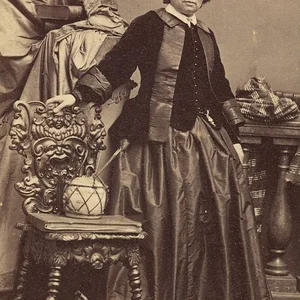

Rosa Bonheur (1822-1899) was a French painter and sculptor, a major figure in 19th-century animal painting. Famous for her meticulous realism, she was the first female artist to receive the Legion of Honour.
Rosa Bonheur(1822 — 1899)
Rosa Bonheur
France
6 min read
Frequently asked questions
Key Facts
- Born in 1822 in Bordeaux into a family of Saint-Simonian artists
- Exhibited at the Paris Salon as early as 1841
- Painted her masterpiece The Horse Fair between 1852 and 1855
- First female artist promoted to Knight of the Legion of Honour in 1865 (by Empress Eugénie)
- Died in 1899 at the Château de By, in Thomery, near Fontainebleau
Works & Achievements
A State commission depicting oxen ploughing the soil of the Nivernais. This realist work cemented her reputation as a great animal painter.
A monumental painting nearly 5 metres wide showing the horse market in Paris. It brought her international fame, notably in England and the United States.
A large scene of harvest and livestock in the Auvergne countryside, shown at the 1855 Universal Exhibition.
A majestic portrait of a stag in the Forest of Fontainebleau, showing her talent for capturing the nobility of wild animals.
A work painted during the visit of the Wild West Show to Paris, depicting the famous American showman on horseback.
Animal sculptures that reveal her mastery of relief modelling, complementing her painted work.
Anecdotes
To study the anatomy of the animals she painted, Rosa Bonheur frequented the slaughterhouses and horse markets of Paris. Since a woman in a skirt attracted mockery and awkwardness there, she obtained from the police prefecture a “permission to cross-dress” that officially authorized her to wear trousers. She had to renew this authorization every six months.
Her immense painting *The Horse Fair* is nearly 5 metres long. To observe her subjects, she went twice a week for months to the Paris market on the boulevard de l’Hôpital, dressed as a man so as not to be noticed among the horse dealers.
In 1865, Empress Eugénie herself travelled to the Château de By to present Rosa Bonheur with the cross of the Legion of Honour: she became the first woman artist to receive this distinction. Eugénie is said to have declared that “genius has no sex.”
At her Château de By, near Fontainebleau, Rosa Bonheur lived surrounded by a veritable menagerie: dogs, horses, sheep, deer, and even lions that she raised and sometimes let roam the grounds so she could paint them better.
When Buffalo Bill’s famous show, the *Wild West Show*, came to Paris in 1889, Rosa Bonheur obtained permission to paint in the camp. She produced an equestrian portrait of Buffalo Bill and closely studied American horses and bison.
Primary Sources
“I was forced to recognize that the clothing of my sex was a constant hindrance. That is why I decided to ask permission to wear men's clothes.”
An administrative authorization granting Mademoiselle Rosa Bonheur the right to wear men's clothing for reasons of health and profession, renewable periodically.
Letters in which the artist speaks of her relentless work, her love of animals, and her determination to be independent as a woman artist living off her art.
Key Places
Birthplace of Rosa Bonheur, where she was born in 1822 into a family of artists.
City where she trained, exhibited at the Salon and studied animals in markets and slaughterhouses. She observed the Horse Fair there for months.
Home and studio she acquired in 1859 near Fontainebleau, surrounded by her menagerie. She lived and worked there until her death in 1899.
Vast forest near her château, where she observed deer and landscapes for her studies from nature.
Burial place of Rosa Bonheur, where she rests with her companion Nathalie Micas.
Liens externes & ressources
Références
Œuvres
Le Labourage nivernais
1849
Fenaison en Auvergne
1855
Le Roi de la forêt (cerf)
vers 1878
Portrait équestre de Buffalo Bill
1889