
French seamstress, companion of Auguste Rodin for over fifty years and one of his very first models. She married him in January 1917, just a few weeks before she died, and Rodin followed her in death the same year.
Rose Beuret(1844 — 1917)
Rose Beuret
France
5 min read
Frequently asked questions
Key Facts
- Born in 1844 in Vecqueville (Haute-Marne) into a modest household
- Met Auguste Rodin around 1864 and became his companion and one of his first models
- Mother of Auguste-Eugène Beuret, the son she had with Rodin in 1866
- Married Auguste Rodin on 29 January 1917 after more than fifty years of life together
- Died on 14 February 1917 in Meudon, a few months before Rodin
Works & Achievements
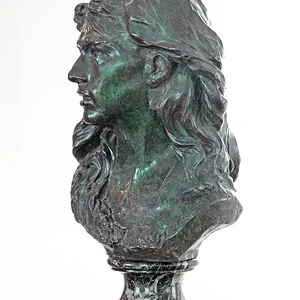
Rose was one of Rodin's very first models, lending her face to several of the artist's early sculpted portraits.
A sculpted portrait of Rose with an expressive face, one of the works in which Rodin captured the features of his companion.
During Rodin's absence, she saved the raw clay sculptures by keeping them damp, preventing their destruction.
She ran the household at the Villa des Brillants and welcomed visitors, a constant support in the sculptor's daily life.
After more than fifty years of common-law union, she married Rodin in January 1917, at last making official a lifetime of devotion.
Anecdotes
Rose Beuret met Auguste Rodin around 1864, when she was a seamstress and he was a still-unknown, penniless sculptor. She posed for him from their earliest years together: her face inspired several of the artist's youthful busts.
During the Franco-Prussian War and the Commune, while Rodin went off to work in Belgium, Rose stayed in Paris to watch over the workshop's fragile clay sculptures. She kept them moist with damp cloths to prevent them from cracking in the sculptor's absence.
The couple had a son, Auguste-Eugène Beuret, born in 1866, whom Rodin never officially acknowledged: the child bore his mother's name his whole life.
For decades Rose endured Rodin's many affairs, notably the artist's stormy passion for the sculptor Camille Claudel, all the while remaining the faithful companion in the shadows, keeper of the home.
It was not until January 1917, after more than fifty years of life together, that Rodin finally married Rose, who was already gravely ill. She died two weeks after the wedding, and Rodin followed her in death a few months later, that same year.
Primary Sources
Auguste Rodin, sculptor, and Marie-Rose Beuret are united in marriage on this day, after a long life together.
Rose watched over my clay, covering it with damp cloths so it would not crack; without her, many a figure would have perished.
Madame Rose received guests with simplicity, the discreet and steadfast guardian of the master's house.
Key Places
Village in Champagne where Rose Beuret was born in 1844 into a modest family of the French countryside.
City where she settled as a seamstress and met Rodin around 1864, and where she watched over the studio during the war and the Commune.
The couple's home from 1895 onward, which became the lasting household of Rose and Rodin and is today part of the Rodin Museum.
The place where Rose and Rodin were buried in 1917, beneath a replica of The Thinker watching over their shared grave.
Typical Objects

Tools of her first trade, which she practiced before and at the start of her life with Rodin. Sewing provided her with an income when the sculptor was still without means.

Moistened fabrics with which she covered the raw clay sculptures to keep them from drying out and cracking. They symbolize her role as guardian of Rodin's works.

Portrait sculpted by Rodin for which Rose posed in her youth, around 1870. It bears witness to her role as the artist's first model.

Simple clothes of a working-class woman, without luxury despite her companion's growing fame. Rose kept a plain and unassuming appearance all her life.

Ring exchanged at the late wedding of January 1917, after more than fifty years of life together. It sealed a union made official just a few days before Rose's death.
School Curriculum
Vocabulary & Tags
Key Vocabulary
Daily Life
Morning
Rose got up early to open the house in Meudon and prepare the hearth before Rodin headed off to his studio. During her younger years in Paris, her mornings were devoted to the sewing work that supported the household.
Afternoon
In the afternoon, she oversaw the running of the household and, in the early years, kept watch over the clay sculptures in the studio. When Rodin received visitors and collectors, she welcomed them with quiet simplicity.
Evening
Evenings brought the couple together around a simple meal, far from the social bustle that Rodin otherwise frequented. Rose led a secluded life, a faithful presence in the artist's shadow.
Food
Of humble origins, she ate simply: bread, soup, vegetables, and the modest dishes of 19th-century French cooking. The couple kept a plain table despite Rodin's growing fame.
Clothing
Rose wore the plain clothes of a woman of modest means: simple dresses, an apron, and a shawl, with no taste for luxury. A seamstress by trade, she made and maintained part of her own wardrobe herself.
Housing
After modest Parisian lodgings, from 1895 onward she lived at the Villa des Brillants in Meudon, a large residence surrounded by grounds where Rodin had set up his studios. It was there that she spent the last decades of her life.
Historical Timeline
Period Vocabulary
Liens externes & ressources
Références
Œuvres
Modèle des premiers bustes de Rodin
vers 1864-1875
Mignon (buste inspiré de Rose)
vers 1870
Gardienne du foyer de Meudon
1895-1917
Épouse de Rodin
1917