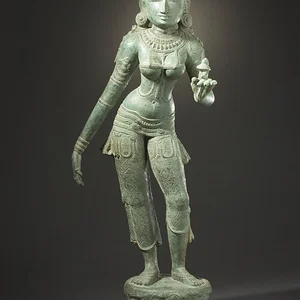

Rukmini is the principal wife of Krishna and the goddess of prosperity in Hinduism. A princess of the kingdom of Vidarbha, she eloped with Krishna to escape a forced marriage, symbolizing divine love and absolute devotion.
Rukmini
Rukmini
8 min read
Frequently asked questions
Key Facts
- Rukmini is the daughter of King Bhishmaka of Vidarbha, mentioned in the Bhagavata Purana
- She sends a secret letter to Krishna asking him to abduct her before her forced marriage to Shishupala
- Krishna abducts her at her wedding, an act symbolizing the triumph of divine love over social convention
- She is considered an incarnation of the goddess Lakshmi, consort of Vishnu
- Her story appears in the Harivamsa and the tenth book of the Bhagavata Purana
Works & Achievements
A foundational text of devotional Krishnaism, chapters 52 to 54 of Book X tell the full story of Rukmini, from her letter to Krishna to their celestial wedding. This narrative is read and recited in millions of Indian households.
A sacred theatrical play performed in temples of South India (notably in Kuchipudi and Bharatanatyam) depicting the abduction and marriage of Rukmini to Krishna. It is still performed during religious festivals today.
The poet-mystic Mira Bai compares herself to Rukmini in her bhajans (devotional songs), declaring that like her, she has "married Krishna in her heart." These poems are among the most recited in all of Hindu literature.
A long poem in Odia (the language of Orissa) that expands on the theme of Rukmini's failed swayamvara and her union with Krishna. It stands as a masterpiece of Indian devotional literature.
An architectural monument dedicated exclusively to Rukmini, adorned with frescoes and sculptures narrating her divine life. It is one of the rare temples in India entirely consecrated to a wife of Krishna rather than to Krishna himself.
Anecdotes
Before her marriage, Rukmini secretly sends a letter to Krishna through a brahmin named Sunanda. She declares her love for him and asks him to abduct her before her brother Rukmi forces her to marry King Shishupala. This letter is regarded in the Hindu tradition as one of the purest acts of devotion ever performed.
On the day of her forced marriage to Shishupala, Rukmini goes to the temple of the goddess Parvati to pray. It is at that very moment that Krishna appears with his chariot, takes her by the hand, and races away toward Dwarka, to the astonishment of all the kings gathered for the ceremony.
In a famous story from the Bhagavata Purana, Rukmini's rival Satyabhama attempts to 'redeem' Krishna by placing him on one side of a scale and piling it high with gold and jewels. Despite mountains of riches, the scale will not balance. Rukmini simply places a single tulasi leaf (sacred basil) along with a sincere prayer — and the scale tips immediately in her favor.
Rukmini is regarded as an earthly incarnation of Lakshmi, the goddess of prosperity and fortune. Her union with Krishna (an avatar of Vishnu) symbolizes the cosmic reunion of the supreme god and his divine feminine energy, known as 'shakti'. In iconography, she is often depicted holding a lotus, a symbol of purity and abundance.
The Rukmini temple in Dwarka (Gujarat) is one of the oldest shrines dedicated to her. According to legend, Rukmini was cursed by the sage Durvasa for drinking water without first offering any to Krishna during a visit — she was then condemned to live apart from him at the edge of the city, which is said to explain why her temple stands slightly apart from the great Krishna temple.
Primary Sources
Rukmini, daughter of King Bhishmaka, sent a message to Krishna: 'O you whose glory is sung by the sages, I have chosen you as my husband in my heart. Come and take me away before I am given to Shishupala.'
Krishna, having received Rukmini's letter through the brahmin messenger, had his chariot harnessed and made his way to Kundina. He carried the princess away before the eyes of all the assembled kings, who tried in vain to stop him.
Rukmini, endowed with every virtue, was of incomparable beauty. Her brother Rukmi, blinded by pride, refused the alliance with Krishna and chose Shishupala against his sister's wishes.
Rukmini, the noble wife of Krishna, sat beside him during Yudhishthira's Rajasuya, honored among all the queens as the foremost of women.
Key Places
Mythic city identified with the present-day Nagpur region (Maharashtra), where Rukmini, daughter of King Bhishmaka, was born and raised. It was from here that she fled with Krishna on the day of her forced marriage.
Divine city built by Vishwakarma on the Arabian Sea, where Krishna reigns as king. Rukmini lived there as his principal queen and is still venerated in a temple dedicated to her.
A 12th-century temple dedicated exclusively to Rukmini, located about 2 km from the great Dwarkadhish temple. According to legend, it marks the spot where Rukmini was compelled to settle after being cursed by the sage Durvasa.
The great main sanctuary of Dwarka where Krishna and Rukmini are venerated together as a divine couple. A major pilgrimage site of Vaishnavism and one of the four sacred Dhamas of Hinduism.
A city in southern India home to an important temple dedicated to Krishna and Rukmini, and a spiritual center of the *dvaita* movement (the philosophy of Madhvacharya), where devotion to Rukmini is especially vibrant.
Typical Objects

Rukmini is one of the rare mythological heroines to have written a divine love letter. This message, entrusted to a brahmin, is considered an act of *bhakti* (total devotion) and is recited as a prayer in certain temples.
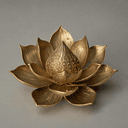
The main attribute of Lakshmi, of whom Rukmini is the avatar, the lotus symbolizes spiritual purity and prosperity. In iconography, Rukmini is often depicted holding it in her right hand.

In the episode of the scale against Satyabhama, a single tulasi leaf offered with sincere devotion outweighs all the gold in the world, symbolizing the supremacy of pure love over material wealth.

The chariot driven by Krishna during Rukmini's abduction is a symbol of divine liberation. It represents the power of destiny and the god's intervention to protect his beloved.

A garland of sacred flowers worn by Rukmini at the time of her abduction, symbolizing spiritual union and the offering of oneself to the divine.

The sacred thread tied around Rukmini's neck at her marriage to Krishna according to the Vedic rite, symbolizing the indissoluble bond between spouses and, in a mystical sense, between the human soul and the divine.

An instrument associated with Vishnu and Krishna, the conch resounds at Rukmini's wedding. It symbolizes the victory of the divine over the dark forces represented by Shishupala.
School Curriculum
Vocabulary & Tags
Key Vocabulary
Tags
Daily Life
Morning
Rukmini begins her day before dawn with a ritual bath in sacred waters, then offers flowers, milk, and tulasi leaves to the palace deities. She recites the names of Vishnu and performs fire rites (homa) for the well-being of the kingdom of Dwarka, in keeping with her role as queen and incarnation of Lakshmi.
Afternoon
As mahishi (chief queen) of Dwarka, Rukmini receives Brahmins and sages, offers alms, and oversees the smooth running of the royal palace. She devotes herself to the arts (music, dance, sacred poetry) and instructs the women of the court in the virtues of devotion and feminine dharma.
Evening
In the evening, Rukmini joins Krishna for communal prayers and recitations of sacred texts. Dressed in precious silks and adorned with jewels, she takes part in the palace's devotional ceremonies, sings hymns, and falls asleep after offering a final prayer to Vishnu, guardian of the cosmos.
Food
As befits a divine queen following Vedic dharma, Rukmini observes a vegetarian diet consisting of rice, ghee (clarified butter), fruits, milk, and sweet dishes prepared as offerings (prasad). She fasts on certain sacred days (Ekadashi) as a sign of devotion to Vishnu-Krishna.
Clothing
Rukmini is depicted wearing a red and gold silk sari, colors of luck and prosperity associated with Lakshmi. She wears many jewels: pearl and gold necklaces, bracelets (shakha-pola), earrings, and the sacred mangalasutra, symbol of her divine marriage to Krishna.
Housing
Rukmini resides in the royal palace of Dwarka, a mythical city built entirely of gold and precious stones according to the Puranas. Her apartments are described as a place of cosmic splendor, adorned with flowers, garlands, and oil lamps, filled with the fragrance of incense and the gentle sound of flutes.
Historical Timeline
Period Vocabulary
Liens externes & ressources
Références
Œuvres
Bhagavata Purana — Rukmini Haran (L'enlèvement de Rukmini)
vers le IXe siècle apr. J.-C.
Rukmini Kalyanam (Mariage de Rukmini) — drame rituel
XIVe-XVIe siècle
Mira Bai — poèmes mystiques faisant référence à Rukmini
XVIe siècle
Rukmini Swayamvara — poème de Mukundara Dasa
XVIIe siècle (Orissa)
Temple de Rukmini Devi à Dwarka — architecture
vers le XIIe siècle