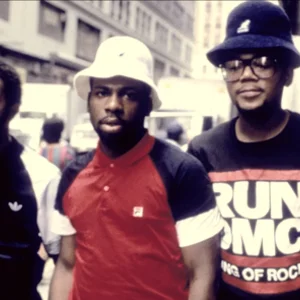

Run-DMC is an American hip-hop group from Queens (New York), formed in 1983. Made up of Joseph "Run" Simmons, Darryl "DMC" McDaniels, and DJ Jason "Jam Master Jay" Mizell, it is considered one of the major pioneers of rap.
Run-DMC
Run-DMC
6 min read
Frequently asked questions
Key Facts
- Group formed in 1983 in Queens, New York.
- Self-titled debut album "Run-D.M.C." released in 1984.
- Cover of "Walk This Way" with Aerosmith in 1986, blending rap and rock and bringing hip-hop to a mainstream audience.
- First rap group to appear on the cover of Rolling Stone magazine and to be put in rotation on MTV.
- The murder of DJ Jam Master Jay in 2002 marked the end of the group; inducted into the Rock and Roll Hall of Fame in 2009.
Works & Achievements
The group's first single, with a minimalist, hard-hitting sound that lays the foundations of modern rap without any superfluous melody.
Their first album, which became the first rap album certified gold, proving the genre's commercial viability.
An album that lays claim to the fusion of rap and rock, the first rap album certified platinum.
The group's major work and the first multi-platinum rap album, featuring “Walk This Way” and “My Adidas”.
A rap-rock cover that became a worldwide hit and brought hip-hop into mainstream rock culture.
An album accompanied by a film, which confirmed the group's star status.
The group's successful return to the top of the charts, proving its longevity.
Anecdotes
In 1986, Run-DMC recorded a cover of “Walk This Way” with the rock band Aerosmith. This track, which blended rap and electric guitar, became a huge hit and introduced hip-hop to a massive white rock audience, breaking down the boundaries between musical genres.
The group wore black tracksuits, Fedora hats, and above all laceless Adidas Superstar sneakers, like the kids on the streets of New York. Their song “My Adidas” impressed the brand so much that it offered them a sponsorship deal worth around one million dollars in 1986: it was the first time a sports brand had sponsored musicians rather than athletes.
Their album “Raising Hell” (1986) became the first rap album to be certified multi-platinum in the United States, meaning it sold several million copies. Run-DMC thus proved that hip-hop could be major popular music and not just a neighborhood phenomenon.
Run-DMC was the first rap group to have its videos played on the music channel MTV, to appear on the cover of Rolling Stone magazine, and to be nominated for the Grammy Awards. These “firsts” paved the way for all the generations of rappers who followed.
In 2002, the group's DJ, Jason “Jam Master Jay” Mizell, was shot and killed in his recording studio in Queens, at just 37 years old. His death brought the group to an end, but Run-DMC was inducted into the Rock and Roll Hall of Fame in 2009, cementing its role as a pioneer.
Primary Sources
Two years ago, a friend of mine / Asked me to say some MC rhymes — the founding lyrics of a stripped-down rap, without melody, carried by rhythm alone.
My Adidas walk through concert doors / and roam all over coliseum floors — a tribute to the sneakers that became a symbol of hip-hop culture.
A rap-rock cover of Aerosmith's 1975 track, whose music video stages the symbolic encounter between the two groups, separated by a wall that eventually falls.
Run-DMC becomes the first rap group to make the front cover of this leading rock music magazine.
Key Places
Modest residential neighborhood in Queens where the three members grew up and formed the group in 1983. The birthplace of their musical identity.
New York borough regarded as the birthplace of hip-hop in the 1970s, a source of inspiration for Run-DMC.
Large Manhattan arena where Run-DMC performed, marking their move from the neighborhood to prestigious stages.
Jam Master Jay's recording studio in Queens, where he was murdered in 2002.
Museum dedicated to the greatest names in music, where Run-DMC was inducted in 2009 in recognition of its legacy.
Typical Objects

White shell-toed athletic shoes, worn without laces by the group's members. They became a fashion emblem of 1980s hip-hop.

Stiff-brimmed felt hat, worn by Run and DMC, which became a visual signature of the group.

Pair of turntables used by Jam Master Jay to mix, scratch, and blend tracks together. It is the central instrument of the hip-hop DJ.

Electronic machine that produces programmable drum sounds. It supplies the crisp, powerful beats characteristic of the Run-DMC sound.

Heavy golden necklaces worn around the neck, symbols of success and pride in the emerging hip-hop culture.

Handheld mic held by Run and DMC to rap as a duo, trading off and completing each other's lines with great energy.
School Curriculum
Vocabulary & Tags
Key Vocabulary
Tags
Daily Life
Morning
The group's members woke up in modest homes in Hollis, Queens. Ordinary mornings looked like those of any other young people in the neighborhood: school for DMC, a serious student, then very quickly rehearsals and writing lyrics.
Afternoon
The afternoon was devoted to creating: writing rhymes, fine-tuning beats on the drum machine, and working on scratches at the turntables. Jam Master Jay spent hours refining his transitions and his sounds.
Evening
Evenings were for concerts and block parties, where the group tested its tracks in front of an audience. Later, their success brought them to major stages and on tour across the country.
Food
Their diet was that of young New Yorkers in the 1980s: fast food, pizza, takeout, and African American home cooking. Nothing fancy at the start of their career.
Clothing
Their outfit had become a trademark: black Adidas tracksuits, Fedora hats, thick gold chains, and Superstar sneakers worn without laces. This unflashy “street” style stood in sharp contrast to the suits of earlier artists.
Housing
They grew up in single-family homes belonging to Hollis's African American middle class, a quiet neighborhood in Queens far from the Bronx where hip-hop was born. Success later allowed them to enjoy greater comfort.