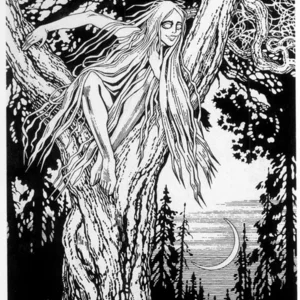

The rusalka is a female water spirit from Slavic folklore, often depicted as a young woman with long hair haunting rivers, lakes, and ponds. According to tradition, she is said to be the soul of a drowned woman or of a young girl who died before marriage, luring men down into the depths.
Rusalka
Rusalka
7 min read
Frequently asked questions
Key Facts
- A female water spirit from pre-Christian Slavic mythology, worshipped before the Christianization of the Slavic peoples (around the 9th-10th century).
- Associated with the souls of young women who drowned or died before marriage, according to popular belief.
- Celebrated during 'Rusalka Week' (Rusalnaya nedelya), a festival tied to the agrarian cycle and to spring.
- Inspired many works of art, including the opera 'Rusalka' by Antonín Dvořák (1901) and poems by Pushkin.
- An ambivalent figure: sometimes a dangerous seductress dragging men down to drown, sometimes a protective spirit of the fields' fertility.
Works & Achievements
An unfinished verse drama: a miller's daughter, seduced and abandoned by a prince, drowns herself and becomes queen of the rusalki, the source of many later works.
A fantastical tale from “Evenings on a Farm Near Dikanka” that fixed the popular image of the drowned maiden turned rusalka in Russian literature.
The first great Russian opera inspired by the subject, adapted from Pushkin's drama, a milestone of Russian national opera.
A Czech operatic masterpiece whose “Song to the Moon” ranks among the most famous opera arias in the world.
A Ukrainian fairy-tale drama featuring the Mavka, a forest spirit akin to the rusalka, a classic of Ukrainian literature.
A monumental study of comparative mythology that gathers and analyzes Slavic beliefs, including those concerning the rusalki.
A landmark ethnographic study that scientifically links the rusalki to the cult of the “unclean dead.”
Anecdotes
During the “rusalki week” (rusalnaya nedelya), just after Pentecost, East Slavic villagers avoided bathing or working in the fields: the rusalki were believed to rise from the water to dance among the birch trees, and they could drag the careless down to the depths. Young women hung wreaths and scraps of cloth on the branches to appease these spirits.
To bring this week to a close, people performed the rite of the “farewell to the rusalka” (provody rusalki): a young girl or a straw effigy dressed as a rusalka was paraded through the village, then “drowned” in the river or torn apart in the fields. The peasants believed this sent the spirits back into the water and ensured the moisture the crops needed.
Depending on the region, the rusalka wore a different face. In northern Russia, folklore made her a hideous and hostile dead woman; in Ukraine and the south, she became a beautiful young woman with loose, flowing hair who seduced travellers. In 1916, the ethnographer Dmitry Zelenin showed that she belonged to the “unclean dead,” those who had perished before their time.
According to many tales, the rusalka killed her victims by tickling them to death or by setting them deadly riddles. It was also said that she must never let her hair dry, for water was her life force.
The Czech composer Antonín Dvořák made the rusalka famous the world over with his opera Rusalka (1901), in which the water spirit sings the celebrated “Song to the Moon” (Měsíčku na nebi hlubokém) by moonlight to declare her love for a human.
Primary Sources
“Měsíčku na nebi hlubokém, světlo tvé daleko vidí” — “Moon in the deep sky, your light sees far away, you wander across the vast world and gaze into the dwellings of men.” The rusalka begs the moon to tell the prince of her love.
The miller scolds his daughter: “That's just how you girls are, all scatterbrained…” Seduced and then abandoned by a prince, she throws herself into the Dnieper and becomes queen of the rusalki.
A young woman persecuted by her witch stepmother drowns herself in the pond and becomes the queen of the rusalki; she asks the hero to identify the witch hidden among the spirits playing at the water's edge.
Zelenin classifies the rusalki among the “unclean dead” (zalozhnye pokoiniki): young women who drowned or died before marriage, who did not fulfill their destiny and haunt the waters until the natural end of their lives.
The Mavka, a Ukrainian spirit of the forests and waters akin to the rusalka, falls in love with the young peasant Lukash; the drama sets the world of men against that of enchanted nature.
Key Places
Great river of Ukraine, the setting of Pushkin's drama; in folklore, its banks and depths are the kingdom of the rusalki.
A vast region of marshes and forests between Belarus and Ukraine, regarded as a major heartland of beliefs in the rusalki.
The largest river in Europe, whose riverside villages kept alive many tales of water spirits.
The deepest lake in Ukraine, in Volhynia, surrounded by legends of drowned young women and water spirits.
Where Dvořák's opera “Rusalka” premiered in 1901, bringing the rusalka onto the great opera stages.
Typical Objects

The rusalka endlessly combs her long hair; according to the tales, as long as her hair stays wet she keeps her strength, and her magic comb can make water gush forth.

Woven from grasses and wildflowers, it adorns the rusalka's head; young girls would cast similar ones into the water during the spring festivals to read their future.

When she does not appear naked, the rusalka wears a long white linen shift, the traditional garment of Slavic peasant women and the shroud of the dead.

It was said that the rusalki stole the thread and cloth left outdoors, and that one had to offer them scraps of linen hung from birch trees to appease them.

A sacred tree of the Slavic spring, the birch was decorated during Rusalka Week; crowns and cloths were hung from it, and the spirits were believed to swing on its branches.
School Curriculum
Vocabulary & Tags
Key Vocabulary
Daily Life
Morning
At dawn, the rusalka withdraws to the depths of the water or into the roots of the willows, fleeing the light of the sun. By day, folklore says she sleeps and is invisible to the living, hidden among the reeds and the water lilies.
Afternoon
During the “rusalka week” that follows Pentecost, she dares to venture out of the water in broad daylight. She is then believed to wander through the rye fields and the birch woods, places where the peasants fear to cross her path.
Evening
It is above all at night, by the light of the moon, that the rusalka comes alive: seated on a branch or a stone, she combs her long hair, sings, and dances in rounds with her sisters to lure men toward the water.
Food
A spirit and no longer a living being, the rusalka has no need to eat as humans do. Folklore tells, however, that she received offerings — painted eggs, bread, garlands, and scraps of cloth — left by the villagers to win her favor.
Clothing
She is most often depicted naked, veiled only by her long, loose hair, or clad in a simple white linen shirt. Her head is sometimes crowned with a wreath of flowers and wild grasses.
Housing
Her dwelling is the water itself: the bottom of rivers, lakes, and ponds, where tales sometimes imagine crystal palaces. In the warm season, she leaves these depths for the birches, the willows, and the fields of wheat.
Historical Timeline
Period Vocabulary
Liens externes & ressources
Références
Œuvres
« Roussalka », drame d'Alexandre Pouchkine
1829-1832 (publié 1837)
« La Nuit de mai ou la Noyée », nouvelle de Nicolas Gogol
1831
« La Chanson de la forêt », drame de Lessia Oukraïnka
1911
« Les Conceptions poétiques des Slaves sur la nature », d'Alexandre Afanassiev
1865-1869
« Essais de mythologie russe », de Dmitri Zelenine
1916