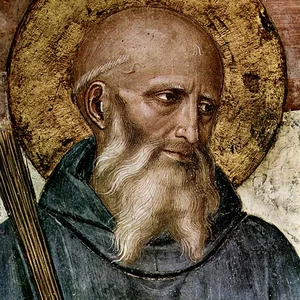

An Italian Christian monk, Benedict of Nursia is regarded as the founder of Western monasticism. He wrote a monastic rule that organized community life around prayer and work, and founded the abbey of Monte Cassino.
Saint Benedict of Nursia(480 — 547)
Benedict of Nursia
http://www.wikidata.org/.well-known/genid/84d128f6dcb886fa722d3dc5f7853faa
6 min read
Frequently asked questions
Famous Quotes
« Ora et labora»
Key Facts
- Born around 480 in Nursia (Norcia), in Umbria (Italy)
- Founds the abbey of Monte Cassino around 529
- Writes the Rule of Saint Benedict, the foundation of Western monasticism
- Died around 547 at Monte Cassino
- Proclaimed patron saint of Europe by Paul VI in 1964
Works & Achievements
A code of 73 chapters organizing monastic life around prayer, work, and obedience. It shaped Western monasticism for more than a thousand years.
A monastery established on the ruins of a temple of Apollo, which became the radiant heart of the Benedictine order and a center of culture for Europe.
A network of small communities of twelve monks each, Benedict's first experiment in organizing cenobitic life.
A principle of balance between prayer and manual work drawn from his Rule, which gave value to labor and stability in the medieval West.
A vow to remain in the same monastery for one's entire life, which made abbeys lasting anchor points in a Europe upended by invasions.
Anecdotes
According to the Dialogues of Gregory the Great, the young Benedict, who had gone to study in Rome, is so sickened by the city's debauchery that he flees to live as a hermit in a cave at Subiaco. A monk named Romanus lowers his bread down to him each day on a rope fitted with a little bell.
Tradition holds that some monks, irritated by Benedict's strictness, tried to poison him by offering him a cup of wine. When the saint blessed it with the sign of the cross, the cup shattered outright as though struck by a stone, revealing the plot.
It is said that one day, to fight off a violent carnal temptation, Benedict threw himself naked into a bush of nettles and brambles, rolling in it until the pain of the body extinguished that of the soul. He is said to have thus conquered temptation for the rest of his life.
According to the Dialogues, a raven came each day to eat from Benedict's hand. When a jealous priest sent him a poisoned loaf, the saint ordered the bird to carry the bread far away, to a place where no one could find it.
Legend has it that at the moment of Benedict's death, two monks in different places had the same vision: a luminous, carpet-covered path rising from his cell to heaven, along which a radiant man announced that this was the road taken by the beloved of the Lord.
Primary Sources
He forsook the home and goods of his father and, desiring to please God alone, he sought the habit of the holy life. He withdrew, therefore, knowingly ignorant and wisely untaught.
Listen, my son, to the precepts of the master, and incline the ear of your heart; willingly receive the admonition of a loving father and put it into practice.
Idleness is the enemy of the soul; therefore the brothers should be occupied at certain hours with the work of their hands, and at other hours with the reading of divine things.
Let all guests who arrive be received as Christ, for he himself will say one day: I was a stranger and you welcomed me.
Key Places
A small mountain town in Umbria where Benedict was born around 480, into a family of Roman nobles.
The capital where the young Benedict was sent to study the liberal arts, before fleeing the city's corruption.
The valley of the Aniene where Benedict lived for three years as a hermit in a cave (the Sacro Speco), then organized his first monasteries.
A height overlooking the Liri valley where Benedict founded his great abbey around 529, the cradle of Western monasticism, and where he died.
Typical Objects

Handwritten collection in which Benedict set down the precepts of communal life, summed up by the motto “ora et labora” (pray and work). It became the founding text of Western monasticism.

A glass of poisoned wine offered by jealous monks which, blessed by Benedict with the sign of the cross, flew to pieces. It became an iconographic attribute of the saint.

A medal engraved with crosses and Latin initials forming a prayer of exorcism. Tradition credits it with the power to ward off evil and diabolical temptations.

An ample hooded robe worn by monks, a sign of their renunciation of the world. Benedict regulated its plain and unadorned use in his Rule.

A curved staff carried by the abbot, a symbol of his authority as father and shepherd of the community. Benedict is often depicted holding it.

A tame bird that ate from the saint's hand and which he charged with carrying away a poisoned loaf of bread. It often accompanies Benedict in Christian art.
School Curriculum
Vocabulary & Tags
Key Vocabulary
Daily Life
Morning
Long before dawn, the monk rises at the sound of the bell for the office of Vigils, chanting psalms in the darkness of the church. At the first light of day come Lauds, after which each goes off to his work or to the reading of Scripture.
Afternoon
The afternoon is divided between manual labor — fields, garden, copying workshop — and further offices marking the hours. The Rule wills that no one remain idle, for “idleness is the enemy of the soul.”
Evening
Before nightfall, the community gathers for Vespers and then Compline, the last prayer of the day. After a brief time of shared reading, the great silence settles in and all return to the dormitory.
Food
Meals are frugal: two cooked dishes, bread in measured quantity, and vegetables from the garden. The Rule forbids the meat of four-footed animals except for the sick, and allows only a modest measure of wine each day.
Clothing
The monk wears a tunic of coarse wool and, over it, a hooded cowl of dark color, with a scapular for work. Every garment must be plain, suited to the climate, and provided by the monastery, with nothing owned as one's own.
Housing
The monks live in enclosure within the monastery, sleeping fully clothed in a common dormitory, each on a modest bed, with a lamp burning all night long. The abbey brings together church, refectory, cellar, and workshops so as to live turned in upon itself, apart from the world.
Historical Timeline
Period Vocabulary
Liens externes & ressources
Références
Œuvres
Règle de saint Benoît
vers 530-540
Fondation de l'abbaye du Mont-Cassin
vers 529
Les douze monastères de Subiaco
vers 520-525
La devise « Ora et labora »
VIe siècle
L'idéal de stabilité monastique
VIe siècle