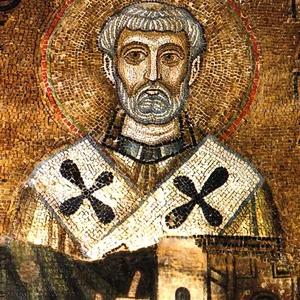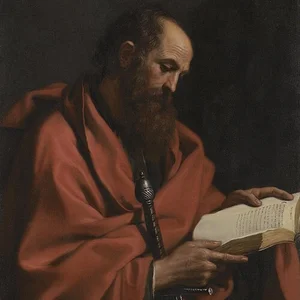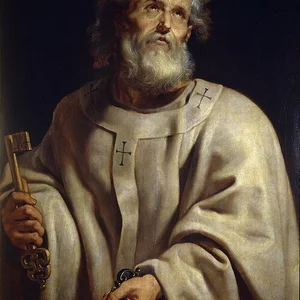

Saint John is one of the twelve apostles of Jesus of Nazareth, traditionally identified as “the disciple whom Jesus loved.” Christian tradition attributes to him the fourth Gospel, three epistles, and the Book of Revelation.
Saint John
Saint John
7 min read
Frequently asked questions
Famous Quotes
« In the beginning was the Word, and the Word was with God, and the Word was God.»
Key Facts
- First century: disciple of Jesus, counted among the twelve apostles
- Traditionally presented as “the disciple whom Jesus loved”
- Tradition attributes to him the fourth Gospel and three epistles
- Exiled on the island of Patmos, where he is said to have received the visions of Revelation
- Venerated as a saint and associated with the Christian community of Ephesus
Works & Achievements
The fourth Gospel of the New Testament, very different from the other three in its meditative and theological style. It opens with the famous prologue “In the beginning was the Word.”
A letter addressed to the Christian communities, stressing brotherly love and the phrase “God is love.” It is one of the foundations of Johannine spirituality.
A very short letter addressed to a community (“the chosen Lady”) warning against false teachers. It is one of the briefest books in the Bible.
A personal letter addressed to a man named Gaius, dealing with the hospitality owed to Christian missionaries. It offers a rare glimpse into the life of the early Churches.
The last book of the Bible, made up of symbolic visions about the struggle between good and evil and the end of times. Its imagery (horsemen, the beast, the heavenly Jerusalem) has profoundly shaped Western culture.
Anecdotes
Christian tradition refers to John as “the disciple whom Jesus loved,” the one who, during the Last Supper, sat very close to the Master. It is also to him that, according to the Gospel, Jesus is said to have entrusted his mother Mary from the cross: “Behold your mother.”
Together with his brother James, John was nicknamed “Boanerges,” meaning “sons of thunder.” This nickname is said to evoke their fiery temperament: one day, seeing a village refuse to welcome Jesus, the two brothers are said to have wanted to call down fire from heaven to consume it.
Tradition holds that John, exiled on the small Greek island of Patmos, received there a series of extraordinary visions that he recorded in the Book of Revelation, the last book of the Bible, filled with beasts, horsemen, and trumpets announcing the end of times.
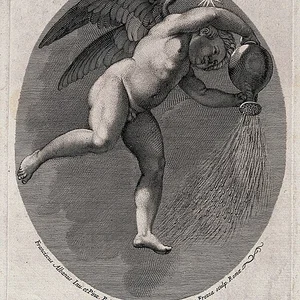
A legend told by the early Christians claims that enemies tried to poison John with a cup of wine, but that the poison escaped from it in the form of a serpent: this is why he is often depicted holding a chalice from which a dragon emerges.
According to another tradition, John is said to have been the only one of the twelve apostles not to die a martyr and to reach a very great age in Ephesus. Having grown too old to give long speeches, he simply repeated: “My little children, love one another.”
Primary Sources
One of his disciples, the one whom Jesus loved, was reclining at table close to Jesus.
When Jesus saw his mother, and the disciple whom he loved standing nearby, he said to his mother: “Woman, here is your son.” Then he said to the disciple: “Here is your mother.”
I, John, your brother, was on the island called Patmos because of the word of God and the testimony of Jesus.
Whoever does not love does not know God, because God is love.
John, the disciple of the Lord, the very one who had leaned on his breast, also published the Gospel during his stay at Ephesus.
Key Places
A vast freshwater lake where John worked as a fisherman with his father Zebedee and his brother James. It was there, according to the Gospels, that Jesus is said to have called him to follow him.
The religious capital of Judea, site of the Last Supper, the crucifixion, and the birth of the first Christian community. John is present there during the great events of the Passion.
A small Greek island in the Aegean Sea where tradition places John's exile and the writing of the Book of Revelation. A cave there is still venerated as the site of his visions.
A great city of Asia Minor where John is said to have spent his final years and led the Christian community. Tradition places his death and his tomb here, over which a basilica was built.
The river where John the Baptist preached and where, according to tradition, several future apostles including John first heard about Jesus.
Typical Objects

A cup from which a dragon or serpent escapes, an iconographic attribute of John recalling the legend of the poisoned cup that he survived. It is his most recognizable symbol in Christian art.

A symbolic animal associated with John among the four living creatures of the Apocalypse, evoking the soaring of his Gospel toward the divine mysteries. The eagle became his emblem in religious art.

A writing support made of rolled papyrus or parchment, onto which the Gospels and epistles were copied in the 1st century. John is often depicted writing or holding a book or a scroll.

A tool of the fisherman's trade that John and his brother practiced on the Sea of Galilee before following Jesus. It recalls their humble origins and the image of the apostles as “fishers of men.”

The scroll sealed with seven seals holds a central place in the visions of Patmos, opened by the Lamb to reveal the fate of the world. It symbolizes the revelation of divine secrets.

A small terracotta lamp fueled with olive oil, a common lighting object in homes and during the nighttime gatherings of the early Christians. Light is a major theme of the Gospel of John.
School Curriculum
Vocabulary & Tags
Key Vocabulary
Tags
Daily Life
Morning
Before following Jesus, John's day began early on the shores of the Sea of Galilee, untangling and mending the nets after a night of fishing. The fish were sorted, then carried to the market or to be salted.
Afternoon
The afternoon was divided between maintaining the boat, drying the nets, and resting away from the heat. Once he became a disciple, John spent his days walking from village to village in the footsteps of Jesus, listening to his teaching.
Evening
The evening brought the family or the community together around a simple meal and prayer. The first Christians sometimes gathered at night, by the light of lamps, to break bread and read the words of Jesus.
Food
The diet was that of the people of Galilee: barley or wheat bread, dried fish from the lake, olives, figs, dates, and a little wine cut with water. Meat was rare and reserved for feast days.
Clothing
John wore the common dress of the Jews of the time: a linen or wool tunic belted at the waist, a cloak for the night and the cold, leather sandals, and sometimes a prayer shawl.
Housing
The houses of the fishermen of Galilee were modest constructions of basalt stone, with one or two rooms, set around a shared courtyard. People slept on mats and cooked over a hearth or in an outdoor oven.
Historical Timeline
Period Vocabulary
Liens externes & ressources
Références
Œuvres
Évangile selon Jean
vers 90-100
Première épître de Jean
fin du Ier siècle
Deuxième épître de Jean
fin du Ier siècle
Troisième épître de Jean
fin du Ier siècle
Apocalypse (Livre de la Révélation)
vers 95