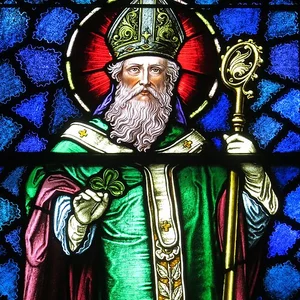

Saint Patrick was a fifth-century Christian missionary, regarded as the man who brought Christianity to Ireland. Captured young and enslaved in Ireland, he later returned there as a bishop to Christianize the island. He is the patron saint of Ireland.
Saint Patrick(400 — 500)
Patrick of Ireland
7 min read
Frequently asked questions
Key Facts
- Born toward the end of the fourth century (around 385-390) in Roman Britain, into a Christian family
- Captured as a teenager by raiders and enslaved in Ireland for six years
- Returns to Ireland around 432 as a bishop to evangelize the island
- Traditionally died on 17 March, around 461, a date that became Saint Patrick's Day
- Author of the “Confession” (Confessio), an attested autobiographical text in Latin
Works & Achievements
Spiritual autobiography in which Patrick justifies his mission and recounts his captivity and his faith. It is the oldest surviving written document from Ireland.
A letter of protest condemning a British chieftain who had massacred and enslaved young Irish Christians. A rare moral testimony against slavery in that era.
A mission said to have converted much of the island to Christianity and baptized thousands of people. Patrick is honored as the apostle of the Irish.
An establishment attributed to Patrick that became the religious center of Ireland. Armagh remains the seat of Ireland's archbishops to this day.
A protective prayer traditionally attributed to Patrick, invoking the power of God to defend him from dangers. It became a famous hymn of Celtic spirituality.
Anecdotes
Around the age of sixteen, Patrick was kidnapped by Irish raiders and forced into slavery. He spent six years tending herds in the hills of Ireland, where he says he turned to prayer and faith to survive the loneliness and the cold.
By his own account, Patrick escaped after hearing a voice in a dream telling him that a ship was waiting for him. He travelled nearly 300 kilometres to the coast, persuaded the crew to take him aboard, and eventually made his way back to his family in Roman Britain.
Tradition holds that Patrick used the three-leaved clover (the shamrock) to explain the Trinity to the Irish: three distinct leaves on a single stem, just as the Father, the Son and the Holy Spirit are but one God. The shamrock has since become the emblem of Ireland.
A famous legend claims that Patrick drove all the snakes out of Ireland by casting them into the sea from a hill where he was fasting. Naturalists believe there were in fact never any snakes on the island, which has been isolated by the sea since the last ice age: the story is thought to be an allegory for the end of paganism.
Saint Patrick's Day, on 17 March, marks the traditional date of his death. Originally an Irish religious holiday, it has become a worldwide celebration of Irish culture, with cities going so far as to dye their rivers and monuments green.
Primary Sources
I, Patrick, a sinner, the most unlearned and least of all the faithful... I had Calpornius for a father, a deacon, son of the priest Potitus. I was then nearly sixteen years old and knew not the true God, and I was taken into captivity in Ireland along with so many thousands of men.
With my own hand I have written and composed these words, that they may be given, delivered and sent to the soldiers of Coroticus; I do not say to my fellow citizens, nor to the fellow citizens of the holy Romans, but to the fellow citizens of demons, because of their evil deeds.
Patrick lit the Paschal fire on the hill of Slane, facing the royal residence of Tara, defying King Lóegaire's edict that no fire should blaze before that of the palace.
Key Places
Roman province of the island of Britain where Patrick was born into a Romano-British Christian family. As a teenager he was captured there by Irish raiders.
Region in the north of Ireland where, according to tradition, Patrick was a slave and tended the flocks for six years. It was there that he is said to have deepened his faith.
Height overlooking the Boyne valley where Patrick is said to have lit the Paschal fire in defiance of the pagan king of Tara. A central episode in his missionary legend.
Seat of the high kings of Ireland, the center of the pagan power and rites that Patrick sought to convert. His confrontation with King Lóegaire there is legendary.
Town where Patrick is said to have established his principal episcopal see, making it the ecclesiastical heart of Ireland. It remains the country's primatial see.
Place where, according to tradition, Patrick founded his first church and where he is said to have died and been buried. A shrine keeps his memory alive.
Typical Objects

Curved staff carried by the bishop, a symbol of his role as a shepherd guiding his flock of the faithful. Irish tradition venerated the “Staff of Jesus” (Bachall Ísu) attributed to Patrick.

Small three-leaved plant that Patrick is said to have used to teach the mystery of the Trinity. It became the national emblem of Ireland.

Christian cross adorned with a ring encircling the intersection of its arms, associated with Patrick's evangelizing mission. Legend holds that Patrick combined the cross with the solar circle venerated by the pagans.

Hand-copied collection of the Gospels that missionaries brought to teach and to celebrate the liturgy. These books foreshadow the great illuminated Irish manuscripts such as the Book of Kells.

Small quadrangular bell used by Irish monks to call the faithful to prayer. Patrick's “Bell of the Testament” was preserved as a relic and enshrined in an ornate metalwork reliquary.

Liturgical vestments worn to celebrate Mass and to baptize converts. They set the missionary bishop apart amid the peoples he was evangelizing.
School Curriculum
Vocabulary & Tags
Key Vocabulary
Tags
Daily Life
Morning
As a monk and missionary bishop, Patrick began the day before dawn with prayer and the recitation of the psalms. He describes praying dozens of times a day himself, even during his captivity, in the cold and the rain.
Afternoon
The afternoon was devoted to the mission: preaching to the Irish clans, baptizing converts, ordaining clergy, and founding churches. He often had to travel on foot or on horseback over long distances across a country without Roman roads.
Evening
In the evening the community gathered for the office and a simple meal. Patrick continued teaching the faith, sometimes negotiated with local kings, and watched over the safety of his disciples in a territory that was still largely pagan.
Food
Food relied on the resources of rural Ireland: oat or barley bread, dairy products, cheese, pork, and fish. Religious fasts, frequent and prolonged, set the rhythm of the liturgical year.
Clothing
Patrick wore the woolen tunic and cloak of the clergy, along with liturgical vestments to celebrate Mass. As a former slave, he had known the coarse garments of a shepherd exposed to the elements.
Housing
He lived in modest dwellings: monastic huts, church enclosures, or residences offered by converts. The first Irish Christian settlements were simple cabins of wood and wattle-and-daub grouped around a church.
Historical Timeline
Period Vocabulary
Liens externes & ressources
Références
Œuvres
Confessio (Confession)
Ve siècle
Epistola ad milites Corotici (Lettre à Coroticus)
Ve siècle
Évangelisation de l'Irlande
Ve siècle
Fondation du siège d'Armagh
vers 445
Lorica (« Cuirasse de saint Patrick »)
attribuée, texte plus tardif