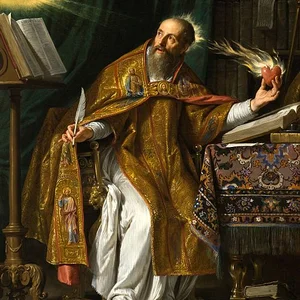

One of the twelve apostles of Jesus, originally from Bethsaida in Galilee. He was among the first to be called and played a role as intermediary between Jesus and Greeks who came to meet him. Tradition holds that he died a martyr at Hierapolis in Phrygia.
Saint Philip (apostle)
Philip of Bethsaida
9 min read
Frequently asked questions
Famous Quotes
« Lord, show us the Father, and it is enough for us. (John 14:8)»
« We have found him of whom Moses in the Law and also the prophets wrote, Jesus of Nazareth, the son of Joseph. (John 1:45)»
Key Facts
- Originally from Bethsaida (Galilee), the same town as Peter and Andrew — mentioned in John 1:44
- Called directly by Jesus among the first apostles (John 1:43)
- Present at the feeding of the multitude; questioned by Jesus about how to feed the crowd (John 6:5-7)
- Acts as intermediary between Greek pilgrims and Jesus at the entry into Jerusalem (John 12:21-22)
- According to tradition, he evangelized Phrygia (Asia Minor) and died a martyr at Hierapolis; feast day on May 3
Works & Achievements
Philip's first apostolic act recorded in the Gospels: he persuades his friend Nathanael to "come and see" Jesus, making himself an active early missionary even before the group of the Twelve had been formed.
Philip acts as an intermediary between Greeks who had come for Passover and Jesus (John 12:20–22), illustrating his symbolic role as a bridge between the Hellenistic world and the Jewish-Christian community — a role made easier by his Greek name.
According to the apocryphal Acts of Philip and ecclesiastical tradition, Philip is said to have evangelized in Asia Minor for several decades, founding Christian communities in Hierapolis and the surrounding region before his martyrdom.
A Gnostic text discovered in Egypt in 1945, pseudepigraphically attributed to Philip. This document reveals the symbolic importance of the apostle in certain fringe Christian movements of the early centuries, particularly regarding the sacraments.
A lengthy apocryphal narrative describing Philip's miracles, travels, and martyrdom in Phrygia. Although non-canonical, this text strongly influenced popular devotion and the iconography of the apostle in both Western and Eastern medieval traditions.
Anecdotes
According to the Gospel of John (1:43-46), Philip is one of the first disciples called directly by Jesus, who says to him simply: “Follow me.” Immediately convinced, Philip runs to find his friend Nathanael and tells him they have found the Messiah foretold by Moses. When Nathanael scoffs — “Can anything good come out of Nazareth?” — Philip replies with a phrase that has become famous in Christian tradition: “Come and see.”
During the feeding of the multitude (John 6:5-7), Jesus tests Philip by asking him how to feed the enormous crowd. Philip, ever pragmatic, quickly calculates: two hundred denarii worth of bread would not be enough for each person to receive even a little. This episode reveals a mind firmly grounded in material reality — a hallmark of this apostle, often portrayed as direct and concrete — in sharp contrast with the miraculous response that follows.
In Jerusalem, Greek pilgrims who had come for the Passover feast approached Philip and asked: “Sir, we wish to see Jesus.” This detail (John 12:20-22) is noteworthy: Philip, who bears a Greek name, serves as a bridge between the Hellenistic world and the Judeo-Christian community. He first consults Andrew before they go together to inform Jesus — a sign of a cautious temperament that prefers to act in pairs.
At Jesus’s last meal with his disciples, Philip makes this bold request: “Lord, show us the Father, and it is enough for us.” Jesus replies with astonishment: “Have I been with you so long, and you still do not know me, Philip? Whoever has seen me has seen the Father.” (John 14:8-9). This philosophically profound scene has nourished centuries of Christian theology on the divine nature and the Incarnation.
An ancient tradition, recorded by Eusebius of Caesarea in the fourth century, places Philip’s death at Hierapolis in Phrygia (present-day Turkey), where he is said to have evangelized for many years. Archaeological excavations conducted in the twentieth century by Italian researchers uncovered a large cross-shaped structure identified as the martyrion of Philip, built in the fifth century in his honor on the presumed site of his martyrdom.
Primary Sources
The next day Jesus decided to go to Galilee. He found Philip and said to him, "Follow me." Now Philip was from Bethsaida, the city of Andrew and Peter. Philip found Nathanael and said to him, "We have found him of whom Moses in the Law and also the prophets wrote, Jesus of Nazareth, the son of Joseph."
Philip said to him, "Lord, show us the Father, and it is enough for us." Jesus said to him, "Have I been with you so long, and you still do not know me, Philip? Whoever has seen me has seen the Father. How can you say, 'Show us the Father'?"
They went up to the upper room, where they were staying: Peter and John and James and Andrew, Philip and Thomas, Bartholomew and Matthew, James the son of Alphaeus, Simon the Zealot, and Judas the son of James.
Philip, one of the twelve apostles, fell asleep at Hierapolis in Phrygia together with his two daughters who had grown old in virginity; a third daughter, who had lived in the Holy Spirit, was buried at Ephesus.
Philip received Scythia and Phrygia as his portion to preach the Gospel. There he performed many miracles and converted great crowds, before being put to death by the authorities of the city of Hierapolis, crucified upside down according to some accounts.
Key Places
Philip's hometown, explicitly mentioned in the Gospel of John. A fishing village on the shores of the Sea of Galilee, it was also the birthplace of the apostles Peter and Andrew.
The site of the founding events: the Last Supper, the Crucifixion, and Pentecost. Philip was present there during the formation of the first Christian community gathered in the Upper Room after the Resurrection.
A spa city in Asia Minor where Philip is said to have carried out his ministry for decades before meeting his death there. A large 5th-century martyrion on the site was excavated by Italian archaeologists from the University of Salento.
According to tradition, the relics of Philip (and of James the Less) were transferred here in the 6th century by Pope Pelagius I. The basilica, rebuilt during the Renaissance, remains a place of veneration for both apostles.
The body of water around which many Gospel episodes unfold, several of them involving Philip. The geographical heart of Jesus's Galilean ministry, it represents the cultural and social world in which Philip grew up.
Typical Objects

In Christian iconography, Philip is often depicted holding a long staff or tau cross (T-shaped), a symbol of his itinerant apostolic mission through the regions of Phrygia and Asia Minor.

The scene of the multiplication of the loaves (John 6) closely associates Philip with the five barley loaves. Some medieval depictions show him holding bread baskets, a vivid reminder of this founding miracle in which his pragmatic realism was surpassed by the wonder.

A son of Second Temple Judaism, Philip was well acquainted with the Hebrew texts. The explicit reference he makes to Moses and the prophets when announcing Jesus to Nathanael shows that the Torah was the framework through which he interpreted his new faith.

According to tradition, Philip was crucified at Hierapolis — some sources speak of an upside-down crucifixion or a particular form of execution. The cross is the primary attribute of his martyrdom in Byzantine and medieval Christian iconography.

An everyday object of the Greco-Roman world, the lamp also symbolizes the light of the Gospel that Philip is charged with spreading. The earliest Christian communities often gathered at nightfall, by the glow of such terracotta lamps.

Philip came from Bethsaida, a fishing town on the Sea of Galilee, as did Peter and Andrew. Although he is not explicitly described as a fisherman, he shares this Galilean maritime culture with several other apostles.
School Curriculum
Vocabulary & Tags
Key Vocabulary
Tags
Daily Life
Morning
The day of an itinerant apostle like Philip began before dawn with the recitation of the Shema Israel, the fundamental prayer of Judaism. On the roads of Galilee or Asia Minor, he rose with the sun, ate a little flatbread and olives, then resumed walking or organized a meeting at the home of a local believer.
Afternoon
The afternoon was devoted to preaching in synagogues, public squares, or private homes that served as the first "house-churches." Philip discussed the Scriptures, answered questions, baptized converts in a spring or stream, and tended to the needs of the nascent community.
Evening
In the evening, the community gathered for the agape, the shared fraternal meal by the light of oil lamps. Letters from other apostles were read aloud, prayers were offered, and what would become the Eucharist was celebrated. Philip slept at the home of a believing host, in keeping with Jesus's instructions to accept the hospitality of welcoming households.
Food
Like all observant Jews of his time, Philip followed the kosher dietary laws: no pork or shellfish, and meat slaughtered according to ritual requirements. In his native Galilee, fish from the Sea of Tiberias was a staple food, accompanied by barley or wheat bread, olives, figs, and dried legumes such as lentils.
Clothing
Philip wore the common attire of first-century Galilean Jews: a linen or wool tunic (*kethoneth*), an outer cloak (*tallith*) that also served as a blanket at night, and leather sandals. While traveling, a belt carrying a few provisions and a walking staff completed his outfit on the long roads of Asia Minor.
Housing
In Bethsaida, homes were simple structures built from volcanic basalt with flat beaten-earth roofs, typical of Galilean fishing villages. On mission, Philip lived according to the evangelical precept: welcomed into the homes of converts, sometimes sleeping several to a room, sharing the community's limited resources.
Historical Timeline
Period Vocabulary
Liens externes & ressources
Références
Œuvres
Appel de Nathanaël (Barthélemy)
vers 27-28 apr. J.-C.
Médiation avec les pèlerins grecs à Jérusalem
vers 30 apr. J.-C.
Mission apostolique en Phrygie
vers 50-80 apr. J.-C.
Évangile de Philippe (texte gnostique de Nag Hammadi)
IIe-IIIe siècle apr. J.-C.
Actes de Philippe (texte apocryphe)
IVe siècle apr. J.-C.