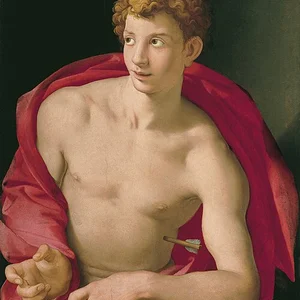

Officer of the Praetorian Guard of Emperor Diocletian, secretly converted to Christianity. Condemned to death by arrows around 288, he survived before being beaten to death. He became one of the most depicted martyrs in Western art.
Saint Sebastian
Saint Sebastian
8 min read
Frequently asked questions
Key Facts
- Born around 256, most likely in Narbonne or Milan
- Officer of the Praetorian Guard under Emperor Diocletian in Rome
- Arrested for his Christian faith and condemned to death by arrows around 288 AD
- Survived the first execution — tended to, according to tradition, by Saint Irene — then beaten to death on Diocletian's orders
- Venerated as a saint and patron of archers, soldiers, and plague victims; his feast day is January 20
Works & Achievements
A hagiographic text attributed to Arnobius the Younger, constituting the primary narrative source for the legend of Saint Sebastian. This detailed account of his conversions, martyrdom, and miracles served as the template for all subsequent iconography.
One of the seven major basilicas of Rome, built over the catacombs of the Via Appia near Sebastian's presumed tomb. An uninterrupted pilgrimage site since Late Antiquity, it bears witness to how rapidly his cult spread.
A masterpiece of Renaissance painting depicting the saint bound to a column and pierced by arrows against a backdrop of ancient ruins. This work illustrates how humanism reinterpreted Christian iconography through the lens of classical Antiquity.
An iconic Baroque painting depicting Sebastian as a young man with an idealized body, his eyes raised toward heaven. This aestheticized vision of martyrdom profoundly shaped the romantic and sensitive image of the saint in Western culture.
A candlelit Caravaggesque painting depicting the scene of Sebastian's rescue by Irene. This work shifts the emphasis from martial heroism toward Christian tenderness and compassion, rendered in a striking chiaroscuro.
Anecdotes
According to hagiographic tradition, Sebastian was an officer of the Praetorian Guard who concealed his Christian faith at the very heart of the imperial palace. He used his position to comfort imprisoned Christians, including Marcellinus and Mark, encouraging them to remain steadfast in the face of torture — an act that could have cost him his life at any moment.
Condemned to death by archery, Sebastian was bound to a post and riddled with arrows by soldiers from his own unit. Left for dead, he was rescued by a Christian widow named Irene of Rome, who removed the arrows and tended his wounds. His miraculous survival became one of the most depicted subjects in European Baroque art.
After his recovery, instead of fleeing Rome, Sebastian chose to confront Emperor Diocletian directly, reproaching him for his persecutions. Astonished to see a man he believed dead, the emperor this time ordered his execution by cudgel. His body was thrown into the Cloaca Maxima, Rome's main sewer.
In AD 680, a terrible plague epidemic struck Rome. A solemn procession was organized around the tomb of Saint Sebastian in the catacombs along the Via Appia, and according to chronicles of the time, the epidemic ceased shortly after. This episode made him the patron saint invoked against epidemics throughout the Middle Ages, most notably during the Black Death in the 14th century.
In several versions of the legend, Sebastian had converted his two fellow soldiers Marcellinus and Mark, twin brothers, who were hesitating to apostatize in order to save their lives. His speech reportedly convinced them so thoroughly that they accepted martyrdom with joy, also bringing about the conversion of their jailers and their families.
Primary Sources
Sebastianus, vir Christianissimus, sub umbra militiae in aula imperatoris latenter Christum colebat, captivosque Christianos consolabatur et ad martyrium confirmabat.
Sebastianus miles Mediolanensis, qui sub Diocletiano imperatore passus est, inter primos martyres Romani imperii numerandus est, qui fidem suam etiam inter arma militaria servavit.
Hic Sebastianus martyr requiescit, miles Christi, qui sub Diocletiano imperatore glorioso certamine coronatus est.
XIII Kalendas Februarias: Romae via Appia, natale sancti Sebastiani militis, qui sub Diocletiano imperatore passus est.
Ob cuius merita in basilica eiusdem martyris pestifera lues protinus conquievit, et crebris signis a Deo ibidem ostensis, universorum corda ad eius amorem accensa sunt.
Key Places
The traditional burial site of Saint Sebastian on the Via Appia Antica. The catacombs have borne his name since Late Antiquity, and the basilica built in the 4th century remains a major center of pilgrimage. This is where the processions against the plague took place in 680.
The administrative capital of the Western Roman Empire under Diocletian, Milan appears in several traditions as the place of Sebastian's origin or military service. Saint Ambrose venerated his memory there.
The seat of imperial power and barracks of the Praetorian Guard on the Viminal Hill, these were the sites of Sebastian's daily service. It was here that he secretly practiced his faith while carrying out his military duties.
A Roman prison at the foot of the Capitoline Hill where many Christian martyrs were held. According to the *Acta*, Sebastian secretly visited the condemned there to offer them spiritual support before their execution.
A Carolingian abbey to which relics of Saint Sebastian were transferred in 826 under Louis the Pious. This transfer spread his cult throughout the Frankish kingdom and made Sebastian a popular figure in northern Christendom.
Typical Objects

The central iconographic attribute of Saint Sebastian throughout the entire Western artistic tradition. The arrows embedded in his body symbolize both his ordeal and, through biblical metaphor, the arrows of divine wrath (Psalm 38) equated with the plague — hence his role as protector against epidemics.

The universal symbol of Christian martyrdom, the palm branch represents victory over death and the crown of eternal life promised to martyrs. It frequently accompanies Sebastian in medieval representations, laid at his feet or held in his hand.

In hagiographic accounts and iconography, Sebastian is bound to a post or column for his execution. The Colonna di San Sebastiano, preserved in the Basilica of San Pietro in Vincoli in Rome, is venerated as a relic of his martyrdom.

Reflecting his status as a Praetorian officer, the cuirass (*lorica*) and military cloak (*paludamentum*) recall that he was a soldier before he was a martyr. Some representations show him in full military dress, underscoring the paradox between martial glory and persecuted faith.

Objects associated with the rescue scene, the care given by the widow Irene is depicted in several Baroque masterpieces (Georges de La Tour, Hendrick ter Brugghen). They symbolize mercy, healing, and Christian fellowship at the heart of persecution.

Borrowed from Roman triumphal imagery, the laurel crown is sometimes substituted for the martyr's crown as a reminder that Sebastian was first and foremost a victorious soldier. It highlights the tension between earthly glory and heavenly glory that lies at the heart of his legend.
School Curriculum
Vocabulary & Tags
Key Vocabulary
Daily Life
Morning
As an officer of the Praetorian Guard, Sebastian's day began at dawn with the military roll call and troop inspection at the Castra Praetoria. Before reporting for his duties at the palace, he would pray secretly according to Christian rites — a perilous practice that could cost him his life if discovered.
Afternoon
His afternoons were divided between the ceremonial and escort duties typical of the Praetorian Guard, and clandestine visits to the prisons where Christians were held. He brought them food, spiritual comfort, and sometimes money to influence the less zealous jailers.
Evening
In the evenings, the guard's soldiers gathered for the communal meal. Sebastian had to pretend to join in the libations offered to the Roman gods while remaining true to his faith. Secret Christian gatherings took place at night in the private homes of believers, known as *domus ecclesiae*.
Food
The diet of a Roman officer of rank was better than that of the ordinary legionary: wheat, meat (chiefly pork), vegetables, dried fruit, and wine diluted with water. Roman Christians gathered for the *agape*, a communal meal that preceded or accompanied the Eucharist and strengthened the bonds of the persecuted community.
Clothing
The Praetorian Guard uniform consisted of a scarlet tunic, a breastplate (*lorica*), a military cloak (*paludamentum*), and a crested helmet. Off duty, Sebastian wore the tunic of a Roman citizen. Christians wore no visible distinguishing marks; their identity was recognized through the sign of the cross or the fish (*ΙΧΘΥΣ*).
Housing
Praetorian Guard officers were housed in the barracks of the Castra Praetoria, on the Viminal Hill in Rome. These buildings provided individual quarters for officers of rank. Private homes belonging to wealthy Christians served as meeting places for the underground communities.
Historical Timeline
Period Vocabulary
Liens externes & ressources
Références
Œuvres
Acta Sancti Sebastiani
Ve siècle ap. J.-C.
Basilique San Sebastiano fuori le mura, Rome
IVe siècle (fondation)