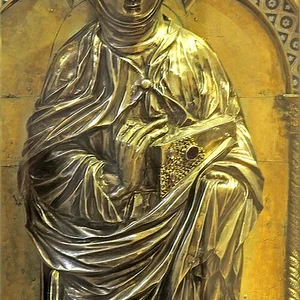

A Hungarian princess who became Landgravine of Thuringia, Elizabeth of Hungary (1207-1231) devoted her life to the poor and the sick. Widowed at a very young age, she joined the Franciscan Third Order and founded a hospital, becoming a major figure of medieval Christian charity.
Saint Elizabeth of Hungary(1207 — 1231)
Elizabeth of Hungary
Hongrie
5 min read
Frequently asked questions
Key Facts
- Born in 1207, daughter of King Andrew II of Hungary
- Married Landgrave Louis IV of Thuringia in 1221
- Widowed in 1227, she joined the Franciscan Third Order and founded a hospital in Marburg
- Died in Marburg in 1231 at the age of 24, exhausted by her life of asceticism and service to the poor
- Canonized by Pope Gregory IX in 1235, only four years after her death
Works & Achievements
Elizabeth opened the grain reserves of the Wartburg to feed hundreds of starving people during the famine.
She was one of the first high-ranking women to embrace the Franciscan ideal of poverty as a laywoman.
An institution dedicated to Saint Francis where she personally cared for the sick, lepers, and the destitute.
A daily work of charity that made her a model of mercy for the entire medieval West.
Renouncing her princely fortune, she redistributed her resources to those in need.
Having become the patron saint of hospitals, bakers, and charity, she inspired many hospital foundations.
Anecdotes
Betrothed at the age of just four, Elisabeth was sent to the court of Thuringia, at Wartburg Castle, to be raised far from her native Hungary. She grew up alongside her future husband, Louis IV, whom she married at fourteen.
The most famous legend about her is the “miracle of the roses”: caught by her husband while carrying bread hidden in her cloak for the poor, she opened her apron and it is said to have filled with roses, despite the winter. This story, told after her death, symbolizes her overflowing charity.
When Louis IV died in 1227, having left for the Crusade and been carried off by the plague in Italy, Elisabeth was driven out of the Wartburg by her in-laws. Widowed at twenty, she gave up her rank and went to live in poverty in Marburg.
She founded a hospital in Marburg where she cared for the sick, the lepers, and the most destitute herself, washing their wounds and feeding them with her own hands.
Elisabeth died exhausted at just twenty-four years old. Her canonization, barely four years after her death in 1235, was one of the fastest in the history of the medieval Church.
Primary Sources
She served the poor and the sick with such humility that she herself carried the children of the destitute and washed their soiled garments.
Having renounced all worldly pomp, she devoted herself entirely to caring for the sick in the hospital she had founded with her own resources.
This glorious woman, scorning royal delights, made herself the servant of the poor of Christ.
She opened her cloak, and within it no bread was found but roses of marvelous beauty, though it was not the season for them.
Key Places
Place traditionally associated with her birth as the daughter of King Andrew II of Hungary.
Residence of the landgraves of Thuringia where Elizabeth was raised and later lived as the wife of Louis IV.
City where, having become a widow, she founded her hospital, cared for the poor, and died; she is buried there.
The first great Gothic building in Germany, raised over her tomb and become a major place of pilgrimage.
Port from which Louis IV set out on crusade and near which he died of the plague in 1227.
Liens externes & ressources
Références
Œuvres
Distribution des greniers du château durant la famine
1226
Entrée dans le Tiers-Ordre franciscain
1228
Fondation de l'hôpital de Marbourg
1229
Soin des lépreux et des malades
1229-1231
Don de sa dot et de ses biens aux pauvres
1228
Patronage des œuvres caritatives chrétiennes
posthume