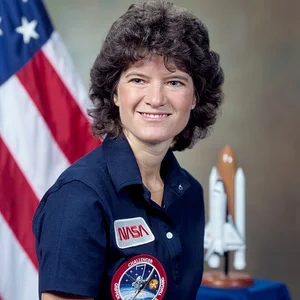

American physicist and astronaut, Sally Ride became in 1983 the first American woman to travel in space aboard the Space Shuttle Challenger. She took part in two space missions and later dedicated herself to promoting science education for young people.
Sally Ride(1951 — 2012)
Sally Ride
États-Unis
8 min read
Frequently asked questions
Famous Quotes
« I would like to be remembered as someone who was not afraid to do what she wanted to do, and as someone who took risks along the way in order to achieve her goals.»
Key Facts
- 1983: first American woman in space, aboard the Space Shuttle Challenger (mission STS-7)
- 1984: second spaceflight during mission STS-41-G
- 1986: member of the Rogers Commission investigating the Challenger disaster
- 1987: leaves NASA to focus on teaching and physics research
- 2001: founds Sally Ride Science to encourage young people, especially girls, to pursue science
Works & Achievements
Aboard the Space Shuttle Challenger, Sally Ride became the first American woman in space at age 32. The mission deployed two commercial satellites and conducted scientific experiments in weightlessness over six days.
Sally Ride's second spaceflight, once again aboard Challenger. It marked the first time two women were simultaneously in space (Ride and Kathryn Sullivan), and the first spacewalk by an American woman took place during this mission.
A children's book co-written with Susan Okie, describing the experience of spaceflight with precision and enthusiasm. Translated into several languages, it inspired generations of young people to take an interest in science and astronautics.
Commissioned by NASA in the wake of the Challenger disaster, this strategic report analyzed the future of American space policy. Sally Ride advocated for diversifying missions, exploring Mars, and improving institutional management.
A nonprofit organization created to encourage young people — especially girls — to take an interest in science, mathematics, and technology. It organized science festivals and published educational resources.
A series of popular science books for children co-written with Tam O'Shaughnessy. Accessible yet rigorous, they cover planetary exploration and helped bring astronomy to a wider young audience.
Anecdotes
In 1977, NASA opened its astronaut selection process to women for the first time. Sally Ride spotted the announcement in her Stanford University newspaper and submitted her application among more than 8,000 candidates. In 1978, she was one of the first six women selected as astronauts — a historic cohort that transformed the face of American space exploration.
While preparing for her first mission in 1983, journalists asked Sally Ride whether she was afraid she might cry if something went wrong in space, and whether her hormonal cycles might affect her judgment. She responded calmly but firmly that these questions were never asked of her male colleagues, refusing to be defined by her gender rather than her abilities as a physicist and astronaut.
On June 18, 1983, as the shuttle Challenger lifted off from Kennedy Space Center, the crowd gathered on the beach chanted “Ride, Sally, Ride!” — a nod to the Wilson Pickett song. At 32, she became the first American woman in space and the third woman in the world, after Soviet cosmonauts Valentina Tereshkova (1963) and Svetlana Savitskaya (1982).
Before becoming an astronaut, Sally Ride was an accomplished tennis player. As a teenager, she trained with champion Billie Jean King, who even encouraged her to pursue a professional career. Ride ultimately chose physics, but she carried the discipline and focus of a competitive athlete with her throughout her life.
After the Challenger shuttle disaster in January 1986, Sally Ride was the only active astronaut to serve on the Rogers Commission, which was tasked with investigating the accident. She played a crucial role by uncovering internal NASA memos warning of the dangers of O-rings in cold temperatures — memos that management had ignored.
Primary Sources
The view of Earth from space is breathtaking. Our planet looks so small and so fragile — a blue marble suspended in the blackness of space.
The engineers at Morton Thiokol had raised objections to launching in cold weather. These warnings were not properly communicated to those responsible for the final launch decision.
The United States is in danger of losing its preeminent position in space exploration and space science. We have allowed the Space Shuttle to become our only launch vehicle, placing all of our eggs in one basket.
I'm sure it was the most fun I'll ever have in my life. The thing that I'll remember most about the flight is that it was fun — and I'm sure it was the most fun I'll ever have.
Key Places
Sally Ride was born on May 26, 1951, in Los Angeles and grew up in the Encino neighborhood. There she developed an early passion for science and sports — particularly tennis — before going on to Stanford.
Sally Ride earned her bachelor's degrees in physics and English literature (1973) and her doctorate in astrophysics (1978) here. It was while reading the university newspaper that she came across the NASA recruitment announcement that would change her life.
NASA's primary astronaut training and operations center. Sally Ride spent six years here in intensive training: flight simulators, weightlessness drills, and operation of the Canadarm robotic arm.
It was from this center that the shuttles STS-7 (June 1983) and STS-41-G (October 1984) launched, carrying Sally Ride into space. Launch Pad 39A remains associated with her two historic missions.
After leaving NASA, Sally Ride joined UCSD as a professor of physics. There she founded Sally Ride Science to promote science among young people, and passed away in July 2012.
Typical Objects

Sally Ride wore this orange suit during the critical phases of launch and landing. Designed to protect astronauts in the event of cabin depressurization, it became a symbol of the Space Shuttle era.

Sally Ride was specially trained to operate this 15-meter robotic arm, used to deploy and retrieve satellites. During mission STS-7, she became the first woman to maneuver it in orbit.

Before her astronaut career, Sally Ride was a near-professional-level tennis player, coached by Billie Jean King. The racket symbolizes the athletic and mental discipline that defined her entire life, from sports to space exploration.

Like all astronauts, Sally Ride used medium-format cameras to photograph Earth from space. These scientific images contributed to research on the terrestrial environment and helped raise public awareness.

The official mission patch features the initials of the five crew members against a starry background. Sally Ride wore this patch throughout her preparations; it remains the symbol of her historic mission in June 1983.

Aboard the shuttle, meals came in dehydrated form and were rehydrated with water. Astronauts ate carefully to prevent crumbs from floating away in microgravity and damaging equipment.
School Curriculum
Vocabulary & Tags
Key Vocabulary
Tags
Daily Life
Morning
During her training years at NASA (1978–1983), Sally Ride started her days early with an intense physical workout — running or tennis — followed by a technical briefing with her team. She would then study the shuttle's systems and mission protocols in the training rooms at Johnson Space Center in Houston.
Afternoon
Afternoons were devoted to flight simulators, where astronauts tirelessly rehearsed every phase of the mission: liftoff, orbital maneuvers, operating the Canadarm robotic arm, and emergency procedures. Sally Ride also attended scientific meetings to prepare the experiments to be conducted aboard the shuttle.
Evening
In the evenings, Sally Ride reviewed technical manuals, prepared her mission notes, or took part in public science outreach lectures. She kept up her tennis practice as both a relaxation sport and a form of mental discipline. After her flights, she devoted more and more of her evenings to writing books for young readers.
Food
Sally Ride followed a balanced diet suited to her demanding physical training. Aboard the shuttle, meals came in freeze-dried or sealed-pouch form: food had to be rehydrated with water and eaten carefully to prevent crumbs from floating away in weightlessness and damaging the instruments.
Clothing
Day to day, Sally Ride wore the standard blue jumpsuit of NASA engineer-astronauts during training. At the launch pad and during critical flight phases, she wore the pressurized orange suit (Launch Entry Suit). As a physicist and professor, she dressed simply and practically, far removed from the formal dress codes of her era.
Housing
During her NASA training, Sally Ride lived in the Houston, Texas area, close to Johnson Space Center. After leaving the space agency, she moved to La Jolla, California, near UCSD where she taught. She shared her life for 27 years with Tam O'Shaughnessy, in complete privacy — a fact revealed only at her death in 2012.
Historical Timeline
Period Vocabulary
Liens externes & ressources
Références
Œuvres
Mission STS-7 — Premier vol d'une Américaine dans l'espace
18-24 juin 1983
Mission STS-41-G
5-13 octobre 1984
To Space and Back (La navette et moi)
1986
Rapport Ride — Leadership and America's Future in Space
Août 1987
Fondation de Sally Ride Science
2001
The Mystery of Mars et Exploring Our Solar System (série jeunesse)
1999-2003