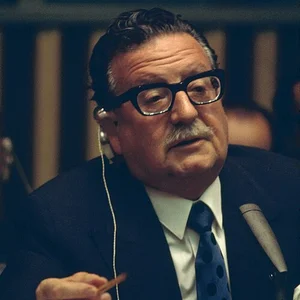

Salvador Allende (1908-1973) was a Chilean statesman and trained physician. As the first democratically elected Marxist president in Latin America in 1970, he pursued a socialist agenda before being overthrown and dying during the military coup led by General Pinochet on 11 September 1973.
Salvador Allende(1908 — 1973)
Salvador Allende
Chili
6 min read
Frequently asked questions
Famous Quotes
« They have the strength; they may be able to crush us, but social processes cannot be halted, neither by crime nor by force. History is ours, and it is made by the people.»
Key Facts
- Elected President of Chile on 4 September 1970 at the head of the Popular Unity coalition, the first electoral victory of a Marxist in a presidential race
- Launched the nationalization of copper in 1971, a key resource of the Chilean economy
- Faced a severe economic and political crisis as well as strong domestic and international opposition in 1972-1973
- Overthrown by the military coup led by General Augusto Pinochet on 11 September 1973
- Died in the besieged presidential palace of La Moneda on 11 September 1973
Works & Achievements
A work written while he was Minister of Health, analyzing the links between poverty, working conditions, and illness in Chile. A founding text of his social thought.
A major reform transferring the large copper mines, previously controlled by foreign companies, to the State. The measure was passed unanimously by Congress.
A free, daily distribution of milk to Chilean children to combat malnutrition. A symbol of the social policy of Popular Unity.
The redistribution of land to peasants, accelerating a reform begun under the previous government. It aimed to reduce rural inequalities.
A pioneering computer system designed to coordinate the nationalized economy in real time. A unique experiment in computer-assisted planning.
An address denouncing the pressure from transnational corporations and the economic isolation imposed on Chile. A plea for the sovereignty of small nations.
Anecdotes
Trained as a doctor, Salvador Allende never abandoned that identity: even as a senator and later as president, he continued to think in terms of public health, viewing poverty and malnutrition as the first diseases to be fought in Chile.
Allende ran for the presidency four times (1952, 1958, 1964, and 1970). After his defeats, he joked that his epitaph would read: “Here lies the future president of Chile.” In 1970, he finally won.
On 11 September 1973, as the army bombarded the La Moneda palace, Allende delivered a final speech to the Chilean people over Radio Magallanes, refusing to flee or to resign. He died that very day in the burning palace.
During his term, Allende launched a program distributing half a liter of free milk per day to every Chilean child, a public health measure inspired by his medical training and aimed at fighting childhood malnutrition.
In 1971, his government nationalized the great copper mines, until then controlled by American companies. Copper, nicknamed “Chile's wages,” thus became national property, which provoked sharp tensions with the United States.
Primary Sources
Workers of my homeland, I have faith in Chile and its destiny. Other men will overcome this gray and bitter moment when treason seeks to prevail. Know that, sooner rather than later, the great avenues will open again, along which free men will walk to build a better society.
Chile is today the first nation on Earth called upon to forge the second path toward socialism: the democratic, pluralist, and libertarian path.
I come from a small country… we are potential victims. We find ourselves facing a head-on conflict between the great transnational corporations and the states.
Key Places
Major Chilean port linked to Allende's birth and his youth. The city shaped his earliest commitments.
Seat of the Chilean presidency, bombed during the coup d'état of 11 September 1973. It was there that Allende delivered his final speech and met his death.
Allende studied medicine here and developed intellectually and politically during the 1920s and 1930s.
Allende sat here for many years as a senator, becoming one of the leading figures of the Chilean left.
The place where Salvador Allende finally rests, after a state funeral in 1990 at the end of the dictatorship. A memorial there is dedicated to him.
Typical Objects

Allende's dark, thick-framed glasses became a recognizable feature of his face. Today they are a symbol of his memory in Chile.

During the attack on La Moneda, those close to him brought him a helmet to protect him. This image captures the tragic confusion of 11 September 1973.

A qualified physician, Allende practiced medicine before entering politics and remained shaped by that training. The stethoscope symbolizes his vision of health as a social right.

A symbol of the program distributing half a liter of milk daily to children. It embodies the social policy of the Popular Unity coalition.

An insignia in the colors of the Chilean flag worn by the head of state. Allende received it in 1970 as the first democratically elected Marxist president.

It was over Radio Magallanes that Allende addressed the Chilean people one last time on 11 September 1973. Radio was the key tool of his political communication.
School Curriculum
Vocabulary & Tags
Key Vocabulary
Tags
Daily Life
Morning
An early riser and tireless worker, Allende began his presidential day by reading the press and economic briefings. A physician by training, he loved a packed schedule and moved straight into cabinet meetings and audiences each morning at La Moneda.
Afternoon
Afternoons were devoted to matters of government: nationalizations, agrarian reform, and negotiations with parties and trade unions. He received many visitors, keen to stay in touch with workers and delegations from the people.
Evening
In the evening, Allende worked on his speeches, which he crafted with particular care, and welcomed advisers and intellectuals. A lover of debate, he often carried political discussions late into the night.
Food
Allende ate simply, with a taste for Chilean cuisine: empanadas, abundant seafood from the Pacific, soups, and vegetables. He enjoyed Chilean wine, a source of national pride, but in moderation.
Clothing
Elegant and well-groomed, he wore a suit and tie, sometimes a bow tie, along with his famous thick-framed glasses. For ceremonies, he donned the presidential sash in the colors of Chile.
Housing
He lived in Santiago and worked at the palace of La Moneda, the heart of Chilean power. His family residence reflected a bourgeois way of life, without excessive ostentation.
Historical Timeline
Period Vocabulary
Liens externes & ressources
Références
Œuvres
La realidad médico-social chilena (La réalité médico-sociale chilienne)
1939
Nationalisation du cuivre
1971
Programme du demi-litre de lait
1971
Approfondissement de la réforme agraire
1971-1972
Projet Cybersyn (Synco)
1971-1973
Discours à l'Assemblée générale de l'ONU
1972