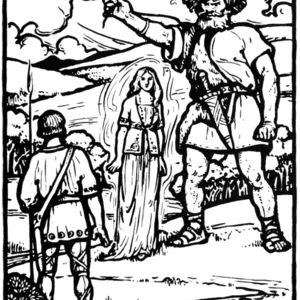

Scáthach is a legendary warrior and weapons master of Irish Celtic mythology. Living on the Isle of Skye, she trains the hero Cú Chulainn in the arts of combat and passes on to him the magical spear Gáe Bolg.
Scáthach
Scáthach
7 min read
Frequently asked questions
Key Facts
- A figure of the Ulster Cycle, a body of Irish mythological tales passed down orally and then written down from the 8th to 12th centuries onward
- Lives in a fortress on the Isle of Skye (Scotland), where she runs a school for warriors
- Trains the hero Cú Chulainn and teaches him her most formidable combat techniques
- Entrusts him with the Gáe Bolg, a magical spear that inflicts deadly wounds
- Opposes her rival warrior Aífe, whom she eventually subdues with the help of Cú Chulainn
Works & Achievements
Scáthach's major achievement: turning the young Sétanta into the greatest champion of Ulster by teaching him the full range of warrior feats.
Giving Cú Chulainn the fearsome spear and the secret of how to wield it, a weapon that would decide his greatest battles, including the duel against Ferdiad.
Mastering and passing on the “high feats,” such as the salmon leap or the thunder feat, spectacular displays unique to Celtic heroes.
Renowned throughout the known world, her school welcomes many warriors, including Ferdiad, brother-in-arms and later opponent of Cú Chulainn.
A prophetic poem in which Scáthach foretells Cú Chulainn's coming battles; one of the oldest literary texts in Ireland.
A clash with the warrior Aífe, ended by Cú Chulainn's victory, which restores peace and, with Aífe, produces a son, Connla.
Anecdotes
The name Scáthach means “the Shadowy One” or “she of the shadows,” and her fortress is called Dún Scáith, the “Fortress of Shadows.” In the Irish tradition, she rules over an island of Alba (present-day Scotland), often identified with the Isle of Skye, where the greatest warriors come to be trained.
According to The Wooing of Emer (Tochmarc Emire), to reach Scáthach's school, Cú Chulainn had to cross the “Bridge of the Cliff”: the moment one set foot on it, its ends would rear up and fling the careless soul into the void. The young hero succeeded only on his fourth attempt, thanks to the “salmon leap” that Scáthach taught her students.
Scáthach reserved a unique teaching for Cú Chulainn: the wielding of the Gáe Bolg, a barbed spear cast with the foot which, once it entered the body, opened up thirty deadly points. None of her other students, not even Ferdiad, received this secret — which would later seal their tragic duel in the Cattle Raid of Cooley.
The weapons-mistress was at war with another warrior-woman, Aífe, portrayed sometimes as her rival, sometimes as her sister. While Cú Chulainn fought Aífe, Scáthach, fearing for her student, is said to have let out a triple cry of anguish — a rare detail in which the implacable warrior lets her worry show through.
Before letting her student depart, Scáthach delivered a long prophecy in verse, the Verba Scáthaige (“The Words of Scáthach”), in which she foretold Cú Chulainn's future battles and the episodes of the great war of the Táin. This poem is considered one of the oldest texts in Irish literature.
Primary Sources
Scáthach then taught Cú Chulainn the great feats of war: the salmon-leap, the thunder-feat, the leap over poison, and finally entrusted him with the Gáe Bolg.
I see a fierce battle where you will stand alone against armies; great slaughter awaits you at the ford, and your name will live until the Judgement.
There was no better master-at-arms than Scáthach in all the East of the world, and it was to her school that all heroes went to learn prowess.
The Gáe Bolg — it was Scáthach who had taught it to Cú Chulainn, and no one else knew how to use it.
Key Places
A Hebridean island traditionally identified as the domain of Scáthach, where she runs her school of martial arts. The heroes of Ireland cross the sea to train there.
Scáthach's citadel, raised on a rock along the Sleat coast on Skye, where the ruins of Dunscaith Castle still survive. It is here that she trains and houses her students.
A magical bridge guarding access to the school: it would rear up beneath the feet of the careless to hurl them into the abyss. Cú Chulainn crossed it only at the cost of the salmon leap.
A neighbouring territory ruled by the warrior Aífe, rival (or sister) of Scáthach. The setting of the combat in which Cú Chulainn confronts and subdues Aífe.
The legendary capital of Ulster and homeland of Cú Chulainn, identified with the site of Navan Fort. It is from here that the hero sets out, and to which he returns, trained by Scáthach, to defend his province.
Typical Objects

A barbed spear that Scáthach passes on to Cú Chulainn alone. Thrown with the foot, often from the water, it enters through a single wound then unfolds many deadly points.

Throwing weapons handled every day at Scáthach's school. They were used to teach precision, speed, and the famous “feats of war” (cleasa).

The close-combat weapon of Celtic warriors. It is by laying his sword on Scáthach's chest that Cú Chulainn, according to the tale, wrests her complete teaching from her.

The fighter's essential protection, at the heart of learning defense. The word sciath echoes the very name of Scáthach and of her fortress.

The emblematic combat vehicle of the heroes of the Celtic Iron Age. Mastering chariot combat was one of the feats taught to Scáthach's students.

More than an object, a physical “feat” taught by Scáthach: a lightning-fast leap that notably allowed crossing the Bridge of the Cliff leading to her school.
School Curriculum
Vocabulary & Tags
Key Vocabulary
Daily Life
Morning
At dawn, Scáthach gathers her students in the courtyard of Dún Scáith for weapons training: handling the spear, the shield, and the sword. The mistress corrects every movement and sets exercises in endurance and agility.
Afternoon
The afternoon is devoted to the most difficult “feats of war,” such as the salmon leap or chariot combat. She also teaches secret techniques, reserving the use of the Gáe Bolg for her best students.
Evening
When evening comes, everyone gathers in the great hall of the fortress around the fire. The warriors feast, listen to tales of past deeds, and receive the prophecies and counsel of their mistress.
Food
Like the warriors of the Celtic Iron Age depicted by tradition, they eat roasted meats — pork, beef — barley or oat cakes, dairy, and hazelnuts. Banquets are washed down with mead and beer.
Clothing
Scáthach is imagined dressed in the Celtic fashion: a linen tunic (*léine*) belted at the waist, a large woolen cloak (*brat*) fastened with a brooch, and a warrior's gear — leather, a sword at her side, and a shield.
Housing
Her dwelling is a *dún*, a fortress of stone and wood perched on a sea-battered rock, far from the world. It is at once a refuge, a defended citadel, and a school of arms.
Historical Timeline
Period Vocabulary
Liens externes & ressources
Références
Œuvres
Formation de Cú Chulainn
Iᵉʳ siècle (cadre légendaire)
Transmission du Gáe Bolg
Iᵉʳ siècle (cadre légendaire)
Enseignement des tours de guerre (cleasa)
Iᵉʳ siècle (cadre légendaire)
Formation de Ferdiad et d'autres héros
Iᵉʳ siècle (cadre légendaire)
Le Verba Scáthaige (prophétie en vers)
VIIᵉ–VIIIᵉ siècle (texte conservé)
Guerre et accord avec Aífe
Iᵉʳ siècle (cadre légendaire)