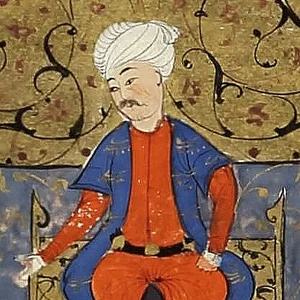

Ottoman sultan from 1512 to 1520, Selim I tripled the size of the Empire by conquering Egypt, Syria, and the Hejaz. Nicknamed “the Grim,” he crushed the Safavids at Chaldiran and made the Ottoman sultan the guardian of Islam’s Holy Sites.
Selim I(1470 — 1520)
Selim I
9 min read
Frequently asked questions
Key Facts
- 1512: ascended to the throne after removing his brothers and his father Bayezid II
- 1514: decisive victory against the Persian Safavids at the Battle of Chaldiran
- 1516–1517: conquest of Syria and Egypt, and defeat of the Mamluks
- 1517: obtained the title of caliph and guardianship of the Holy Sites (Mecca, Medina)
- 1520: died during a military campaign, leaving a considerably enlarged empire to Suleiman the Magnificent
Works & Achievements
After crushing the Safavids, Selim annexed the Kurdish and Turkmen provinces of eastern Anatolia, definitively securing the empire's eastern flank and halting the spread of Shiism into Ottoman territories.
Within months of Marj Dabiq, Selim integrated the entire Mamluk Levant into the Ottoman Empire, inheriting cities such as Aleppo, Damascus, and Jerusalem — major commercial and cultural crossroads of the Islamic world.
The Egyptian campaign, crowned by the victory at Ridaniyya, brought 267 years of Mamluk rule to an end. Egypt, the Mediterranean's breadbasket and hub of trade routes to India, became the Ottoman Empire's wealthiest province.
Without a fight, Selim obtained the submission of the Sharif of Mecca, guardian of the holy cities. The title of “Servant of the Two Holy Places” gave the Ottoman sultans an unprecedented spiritual standing in the Sunni world.
A collection of lyric poems composed in Persian under the pen name “Selîmî”, attesting to the sultan's classical literary education and his attachment to the tradition of the great Islamic courts where poetry and power intertwined.
Following his conquests, Selim established a system of governance for the new Arab provinces based on pashas appointed by Istanbul, incorporating local Mamluk structures to ensure administrative continuity while asserting Ottoman suzerainty.
Anecdotes
Upon his accession to the throne in 1512, Selim I had his two brothers Ahmed and Korkut, as well as his nephews, executed to prevent any war of succession. While this practice of dynastic fratricide was legally regulated within the Ottoman Empire, it earned Selim the reputation of a ruthless ruler, nicknamed 'Yavuz' ('the Grim') in Turkish.
At the Battle of Chaldiran in 1514, Selim made extensive use of artillery and arquebuses against the Safavid cavalry of Shah Ismail I, who refused out of pride to employ these 'diabolical fire' weapons. The Ottoman technological superiority proved decisive: the Safavids were crushed, and the Shah fled, abandoning his camp.
Selim I was a learned man and a poet who composed verse in Persian under the pen name 'Selîmî'. He corresponded in Persian with his Safavid enemies and maintained a cultivated court; this paradox between his political brutality and his artistic sensibility fascinated his contemporaries.
Following the conquest of Egypt in 1517, Selim had the most sacred relics of Islam transferred to Constantinople, including the Prophet Muhammad's cloak and sword, which had been preserved in Cairo for centuries. These relics, housed in the 'Chamber of Sacred Relics' (Hırka-i Saadet) of Topkapi Palace, considerably enhanced the spiritual prestige of the Ottoman sultans.
According to chroniclers of the era, Selim I was renowned for his speed of maneuver: he is said to have led his army of more than 60,000 men from Constantinople to Egypt in less than five months, crossing Anatolia, Syria, and the Sinai. This swiftness disconcerted his adversaries and was one of the keys to his spectacular successes.
Primary Sources
Ibn Iyas, an Egyptian chronicler and direct eyewitness to the Ottoman conquest, describes Selim's entry into Cairo: “The sultan went to the citadel... he had Sultan Tuman Bay brought before him in chains... and ordered him to be hanged at the Zuweila Gate.”
Court historian Kemal Paşazâde recounts the victory at Chaldiran: “The Shah's army, lacking cannons and arquebuses, could not withstand the power of Ottoman firepower. The Shah fled, leaving the camp in the hands of the victorious sultan.”
This literary genre, of which several versions exist, recounts the campaigns of Selim I. One of them notes: “In eight years of reign, the Padishah accomplished what no sultan had achieved in a century, tripling the empire's lands.”
Selim I composed in Persian under the name ‘Selîmî’: “I am the sultan of sultans of East and West... my pen and my sword are one, for poetry and war are the two faces of power.”
The Venetian ambassadors regularly informed their government of Ottoman power: “This sultan is of a cruel and unpredictable nature... in eight years he has added more lands to his empire than his predecessors did in fifty.”
Key Places
City on the Pontic coast of Anatolia where Selim was born around 1470 and served as governor before seizing the throne. It was there that he built his military reputation and prepared his forces to challenge his father Bayezid II.
Capital of the Ottoman Empire where Selim resided at Topkapi Palace. It was here that he received the relics of the Prophet brought back from Egypt and governed an empire now stretching from Anatolia to the Arab Near East.
Site of the decisive battle of August 23, 1514, in eastern Anatolia, where Selim crushed the Safavids of Shah Ismail I with his artillery. This victory halted the Shia expansion westward and permanently fixed the Ottoman-Safavid border.
Capital of the Mamluk Sultanate, conquered by Selim in 1517 following the Battle of Ridaniyya. He had the last Mamluk sultan Tuman Bay hanged there and transformed Egypt into an Ottoman province, seizing the country's trade routes and riches.
Holy city of Islam whose protection Selim secured in 1517 after the submission of the Sharif of Mecca. The title of "Servant of the Two Holy Places" (Khadim al-Haramayn) conferred considerable spiritual legitimacy on the Ottoman sultans throughout the Sunni world.
Plain in northern Syria, near Aleppo, where on August 24, 1516, the battle that broke Mamluk power took place. The death of Sultan Qânsûh al-Ghawrî on the battlefield opened the road to Syria, Lebanon, Palestine, and Egypt for Selim.
Liens externes & ressources
Références
Œuvres
Victoire de Tchaldiran et annexion de l'Anatolie orientale
1514
Conquête de la Syrie, du Liban et de la Palestine
1516
Conquête de l'Égypte et fin du sultanat mamelouk
1517
Protection du Hedjaz et des Lieux Saints de l'islam
1517
Divan poétique en persan (Selîmî)
vers 1510-1520
Réorganisation administrative des provinces arabes
1517-1520