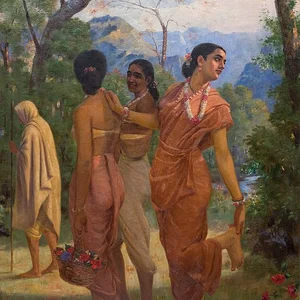

Shakuntala is a heroine of Hindu mythology, the daughter of the ascetic Vishvamitra and the apsara Menaka. Raised in a hermitage, she marries King Dushyanta and becomes the mother of Bharata, the eponymous ancestor of the dynasty that gave India its name. Her story, told in the Mahabharata, was immortalized by the playwright Kalidasa.
Shakuntala
Shakuntala
6 min read
Frequently asked questions
Key Facts
- A character from the Mahabharata, the great Sanskrit epic (compiled between the 4th century BCE and the 4th century CE)
- Heroine of the play 'Abhijnanashakuntalam' (The Recognition of Shakuntala) by the poet Kalidasa, around the 5th century
- Mother of the emperor Bharata, whose name designates India (Bharat) in Hindi
- The legend inspired the sculptural group 'Sakountala' by Camille Claudel (1888)
- A tale centered on forgetting caused by a curse and on recognition thanks to a royal ring
Works & Achievements
The original epic version of the legend, in which Shakuntala forcefully defends her own rights as wife and mother before the court, asserting the legitimacy of her son.
Shakuntala gives birth to Bharata, a model ruler whose Bharata dynasty dominates the epic; his name still designates India today (“Bhārat”).
A drama in seven acts regarded as the pinnacle of Sanskrit theater, which reinvents the legend around a curse, forgetfulness, and the recovered ring.
Thanks to the translations by William Jones and later Chézy, the figure of Shakuntala inspired German and French Romanticism and came to symbolize the discovery of Indian literature.
Anecdotes
According to the Mahabharata, Shakuntala was born from the union of the ascetic Vishvamitra and the apsara Menaka, a celestial nymph sent by the gods to break the sage's austerities. Abandoned at birth, she was protected by birds called “shakunta,” which gave her her name: “the one who is surrounded by birds.”
King Dushyanta, out hunting, discovers Shakuntala in the hermitage of the sage Kanva and marries her according to the “gandharva” rite, a marriage by mutual consent with neither ceremony nor witness. Before leaving, he gives her a royal ring as a token of their union.
In Kalidasa's play, the irascible sage Durvasa curses Shakuntala because she failed to welcome him, lost as she was in her romantic daydreams: the man she loves will forget her, unless he sees again an object of recognition. It is this device that turns the legend into a drama of forgetting and remembrance.
Dushyanta's ring, lost by Shakuntala in a river, is swallowed by a fish. Later found by a fisherman in the fish's belly and brought back to the king, it abruptly restores his memory of his wife: this motif of the recovered ring is one of the most famous in classical Indian theatre.
Shakuntala's son, Bharata, is described as a child so strong that he amused himself by counting the teeth of lion cubs. The eponymous ancestor of the Bharata dynasty, he gave his name to the country: “Bhārat” remains today the official name of India in Hindi and Sanskrit.
Primary Sources
Because she was surrounded (abhitah) by shakunta birds, she was named Shakuntala by the sages of the forest.
What we behold with affection, the soul keeps as an imprint; when we no longer recognize it, it is because the memory lies dormant, veiled by a forgotten fault.
A translation of Kalidasa's play that first revealed Sanskrit theatre to Europe and won the admiration of Goethe and Herder.
Key Places
Forest ashram at the foot of the Himalayas where Shakuntala is taken in and raised by the sage Kanva. The peaceful setting of her childhood and of her meeting with Dushyanta.
Royal city of the Kuru dynasty, on the Ganges, where Shakuntala goes to claim her place as queen and where the king, struck with forgetfulness, finally recognizes her.
Wild realm of the apsaras, sages, and animals, the scene of Vishvamitra's austerities and the mythical setting of Shakuntala's birth.
Mythical abode of the sage Kashyapa and his wife Aditi, in the celestial regions, where Shakuntala lives in seclusion and raises her son Bharata after her rejection, until the final reunion.
Typical Objects

A royal ring engraved with the king's name, given to Shakuntala as a token of love. Lost and then found in the belly of a fish, it triggers the return of the king's memory.

A garment of beaten bark worn by ascetics and by young women raised in forest hermitages. Shakuntala wears it before her departure for the royal court.

The vessel with which Shakuntala waters the young shoots and trees of the hermitage, a gesture that opens Kalidasa's play and illustrates her tender bond with nature.

The king's hunting weapons, with which he pursues a gazelle to the edge of the hermitage where he meets Shakuntala. The ascetics stop him in the name of the non-violence owed to the animals of the sacred place.

In the play, Shakuntala scratches a message of love onto a lotus leaf with her fingernail to express her feelings to the king. A poetic object typical of the sensibility of the Sanskrit court.

An ornament of wildflowers woven by Shakuntala and her companions in the hermitage. It symbolizes youth, innocence, and union with nature.
School Curriculum
Vocabulary & Tags
Key Vocabulary
Daily Life
Morning
Raised at the hermitage, Shakuntala begins the day with the rites of dawn: ablutions in the river Malini and offerings to the sacred fire. She then waters the young trees and the plants of the ashram, which she treats as companions.
Afternoon
The afternoon is spent gathering wild flowers and fruits with her friends Anasuya and Priyamvada, weaving garlands, and caring for the hermitage's tame animals, such as the young gazelle she has raised.
Evening
At dusk, the hermitage community gathers around the sages for evening prayers and the tending of the fire. Shakuntala listens to recitations of the Vedas and stories of the gods before an early rest.
Food
The diet of the hermitages is vegetarian and frugal: rice, wild fruits, roots, honey, and milk from the sacred cows. Meat is avoided out of respect for non-violence (ahimsa) toward living beings.
Clothing
Like the women of the hermitages, Shakuntala wears simple garments of bark or undyed cotton, without precious jewels. At court, she dons fine fabrics and adornments of gold and flowers worthy of a queen.
Housing
She lives in a hermitage hut made of wood, foliage, and thatch, open to the forest. These secluded ashrams blend rustic dwellings, gardens, fire altars, and enclosures for the animals.
Historical Timeline
Period Vocabulary
Liens externes & ressources
Références
Œuvres
Épisode de Shakuntala dans le Mahabharata (Adi Parva)
vers IVe s. av. J.-C. – IVe s. apr. J.-C.
Naissance de Bharata, ancêtre de l'Inde
temps mythiques
Abhijnanashakuntalam de Kalidasa
vers le Ve siècle apr. J.-C.
Diffusion européenne de Shakuntala
1789-1832