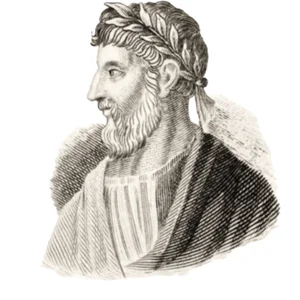

Apollonius of Rhodes was a Greek poet and grammarian of the 3rd century BC, a major figure of Hellenistic literature. He directed the famous Library of Alexandria and composed the Argonautica, a great epic recounting the quest for the Golden Fleece by Jason and the Argonauts.
Apollonius of Rhodes(294 av. J.-C. — 214 av. J.-C.)
Apollonius of Rhodes
5 min read
Frequently asked questions
Key Facts
- Born around 295 BC, probably in Alexandria or Naucratis
- Author of the Argonautica, an epic in four books on the quest for the Golden Fleece
- Directed the Library of Alexandria in the 3rd century BC
- Incorporates Circe into the Argonautica as the priestess who purifies Jason and Medea after the murder of Apsyrtus
- His literary rivalry with Callimachus illustrates the poetic debates of the Hellenistic era
Works & Achievements
Epic poem in four books recounting the quest for the Golden Fleece by Jason and the Argonauts. The only major Hellenistic epic preserved in its entirety, it influenced Virgil and all of Latin poetry.
Poem on the legendary origin of the city of Alexandria, now lost and known only through ancient references.
Foundation poem (ktisis) devoted to the origins of the city of Naucratis, of which only fragments survive.
Another aetiological poem on the founding of a Greek city, now lost, attesting to his taste for learned poetry.
Works of philological scholarship, including writings against the grammarians, reflecting his role as librarian and Alexandrian scholar.
Anecdotes
Apollonius reportedly presented an early version of the *Argonautica* while he was still very young. The reception was so cold that he left Alexandria, humiliated, and took refuge in Rhodes — hence his nickname “of Rhodes.”
On Rhodes, he is said to have reworked his epic and finally found success, to the point that the city granted him citizenship and great honors. This is why posterity has permanently associated him with that island rather than with Alexandria or his native Naucratis.
Apollonius was one of the directors of the prestigious Library of Alexandria, succeeding Zenodotus. He thus had in his care one of the greatest collections of manuscripts in the ancient world.
A fierce literary quarrel is said to have set him against the poet Callimachus, his former teacher. Callimachus championed short, refined poems, while Apollonius dared to revive the long epic in the manner of Homer.
In the *Argonautica*, Apollonius gives a central place to Medea's love for Jason, analyzing her inner turmoil with a new psychological subtlety — an innovation that would later inspire the Latin poet Virgil for his Dido.
Primary Sources
Beginning with you, Phoebus, I shall recall the deeds of those heroes of old who, aboard the ship Argo, passed through the mouth of the Pontus and the Cyanean Rocks, and went, at the command of King Pelias, to fetch the Golden Fleece.
A cruel fire burned in secret within the maiden's heart; ceaselessly her mind flew toward Jason, and her whole being languished with a sweet torment.
Apollonius, of Alexandria, epic poet, who lived in Rhodes; son of Silleus or Illeus, in the time of Ptolemy Euergetes; disciple of Callimachus.
Key Places
Capital of the Ptolemies and a great intellectual center, home to the Library and the Museum that Apollonius directed.
The largest collection of manuscripts in the ancient world, attached to the Museum. Apollonius served there as chief librarian.
A flourishing Greek island in the Aegean where Apollonius retired, taught rhetoric, and was granted citizenship, earning him his nickname.
A Greek city in the Nile Delta, sometimes given as Apollonius's birthplace by ancient sources.
Typical Objects

A rolled writing surface on which poems and treatises were copied. The *Argonautica* filled several scrolls kept at the Library.

A cut reed used as a pen, dipped in black soot-based ink. The everyday tool of the poet and the grammarian.

The hide of the winged ram Chrysomallos, guarded by a dragon in Colchis. The object of the Argonauts' quest at the heart of Apollonius's epic.

The instrument of the poet Orpheus, taken aboard the Argo. His song calmed the waves and drowned out that of the Sirens to save the crew.

A legendary vessel built for the quest of the Golden Fleece, fitted with a prophetic beam cut from the sacred oak of Dodona.

Tablets or registers listing the works of the Library of Alexandria. The head librarian oversaw their upkeep.
School Curriculum
Vocabulary & Tags
Key Vocabulary
Tags
Daily Life
Morning
At daybreak, the scholar makes his way to the Museum of Alexandria, that sanctuary of the Muses where the men of letters supported by the king live and work. He consults the scrolls, supervises the copyists, and discusses the lessons of Homer with his colleagues.
Afternoon
The afternoon is divided between reading, composing his verses, and managing the Library: checking acquisitions, classifying manuscripts, settling disputes over attribution. Epic poetry demands meticulous work, verse after verse.
Evening
In the evening, he may take part in a banquet (symposion) where poems are recited and literature debated. Rivalries run high there, especially with the school of Callimachus, an advocate of brevity.
Food
The Greek diet in Egypt is based on wheat bread, olive oil, olives, fish from the Nile and the sea, vegetables, and fruit. Wine diluted with water accompanies meals, and above all the evening banquets.
Clothing
Like the Greek men of letters, he wears the linen tunic (chiton) and, over it, the draped cloak (himation) that marks his status. Sandals and a well-groomed beard complete the look of the philosopher and poet.
Housing
He lodges in the royal quarter of the Brucheion, near the palace and the Museum, in buildings set aside for scholars. Houses of stone and mud brick, organized around courtyards, with porticoes and shared study rooms.
Historical Timeline
Period Vocabulary
Liens externes & ressources
Références
Œuvres
Les Argonautiques
IIIe siècle av. J.-C.
Fondation d'Alexandrie (Ktisis)
IIIe siècle av. J.-C.
Fondation de Naucratis
IIIe siècle av. J.-C.
Fondation de Cnide
IIIe siècle av. J.-C.
Écrits grammaticaux et critiques sur Homère et Hésiode
IIIe siècle av. J.-C.