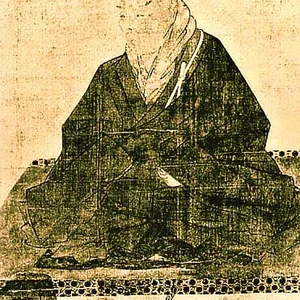

Shinran was a Japanese Buddhist monk of the Kamakura period and a disciple of Hōnen. He founded Jōdo Shinshū, the "True Pure Land School," which teaches salvation through faith alone in the Buddha Amida.
Shinran(1173 — 1263)
Shinran
Japon
6 min read
Frequently asked questions
Key Facts
- Born in 1173 near Kyoto, he entered the monastery on Mount Hiei at a very young age
- Around 1201, he became a disciple of Hōnen, master of the Pure Land school
- In 1207, he was exiled following the suppression of the Amidist movement
- He wrote the Kyōgyōshinshō, his major work setting out his doctrine of salvation through faith
- He died in 1263 and is regarded as the founder of Jōdo Shinshū, a Buddhist tradition still widespread in Japan today
Works & Achievements
Shinran's masterwork, a vast annotated anthology that doctrinally grounds **Jōdo Shinshū** in teaching, practice, faith, and realization.
The birth of the “True Pure Land School,” which became one of the largest branches of Japanese Buddhism.
A collection of hymns in Japanese on the three ages of the Dharma, making the doctrine accessible to ordinary people.
Series of hymns in the vernacular praising the Pure Land and the great masters of the tradition.
An explanatory commentary in which Shinran clarifies the meaning of single-hearted faith in **Amida** for his disciples.
A collection of his sayings compiled after his death by the disciple Yuien, which became a spiritual classic of Japan.
Anecdotes
Around 1201, while doubting his own path, Shinran is said to have withdrawn for a hundred days to the Rokkaku-dō temple in Kyoto. A vision of the bodhisattva Kannon supposedly prompted him to become a disciple of Master Hōnen, founder of Pure Land Buddhism in Japan.
In 1207, the imperial authorities banned Hōnen's teaching. Shinran was forcibly stripped of his monastic status and exiled to the distant province of Echigo, on the shore of the Sea of Japan. He then took the name “Gutoku,” meaning “the shaven-headed fool,” to signify that he was neither truly a monk nor truly a layman.
Shinran caused a scandal by openly marrying Eshinni and starting a family, at a time when Japanese Buddhist monks were expected to remain celibate. For him, salvation through faith in Amida depended neither on monastic rules nor on personal merit.
For some twenty years, Shinran preached to the peasants, fishermen, and hunters of the rural eastern provinces of Japan — despised people who were thought incapable of salvation. On the contrary, he affirmed that it was precisely these “sinners” whom Amida wished to save first.
One of his most famous sayings, recorded in the Tannishō, turns common sense on its head: “Even a good person attains rebirth in the Pure Land, how much more so an evil person.” According to him, the person who believes himself virtuous relies too heavily on his own strength.
Primary Sources
Reverently meditating on the establishment of the true Pure Land, I see that its cause is the original power of Amida Buddha, and that its fulfillment springs from his great compassion.
Even a good person attains rebirth in the Pure Land, so it goes without saying for an evil person.
He confined his heart to practice at the Rokkaku-dō for a hundred days, praying for the life to come, and he went to listen to Hōnen Shōnin for a hundred days as well.
Although I take refuge in the true Pure Land, it is hard for me to possess a true heart; this self is false and insincere, and I have not the least mind of purity.
Key Places
Traditional birthplace of Shinran, into a family of minor nobility connected to the Fujiwara.
Great Tendai monastery overlooking Kyoto, where Shinran studies and practices for some twenty years before leaving it, disillusioned.
Temple where Shinran undertakes a hundred-day retreat in 1201 and receives the vision that leads him to Hōnen.
Remote coastal region where Shinran is exiled in 1207; there he lives, marries and begins preaching to the common people.
Rural eastern Japan where Shinran preaches for about twenty years and composes the Kyōgyōshinshō.
Imperial capital where Shinran returns around 1234 and dies in 1263; his mausoleum would become the great temple Hongan-ji.
Typical Objects

A string of beads used to count invocations of Amida's name. In Jōdo Shinshū, it becomes above all a sign of respect and gratitude rather than a counting tool.

The nenbutsu formula, “Homage to Amida Buddha,” calligraphed and venerated as a central object of worship. Shinran makes it the absolute heart of the practice.

A sacred text (such as the Larger Sutra of Immeasurable Life) describing Amida's vows and his Pure Land of the West. From it Shinran drew the foundations of his doctrine.

A depiction of Amida, often standing to welcome the faithful, placed at the center of Pure Land sanctuaries. It represents the Buddha who comes to receive the believer's soul.

The Buddhist monk's garment, made of sewn strips of cloth. Shinran wears it but defines himself as “neither monk nor layman,” blurring the usual meaning of this garment.

Calligraphy instruments with which Shinran wrote his great treatises and his hymns (wasan) in Japanese. They served to spread his thought beyond the scholars who read Chinese.
School Curriculum
Vocabulary & Tags
Key Vocabulary
Daily Life
Morning
After waking, Shinran turns toward the image of Amida and recites the nenbutsu, not to earn merit but out of gratitude. During his years of exile and itinerant work, his mornings blend devotion with the ordinary tasks of village life.
Afternoon
The afternoon is devoted to studying the sutras and to writing his treatises and hymns, often in plain Japanese so that ordinary people could understand them. He also receives the peasants and fishermen who come to listen to him or ask questions about salvation.
Evening
In the evening, Shinran teaches in small circles, explaining that faith is a gift from Amida and not a human effort. He takes his meals with his wife Eshinni and their children, leading a family life rare for a religious figure.
Food
Like the monks, he favors frugal, largely vegetarian fare: rice, vegetables, miso soup, pickled vegetables. But living among hunters and fishermen, he refuses to condemn those who eat meat and fish to survive.
Clothing
He wears the dark robe and the kesa of the Buddhist monk, yet presents himself as “Gutoku,” neither monk nor layman. His plain attire reflects his rejection of religious prestige and his closeness to common folk.
Housing
Far from the wealthy monasteries, Shinran lives in modest dwellings: a house of exile in Echigo, country homes in the Kantō, a simple lodging in Kyoto. The first places of worship of his school are plain meeting halls (dōjō) in the homes of the faithful.
Historical Timeline
Period Vocabulary
Liens externes & ressources
Références
Œuvres
Kyōgyōshinshō
vers 1224-1247
Fondation du Jōdo Shinshū
vers 1224
Shōzōmatsu wasan
1257
Jōdo wasan et Kōsō wasan
vers 1248
Yuishinshō mon'i
1250 et révisions
Tannishō (transmission posthume)
vers 1290