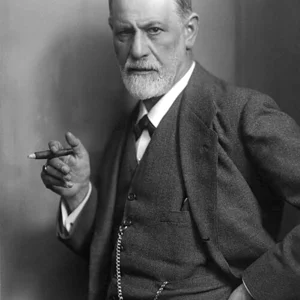

Austrian neurologist and psychoanalyst (1856-1939), founder of psychoanalysis. Freud developed a revolutionary theory of the unconscious and the psychological mechanisms governing human behavior, profoundly influencing modern psychology, psychiatry, and philosophy.
Frequently asked questions
Famous Quotes
« Dreams are the royal road to the unconscious.»
« The unconscious is universal — permanent, immovable, warm, and alive.»
« Man cannot bear too much reality; he needs a little dream.»
Key Facts
- 1885-1886: Freud studies in Paris under Jean-Martin Charcot, a specialist in hysteria
- 1900: Publication of 'The Interpretation of Dreams' (Die Traumdeutung), the founding work of psychoanalysis
- 1905: Publication of 'Three Essays on the Theory of Sexuality', theorizing the stages of psychosexual development
- 1923: Development of the tripartite model of the psyche (id, ego, superego)
- 1938: Freud flees Nazi-occupied Austria and settles in London
Works & Achievements
A foundational work in which Freud presents his theory of the unconscious through dream analysis, viewing dreams as expressions of repressed desires. This book laid the foundations of modern psychoanalysis.
An essay demonstrating that slips of the tongue, parapraxes, and forgetting are not random but reveal the workings of the unconscious. Freud applies psychoanalysis to ordinary everyday behavior.
A landmark work presenting the psychosexual development of the child and its various phases (oral, anal, phallic). This revolutionary account sparked fierce controversy.
The founding text of Freud's second topography, structuring the psyche into three agencies: the Id, the Ego, and the Superego. This theory remains central to contemporary psychoanalysis.
A philosophical essay in which Freud analyzes the tensions between individual drives and the demands of civilization, exploring the sources of psychic conflict inherent in society.
A work introducing the concept of the death drive and questioning human motivations beyond the simple pleasure principle, enriching psychoanalytic theory.
Sets out the fundamental technique of psychoanalysis based on free association and the analysis of transference. This method became the therapeutic framework of psychoanalytic practice.
Anecdotes
In 1885, Freud traveled to Paris to study under the renowned neurologist Jean-Martin Charcot at the Salpêtrière hospital. This experience transformed his career: he discovered that hypnosis could relieve the symptoms of hysteria, which gradually led him to abandon classical neurology in favor of exploring the human mind. His encounter with Charcot marked the beginning of his interest in the unconscious.
Freud smoked around 20 cigars a day for most of his life, despite repeated medical warnings about the dangers of tobacco. In 1923, he was diagnosed with jaw cancer linked to his smoking habit, yet he refused to quit entirely, claiming that cigars helped him think. This addiction highlights the complexity of the man — someone who, despite his insights into the human psyche, was unable to overcome his own dependency.
Freud stumbled upon the psychoanalytic couch technique almost by accident: he asked his patients to lie down to help them relax during sessions, and noticed that they revealed far more intimate information in that position. This setup quickly became the symbol of psychoanalysis and is still used by psychoanalysts to this day.
In 1909, Freud was invited to the United States by Clark University to deliver lectures on psychoanalysis — a major milestone of international recognition for his theories. The trip marked the worldwide spread of his ideas, even as psychoanalysis remained controversial in the scientific community for many years.
Freud fled Austria in 1938 following Hitler's rise to power and the Nazi annexation of the country. His books were burned by the Nazis, who condemned his theories as degenerate. At the age of 82, he went into exile in England, where he died a year later in 1939, far from his homeland.
Primary Sources
Dreams are the royal road to knowledge of the unconscious. In dreams, repressed desires find a disguised expression, and the analysis of these manifestations allows us to access the deeper layers of the psyche.
Infantile sexuality exists and manifests itself from the earliest years of life. It does not begin at puberty, but passes through several phases of psychosexual development upon which the psychological balance of the adult depends.
Within mental life there exists a death drive that opposes the pleasure principle and the drive toward life. This compulsion to repeat pushes individuals to relive traumatic experiences.
Civilization imposes considerable instinctual sacrifices on human beings, giving rise to deep guilt and a fundamental sense of unease. The price of social progress is paid through the renunciation of instinctual satisfactions.
Key Places
Sigmund Freud's birthplace in Moravia (present-day Czech Republic). Freud was born there on May 6, 1856, into a Jewish family — a formative experience for his personal and intellectual development.
The Austrian capital where Freud spent most of his professional life (1860–1938). It was in Vienna that he developed psychoanalysis, established his medical practice, and wrote his major theoretical works.
The institution where Freud studied medicine (1873–1881) and conducted neurological research. The university was central to his scientific training and his entry into the academic community.
The institution where Freud worked and made his earliest observations on hysteria and the unconscious. These clinical experiences laid the groundwork for psychoanalytic theory.
The city where Freud went into exile in 1938 to escape the Nazi regime. He spent the final months of his life there, publishing his last works before his death in 1939.
A region where Freud often spent his holidays and pursued archaeological interests. These retreats influenced his theoretical development and personal reflections.
Typical Objects

The iconic piece of furniture in Freud's consulting room where patients would lie down during analytic treatment. The couch has become the defining symbol of psychoanalysis and the Freudian therapeutic relationship.

Freud meticulously recorded his patients' observations and words in order to analyze the unconscious. These notebooks formed the empirical foundation of his psychoanalytic theories.

Freud was a passionate cigar smoker throughout his life. This personal object became emblematic of his public image and his Viennese intellectual world.

Published in 1900, this landmark work by Freud lays out his theory of the unconscious through the analysis of dreams. It is the founding text of modern psychoanalysis.

A medical instrument Freud used as a neurologist before developing psychoanalysis. It represents his early years in clinical medicine in Vienna.

Comprising thousands of volumes, it reflects Freud's vast learning in neurology, philosophy, and the humanities — knowledge that fed directly into his psychoanalytic thought.

Freud's famous consulting room in Vienna, where he saw patients and developed the foundations of psychoanalysis from 1891 to 1938.

Freud collected Greco-Roman and Egyptian antiquities that decorated his consulting room. These objects reflected his deep interest in archaeology and the history of civilization.
School Curriculum
Vocabulary & Tags
Key Vocabulary
Daily Life
Morning
Freud rises early, around 7-8 a.m., in his Viennese apartment. After a light breakfast, he gets ready carefully before heading to his consulting room, located close to his home. He begins seeing patients by late morning.
Afternoon
The afternoon is devoted to consultations and patient analyses, typically from 1 p.m. to 7 p.m., with brief breaks in between. Freud takes detailed notes on his clinical observations and the dreams reported by his patients — the raw material of his theoretical thinking.
Evening
In the evening, after dinner with his family, Freud retreats to his study for reading, writing, and scientific correspondence. He regularly smokes cigars while working and exchanges letters with fellow psychoanalysts across Europe, most notably Jung and Adler.
Food
Freud follows a typical Viennese middle-class diet of the late 19th and early 20th centuries: a light breakfast, a hearty midday lunch, and a lighter dinner in the evening. He drinks coffee and tea and enjoys the dishes of Austro-Hungarian cuisine.
Clothing
Dressed in the bourgeois fashion of the Victorian-Edwardian era, Freud wears dark three-piece suits, ties, and formal waistcoats. He maintains a neat, professional appearance, complete with round glasses and carefully combed hair.
Housing
Freud lives in a spacious middle-class apartment at 19 Berggasse in Vienna, a prosperous neighborhood popular with well-to-do professionals. His home combines family living quarters with a medical practice, and houses an impressive collection of antiques and archaeological artifacts that he collects with great passion.
Historical Timeline
Period Vocabulary
Visual Style
Un style Art Nouveau viennois des années 1900 caractérisé par des tons chauds sépia-dorés, des contrastes d'ombres soulignant l'introspection psychologique, et des motifs ornementaux entrelacés symbolisant les strates de l'inconscient. Une esthétique à mi-chemin entre le médical scientifique et l'expression surréaliste.
Sound Ambience
Une atmosphère sonore immersive du cabinet de Freud à Vienne : le confort studieux du XIXe siècle avec la rigueur scientifique d'une époque de révolution psychologique, mêlant l'intimité du travail intellectuel aux bruits discrets de la Vienne bourgeoise.
Liens externes & ressources
Références
Œuvres
L'Interprétation des rêves (Die Traumdeutung)
1900
Psychopathologie de la vie quotidienne
1901
Trois essais sur la théorie de la sexualité
1905
Le Moi et le Ça (Das Ich und das Es)
1923
Malaise dans la civilisation (Das Unbehagen in der Kultur)
1930
Au-delà du principe de plaisir (Jenseits des Lustprinzips)
1920
La Méthode psychanalytique
1904