
In Norse mythology, Sleipnir is the eight-legged horse of the god Odin, considered the best of all horses. Born of the god Loki transformed into a mare, he carries his master across the nine worlds, over land, over sea, and through the air.
Sleipnir
Sleipnir
6 min read
Frequently asked questions
Famous Quotes
« “Sleipnir is the best of horses” (Poetic Edda, Grímnismál)»
Key Facts
- Born of Loki, transformed into a mare, and the stallion Svaðilfari, according to Snorri Sturluson's Edda
- Has eight legs, which makes him the swiftest steed in Norse mythology
- Serves as the mount of the god Odin, able to cross land, sea, and sky
- The god Hermóðr rides him down to the realm of the dead (Hel) in an attempt to bring back Baldr
- Described in the Poetic Edda and the Prose Edda of Snorri Sturluson (13th century)
Works & Achievements
The founding episode in which Loki, transformed into a mare, gives birth to the eight-legged foal. It explains the extraordinary origin of the gods' finest steed.
Sleipnir carries the messenger of the gods to the realm of the dead and clears its gate in a single bound. This is the horse's most famous feat.
The poems present Sleipnir as able to carry Odin over land, over sea, and through the air, making him the symbol of travel between the worlds.
A carved work from Gotland depicting an eight-legged horse. It proves how ancient the image of Sleipnir is in Norse art.
Snorri Sturluson's text sets down in writing the appearance and history of Sleipnir. It is the most complete literary source on the horse.
The horse's name has been adopted for ships, a Norwegian gas field, and software. Sleipnir remains a living emblem of Scandinavian culture.
Anecdotes
Sleipnir has a very strange birth: to prevent a giant builder from finishing the walls of Asgard too quickly, the god Loki turns himself into a mare and lures away the giant's stallion, Svaðilfari. Some time later, Loki gives birth to a grey, eight-legged foal: this is how Sleipnir is born, one of the rare cases in mythology where a male god gives birth.
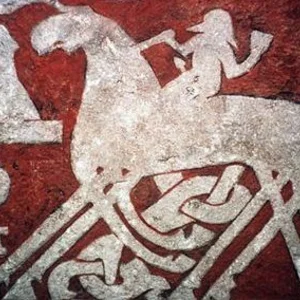
His most famous feature is that he has eight legs, making him the fastest horse in the nine worlds. An eight-legged horse can be found carved on Scandinavian stones such as the Tjängvide stone, on the Swedish island of Gotland (8th-9th century), proof that this image circulated long before it was written down.
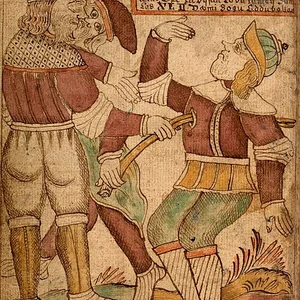
After the death of the god Baldr, it is Sleipnir who is chosen for the most dangerous mission: the messenger Hermóðr rides him and gallops for nine nights through dark valleys to the realm of the dead. Before the gate of Hel, Sleipnir gathers his momentum and leaps over it with a bound so powerful that he does not even touch it.
In the poem Grímnismál, Sleipnir is named “the best of horses,” just as Odin is the best of gods, the ash tree Yggdrasil the best of trees, and Bifröst the best of bridges. Being the “best” of one's category was a typically Norse way of ranking the world.
Sleipnir is not just a fast horse: according to the poem Sigrdrífumál, magical runes were said to have been carved on his teeth. The horse thus becomes a vessel of secret knowledge, able to carry Odin over land, over sea, and through the air, between the nine worlds.
Primary Sources
Loki had had such dealings with Svaðilfari that some time later he gave birth to a foal. It was grey and had eight legs; it is the best horse among gods and men.
Just as the ash Yggdrasil is the foremost of trees and Skíðblaðnir the foremost of ships, Odin the foremost of the Æsir, so Sleipnir is the foremost of horses.
Hermóðr rode for nine nights through valleys so deep and so dark that he could see nothing; then Sleipnir leapt over the gate with such force that he never touched it.
Runes were carved in many secret places — and some were also carved on Sleipnir's teeth.
Key Places
Fortified domain of the Æsir gods and home of Odin, where Sleipnir lives. It was to build its ramparts that a giant brought the stallion from which the horse would be born.
Blazing bridge linking Asgard to the world of men. Sleipnir, a mount able to cross every realm, is associated with these journeys between the worlds.
Underground world of the dead, guarded by a formidable gate. Sleipnir carries Hermóðr there and clears the gate in a single leap in the attempt to bring back Baldr.
Land of the giants from which comes Svaðilfari, the building giant's stallion and father of Sleipnir. It lies at the heart of the tale of his birth.
Island in the Baltic Sea where the picture stones depicting an eight-legged horse were found. It preserves the archaeological memory of Sleipnir.
Typical Objects

According to the poem Baldrs draumar, Odin himself places the saddle on Sleipnir before riding toward the realm of the dead. It symbolizes the bond between the god and his mount.

The harness by which Odin guides Sleipnir across land, sea, and air. It recalls the very real equipment of horses in the Viking age.

The Sigrdrífumál states that magic runes were carved on the horse's teeth. They make Sleipnir a bearer of secret knowledge and power.

A Swedish carved stone from the 8th-9th century showing a rider welcomed into a great hall, mounted on an eight-legged horse. It is one of the oldest identified depictions of Sleipnir.

Another carved stone from Gotland depicting mythological scenes, including an eight-legged horse. These stones attest to the spread of Sleipnir's image before the Eddas were written down.
School Curriculum
Vocabulary & Tags
Key Vocabulary
Daily Life
Morning
In the tales, Sleipnir waits in Asgard, ready to serve Odin. In the morning, the god comes to saddle him himself before setting off to roam the worlds, observing humankind and seeking wisdom.
Afternoon
The afternoon is the time for great journeys: Sleipnir gallops over dry land, runs across the sea and crosses the skies without ever tiring. No obstacle — neither mountain nor gate — can stop him.
Evening
In the evening, the horse returns toward the great hall of the gods. According to the carved stones of Gotland, one imagines him bringing Odin back to the threshold of Valhalla, where the warriors await.
Food
Like any horse, Sleipnir feeds on grass, hay and grain; in the Viking age, the finest horses were given oats and barley. But as the horse of the gods, his vigor never runs out.
Clothing
Sleipnir mainly “wears” his harness: a saddle set upon him by Odin, a bit and reins. The picture stones show him richly equipped, just as the horses of Scandinavian chieftains were.
Housing
His home is Asgard, the city of the Æsir gods. In the Viking age, prized horses lived in stables near the master's great house, and some were even buried with their owner.
Historical Timeline
Period Vocabulary
Liens externes & ressources
Références
Œuvres
La naissance de Sleipnir, fils de Loki
récit de la Gylfaginning, vers 1220
La chevauchée d'Hermóðr vers Hel
récit de la Gylfaginning, vers 1220
Sleipnir, monture des neuf mondes
tradition de l'Edda poétique
Pierre image de Tjängvide
VIIIe-IXe siècle
Description dans l'Edda de Snorri
vers 1220
Héritage moderne du nom Sleipnir
XXe-XXIe siècle