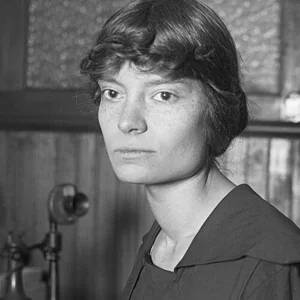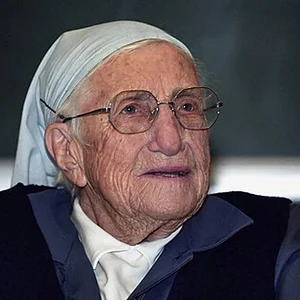

Franco-Belgian nun of the Congregation of Our Lady of Sion, famous for her humanitarian work among the rag-pickers of Cairo. A popular figure of solidarity, she founded the Asmae association to help the most destitute.
Sister Emmanuelle(1908 — 2008)
Sister Emmanuelle
Belgique, Égypte, France
5 min read
Frequently asked questions
Famous Quotes
« Yalla!»
Key Facts
- Born on 16 November 1908 in Brussels under the name Madeleine Cinquin
- Entered the Congregation of Our Lady of Sion in 1931 and taught for several decades in the Near East
- Settled in 1971 in the shantytown of the Cairo rag-pickers to share their life
- Founded the Asmae association in 1980 to help disadvantaged children
- Died on 20 October 2008 in Callian, France, at nearly 100 years old
Works & Achievements
Founded schools to educate the rag-picker children of Cairo, opening up access to reading and a better future for them.
Set up medical care and small workshops to improve the sanitary and economic living conditions of families.
An NGO founded to support underprivileged children in several countries, which still carries on its humanitarian work today.
A book of interviews that introduced the wider public to her thinking and her infectious energy.
A book in which she shares the life lessons drawn from her experience among the most destitute.
A spiritual testament published after her death, in which she reveals her doubts and her inner life with great sincerity.
Anecdotes
Sister Emmanuelle was born Madeleine Cinquin in Brussels in 1908, into a well-off family in the garment trade. At the age of six, she watched her father drown before her eyes during a seaside holiday: this tragedy left a deep mark on her childhood and would later feed her reflection on the meaning of life.
After decades spent teaching in her congregation's schools in Turkey, Tunisia, and Egypt, she decided in 1971, at 62 — the age of retirement — to leave her comfortable life behind and go live in a shantytown of Cairo, among the rag-pickers who sort through the city's garbage.
The Egyptians affectionately called her “Abla” (big sister). Her rallying cry was “Yallah!”, an Arabic word meaning “let's go, forward!”, which she repeated constantly to spur others into action.
Having become a genuine media star in France during the 1980s and 1990s, recognizable by her ever-present grey headscarf, she knew how to stir people's consciences with a joyful, provocative frankness, never hesitating to challenge the powerful in order to defend the poorest.
She passed away on 20 October 2008, in Callian in the Var, just a few weeks before her hundredth birthday. In a book published after her death, she confided with great candour her doubts and inner struggles, far from the polished image of a saint.
Primary Sources
Happiness is in serving. The more you give, the more you receive, the happier you are.
Among the ragpickers I discovered a joy in living, a solidarity that I had never encountered in comfort.
I knew doubt and temptation. I was never the saint people imagine; I was a woman who struggled.
Love one another. All the rest is mere literature.
Key Places
Birthplace of Madeleine Cinquin, the future Sister Emmanuelle, where she was born in 1908 into a middle-class family.
One of the cities where she taught in the schools of the Congregation of Notre-Dame-de-Sion during her first decades of religious life.
Egyptian city where she taught in an upscale school before choosing to give it all up for the slums.
The Cairo district of the garbage collectors (zabbaleen) where she lived from 1971 onward, founding schools and clinics in the midst of the rubbish.
Provençal village where she spent the end of her life in a retirement home and where she died on 20 October 2008.
Typical Objects

A simple scarf knotted on the head, which became her distinctive feature on television. It replaced the traditional veil and symbolised her closeness to humble people.

A Catholic prayer object made of beads that are counted while reciting prayers. It accompanied her daily spiritual life.

A cart pulled by a donkey used by the zabbaleen to collect Cairo's rubbish in order to sort and recycle it. It was the working tool of the families she joined.

A small, plain cross worn by the nuns, a sign of their Christian faith. It reflected her chosen austerity.

Simple notebooks used in the schools she opened in the shantytown to teach the rag-picker children to read and write.

Simple, battered shoes she wore out of a choice of poverty, walking through the dust and refuse of the shantytown.
School Curriculum
Vocabulary & Tags
Key Vocabulary
Tags
Daily Life
Morning
Sister Emmanuelle rose early to pray and meditate, faithful to her religious life. She would then walk through the alleys of the slum to greet families and organize the day's activities.
Afternoon
The afternoon was devoted to concrete action: visiting schools and clinics, listening to residents, seeking funding, and negotiating with the authorities to improve the neighborhood.
Evening
In the evening, she took the time to talk with young people and neighbors, sharing a simple meal. She also wrote letters and prepared her speeches to raise public awareness of the cause of the poor.
Food
She ate frugally, sharing the modest food of the ragpickers: bread, beans, vegetables, and tea. This voluntary simplicity was at the heart of her chosen way of life.
Clothing
She wore simple, worn clothes, recognizable by the gray scarf tied around her head rather than the traditional veil, a sign of her closeness to the humble.
Housing
In Cairo, she lived in a modest shack in the middle of the slum, without comfort, sharing the precarious conditions of the families around her.
Historical Timeline
Period Vocabulary
Liens externes & ressources
Références
Œuvres
Écoles du bidonville de Mokattam
1970s
Dispensaires et ateliers du Caire
1970s-1980s
Association Asmae – Sœur Emmanuelle
1980
Yallah ! Sœur Emmanuelle au quotidien
1992
Richesse de la pauvreté
2001
Confessions d'une religieuse
2008