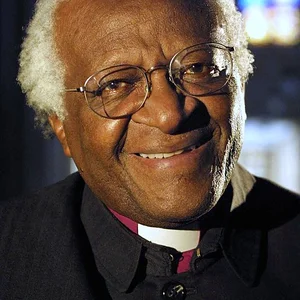

South African Anglican archbishop and a leading figure in the non-violent struggle against apartheid. Winner of the 1984 Nobel Peace Prize, he chaired the Truth and Reconciliation Commission after the fall of the segregationist regime.
Desmond Tutu(1931 — 2021)
Desmond Tutu
Afrique du Sud
5 min read
Frequently asked questions
Famous Quotes
« If you are neutral in situations of injustice, you have chosen the side of the oppressor.»
Key Facts
- Appointed Bishop of Johannesburg in 1985, then Archbishop of Cape Town in 1986
- Received the Nobel Peace Prize in 1984 for his non-violent fight against apartheid
- Chaired the Truth and Reconciliation Commission from 1995, under the presidency of Nelson Mandela
- Popularized the phrase “rainbow nation” to describe post-apartheid South Africa
- Died on 26 December 2021 in Cape Town
Works & Achievements
Tutu led this process, unique in the world, allowing victims and perpetrators of apartheid-era crimes to testify, favouring truth and forgiveness over revenge.
A collection of sermons and speeches in which Tutu denounces apartheid in the name of the Gospel.
A major work in which he recounts the experience of the Commission and develops his philosophy of forgiveness and reconciliation.
An expression coined by Tutu to celebrate the new democratic South Africa uniting all its peoples.
A practical four-step guide to forgiveness, based on his South African experience.
A collection of texts advocating respect between religions and the universal dignity of every person.
Anecdotes
Nicknamed "the Rainbow," Desmond Tutu popularized the expression "rainbow nation" to describe post-apartheid South Africa, celebrating the diversity of its peoples united in a single democracy.
In 1984, when he received the Nobel Peace Prize, Tutu was still only a bishop; the apartheid regime was furious because this award turned the world's spotlight onto South Africa's racial injustice.
Known for his infectious laugh and his sense of humor, Tutu would defuse the gravest tensions with a joke. He described himself, laughing, as "a man who loves God, but also a good meal."
During the Truth and Reconciliation Commission, Tutu sometimes burst into tears while listening to the testimonies of torture victims, showing that acknowledging suffering was part of the nation's healing process.
Tutu was a tireless defender of human rights beyond apartheid: he criticized the ANC government as readily as persecutions elsewhere in the world, declaring that he would never stay silent in the face of injustice.
Primary Sources
Racism is an evil. Apartheid is an evil, totally and fundamentally. It cannot be reformed, it must be abolished.
Forgiveness is not some nebulous feeling; it is the refusal to let the past hold the future hostage.
We chose the path of truth rather than that of vengeance, so that the nation could heal its wounds.
Key Places
Mining town in the western Transvaal where Desmond Tutu was born in 1931.
Township of Johannesburg where Tutu lived and preached; the epicenter of resistance to apartheid, notably during the 1976 uprising.
Seat of the Anglican Archbishop of Cape Town, nicknamed the “people's cathedral” for its role as a refuge for opponents of apartheid.
City where Tutu received the Nobel Peace Prize in 1984.
Major city where Tutu served as archbishop and where he died in 2021.
Typical Objects

A cross worn on the chest, a symbol of his role as Anglican Archbishop of Cape Town. It embodied the union of his faith and his fight against injustice.

Purple episcopal garments marking his rank as bishop and later archbishop. Tutu wore them at the altar as readily as in protest marches.

The sacred text at the heart of his preaching, which he quoted to denounce apartheid as a heresy. The source of his message of reconciliation.

An award received in 1984 for his non-violent struggle against apartheid. It gave his cause an international audience.

A pastoral staff shaped like a shepherd's crook, carried by the archbishop. It recalled his mission to guide and protect his “flock”.

The tool through which victims and perpetrators publicly gave their testimonies. It symbolizes the transparency South Africa chose in order to heal.
School Curriculum
Vocabulary & Tags
Key Vocabulary
Tags
Daily Life
Morning
A man of deep prayer, Tutu began his day very early with a long meditation and the Eucharist. He considered this spiritual time indispensable before any public struggle.
Afternoon
His afternoons were filled with meetings of the Council of Churches, pastoral visits to the townships, and the writing of committed sermons. He also received journalists and activists from all over the world.
Evening
In the evening, Tutu would rejoin his wife Leah and his family, sharing meals and laughter. He liked to end the day with prayer and a little music.
Food
Tutu enjoyed simple, convivial South African cooking, such as pap (maize porridge) served with stews. An unabashed food lover, he made no secret of his fondness for a good meal shared with others.
Clothing
Day to day he wore the Roman collar and black shirt of the clergy, and for ceremonies the purple cassock, the mitre, and the pectoral cross of an archbishop.
Housing
For a long time he lived in a modest house in Soweto, among the Black community he defended, before residing in Cape Town during his episcopate.
Historical Timeline
Period Vocabulary
Liens externes & ressources
Références
Œuvres
Présidence de la Commission Vérité et Réconciliation
1995-1998
Crying in the Wilderness
1982
No Future Without Forgiveness
1999
Concept de la « nation arc-en-ciel »
1994
The Book of Forgiveness (avec sa fille Mpho Tutu)
2014
God Is Not a Christian
2011