
An Italian Renaissance painter (1532–1625), she was one of the first women artists to achieve international renown. Official portraitist at the court of King Philip II of Spain, she influenced many artists, including Caravaggio and Van Dyck.
Sofonisba Anguissola(1532 — 1625)
Sofonisba Anguissola
Crémone
7 min read
Frequently asked questions
Key Facts
- Born in 1532 in Cremona (Lombardy), into a noble family that encouraged her artistic education
- Mentored by Michelangelo, who gave her guidance after examining her drawings around 1554
- Appointed lady-in-waiting and court painter to Philip II of Spain in 1559, a position she held for twenty years
- Painted numerous portraits of the Spanish royal family, including Queen Elisabeth of Valois
- Died in Palermo in 1625 at the age of 93; Anthony van Dyck paid her a visit shortly before her death
Works & Achievements
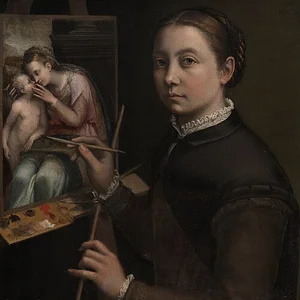
One of the earliest known depictions of a woman artist at work, held at Łańcut Castle in Poland. This painting boldly asserts Sofonisba's professional identity.
A painting showing three of her sisters playing chess, held at the National Museum in Poznań. A pioneering work for its intimate genre scene and natural rendering of expressions.
Held at the Museo Nazionale di Capodimonte in Naples, this painting shows her playing the harpsichord, reflecting her dual mastery of music and painting. It embodies the Renaissance ideal of the accomplished woman.
A portrait of the Queen of Spain, wife of Philip II, painted during her years at the Madrid court. Several versions exist, attesting to the importance of her role as official portraitist.
A portrait of the King of Spain, held at the Museo del Prado in Madrid. A demonstration of her mastery of court portraiture, combining royal dignity with subtle psychological insight into the sitter.
A mature work revealing the evolution of her technique toward greater psychological depth. Long attributed to other masters, it has been restored to her by contemporary scholarship.
Anecdotes
Sofonisba Anguissola learned painting under Bernardino Campi in Cremona — an exceptional circumstance for a woman in the 16th century. Her father Amilcare, convinced of his daughters' talent, made the bold decision to have them trained as professional artists, breaking the conventions of the time.
Michelangelo himself took an interest in her work: around 1557, Sofonisba sent him a drawing of a boy crying after being bitten by a crayfish. The master was so impressed that he offered corrections and encouraged her artistic development — a correspondence attested by surviving letters.
In 1559, she was invited to the court of King Philip II of Spain as a lady-in-waiting and painter to Queen Elisabeth of Valois. For nearly fifteen years, she produced numerous portraits of the royal family, enjoying a status and salary unprecedented for a woman artist of her time.
At the age of ninety-two, blind but still sharp-minded, Sofonisba received a visit from the young Anthony van Dyck in Palermo in 1624. Struck by her intelligence and her memory for works of art, he painted her portrait and recorded in his travel sketchbook the invaluable advice she gave him on the art of portraiture.
Primary Sources
I have sent to Your Lordship a drawing by my daughter Sofonisba, so that you may see and judge the progress she has made in the noble arts that you taught her.
Sofonisba Anguissola, of Cremona, has labored with greater study and grace than any other woman of our time at the difficulties of drawing; she has not only succeeded in drawing, coloring, and painting from nature, but has also produced very beautiful and rare paintings.
I visited the signora Sofonisba, painter. She gave me much good advice on painting. She said that to make a good portrait, one must engage the subject in conversation so that they do not take on a stiff expression.
I beseech Your Majesty to allow me to return to Italy to marry according to my station, having faithfully served the queen for many years.
Key Places
Sofonisba's birthplace and an active artistic center in the 16th century, where she received her initial training under Bernardino Campi. It was in this Lombard city that her artistic vocation took root.
Sofonisba visited Rome around 1556 and met Michelangelo, who encouraged her and offered corrections on her drawings. This encounter with the master cemented her growing reputation.
Sofonisba lived and worked here for nearly fifteen years (1559–1573) as the official portraitist of Philip II's court. It was here that she created her most celebrated works and gained a European-wide reputation.
After the death of her first husband, Sofonisba settled in Genoa with her second husband Orazio Lomellini. She was active in Genoese artistic circles there and continued to paint.
The city where Sofonisba spent the final years of her life, and where Anthony van Dyck came to visit her in 1624, a year before her death. She is buried in the church of San Giorgio dei Genovesi.
Typical Objects

The essential tools of Sofonisba's daily life, which she handled with remarkable precision in her portraits. Several of her self-portraits show her holding a palette and brush, proudly asserting her identity as an artist.

An indispensable instrument for her many self-portraits, the mirror allowed Sofonisba to study her own face with the same rigor she applied to her sitters. She is one of the first artists to have made such extensive use of the self-portrait genre.

Sofonisba was also an accomplished musician; she depicted herself playing the harpsichord in a celebrated 1561 self-portrait. Music and painting were the two arts cultivated by noblewomen of the Italian Renaissance.

A common object of piety in court portraits, the book illustrates the virtue and education of its owner. Sofonisba incorporates it into several of her portraits to convey the culture and faith of her sitters.

As a lady-in-waiting to the Queen of Spain, Sofonisba wore exceptionally rich attire, the details of whose fabrics and embroideries are rendered with virtuosity in her portraits. These garments reflect her deep immersion in Spanish aristocratic life.

Sofonisba used sketchbooks for her preparatory studies, particularly to observe the natural expressions of her sitters. Her method involved engaging her subjects in conversation to avoid stiff poses — an approach she later shared with Van Dyck.
School Curriculum
Vocabulary & Tags
Key Vocabulary
Tags
Daily Life
Morning
Sofonisba began her day early, taking advantage of the northern morning light to work in her studio. She prepared her pigments — grinding lapis lazuli, ochre, and vermilion with linseed oil — then received her noble sitters in the early hours of the morning.
Afternoon
The afternoons were devoted to long sitting sessions with members of the royal court. Sofonisba actively conversed with her subjects to enliven their expressions and avoid stiff poses, a technique she later passed on to Van Dyck. She also supervised the work of her assistants.
Evening
In the evenings, as lady-in-waiting to the queen, Sofonisba took part in court life: dinners, concerts, and learned conversation. She also dedicated part of her evenings to music, playing the harpsichord, and to reading Italian treatises on painting.
Food
At the Spanish court, Sofonisba enjoyed the royal table, abundant in roasted meats, fish, Mediterranean vegetables, white bread, and Spanish wines. Spices from the American colonies — pepper, cinnamon, saffron — seasoned the dishes served at official banquets.
Clothing
As a royal lady-in-waiting, Sofonisba wore gowns of silk and velvet in dark colors — black, burgundy, deep green — adorned with white lace collars and understated jewelry. Her dress reflected the strict protocol of the Habsburg court, as seen in her own self-portraits.
Housing
In Madrid, Sofonisba resided in the royal palace apartments reserved for the queen's ladies. In Genoa and later Palermo, she lived in grand aristocratic mansions with vaulted halls, inner gardens, and well-lit studios overlooking the street or the harbor.
Historical Timeline
Period Vocabulary
Visual Style
Portraits raffinés à l'huile d'inspiration lombardo-flamande, lumière dorée sur soieries et velours sombres, fond neutre chaud et expressivité psychologique subtile caractéristiques de la cour de Philippe II.
Sound Ambience
L'atelier feutré d'une peintre de cour Renaissance, entre sons de palette, froissement de soieries et harpsichord lointain, mêlés aux rumeurs du palais royal madrilène.
Liens externes & ressources
Références
Œuvres
Autoportrait au chevalet
vers 1556
Portrait de la reine Élisabeth de Valois
vers 1565
Portrait de Philippe II d'Espagne
vers 1565
Portrait d'un vieillard
vers 1580