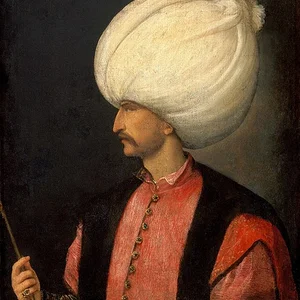

Suleiman I, known as the Magnificent, was the tenth Ottoman sultan, reigning from 1520 to 1566. He brought the Ottoman Empire to its territorial and cultural peak, threatening Christian Europe at the very gates of Vienna.
Suleiman the Magnificent(1494 — 1566)
Suleiman the Magnificent
8 min read
Frequently asked questions
Key Facts
- 1520: Suleiman ascends the Ottoman throne following the death of his father Selim I
- 1521: Capture of Belgrade, opening the road into Central Europe
- 1526: Victory at Mohács against King Louis II of Hungary, leading to the partial annexation of his kingdom
- 1529: First Siege of Vienna, repelled but leaving a lasting mark on Christian Europe
- 1536: Diplomatic alliance with Francis I of France against the Habsburgs
Works & Achievements
Built by the great architect Sinan on Suleiman's orders, this mosque is considered the pinnacle of classical Ottoman architecture. It stands as a symbol of the sultan's power and piety.
Suleiman commissioned a vast body of civil and criminal law that earned him the title Kanuni (the Lawgiver). This code governed the administration of the Empire, taxation, and the rights of non-Muslim subjects.
Writing under the pen name Muhibbi, Suleiman composed more than two thousand poems in Ottoman Turkish, including love odes to Roxelana. This divan reveals a literary sensitivity rarely found in a ruler of his stature.
A groundbreaking diplomatic agreement granting France commercial and judicial privileges within the Ottoman Empire. This lasting alliance fractured the united Christian front against the Ottomans and reshaped the balance of power in Europe.
A vast hydraulic network designed by Sinan to supply fresh water to the city of Istanbul. This monumental infrastructure permanently improved living conditions in the Ottoman capital.
Suleiman thoroughly reorganized the Empire's provincial administration, the Janissary military system, and the justice system. These reforms ensured the cohesion of a territory stretching from Hungary to Mesopotamia.
Anecdotes
Suleiman maintained an exceptional relationship with his grand vizier Ibrahim Pasha, a former Greek slave who had become his childhood friend. The two men sometimes slept in the same tent during military campaigns. Yet in 1536, Suleiman had Ibrahim strangled on the advice of his wife Roxelana, illustrating the ruthless violence of Ottoman power.
Suleiman was an accomplished poet who wrote under the pen name 'Muhibbi' (the beloved). He composed more than two thousand poems in Ottoman Turkish, including many odes to Roxelana, the Ukrainian slave he officially married — an exceedingly rare act for a sultan.
During the Siege of Vienna in 1529, Suleiman had a sumptuous tent adorned with silks and gold erected before his lines to impress enemy ambassadors. The terrified Viennese were astonished that a ruler could travel on campaign with such splendor.
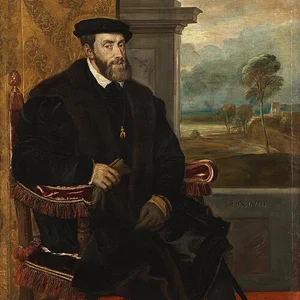
Charles V and Suleiman never met in person, yet exchanged thousands of letters and embassies over forty years. Their rivalry shaped European and Mediterranean politics throughout the sixteenth century, with Suleiman going so far as to ally with Francis I of France against the Emperor.
At his death in 1566 during the Siege of Szigetvár in Hungary, his physicians concealed his passing for several days to prevent the demoralization of the troops. Grand Vizier Sokollu Mehmed Pasha commanded the campaign alone and captured the fortress before announcing the sultan's death.
Primary Sources
The King of France sought military assistance from the sultan against Charles V, implicitly acknowledging the power of the Ottoman Empire as a counterweight to Habsburg dominance in Europe.
"We have arrived before Belgrade. The city is strong but our artillery is superior. God will grant us victory." These campaign diaries, written by imperial secretaries, constitute a valuable source on Ottoman military operations.
"My Istanbul, my Karaman, my Anatolia — You are my life, my love, my moonlight." Suleiman dedicated numerous poems to Roxelana, reflecting a refined literary sensibility.
The Flemish Habsburg ambassador described Suleiman: "He looked older than his years, with a grave and stern face. Seeing him, one cannot doubt that he is a great sovereign."
Suleiman commissioned a vast body of civil and criminal laws governing the administration of the Empire, taxation, and the rights of non-Muslim subjects, earning him the epithet Kanuni (the Lawgiver).
Key Places
Suleiman's primary residence, this palatial complex overlooking the Bosphorus housed the harem, the divans (imperial councils), and the empire's treasuries. Suleiman had several pavilions built there and spent most of his life within its walls.
A masterpiece by the architect Sinan, this monumental mosque completed in 1558 towers over Istanbul from the Third Hill. It serves as Suleiman's mausoleum and stands as a symbol of the golden age of classical Ottoman architecture.
It was here that Suleiman crushed the Hungarian army in 1526, killing King Louis II and opening the door to Ottoman dominance over Central Europe. The battle remains a defining trauma in Hungarian historical memory.
The Habsburg capital, Vienna withstood two Ottoman sieges in 1529 and 1532, marking the western limit of Suleiman's expansion. The city came to symbolize the ultimate boundary of his European ambitions.
The island fortress of the Knights of Saint John, Rhodes was conquered by Suleiman in 1522 after a siege lasting several months, allowing him to establish control over the eastern Mediterranean.
Typical Objects

A ceremonial garment of silk and gold brocade, the caftan symbolized the sultan's power. Suleiman owned dozens of them, preserved in the treasuries of Topkapi Palace, testaments to Ottoman textile art at its height.

The imperial turban crowned with a jewel-studded aigrette (sorguç) was the distinctive mark of the Ottoman sultan. Suleiman's turban, exceptionally tall, left a deep impression on foreign ambassadors received in audience.

A curved blade of Damascus steel, the kilij was presented to the sultan at his enthronement as a symbol of his role as commander in chief. Suleiman was girded with the sword of Osman, founder of the dynasty, upon his accession to the throne.

Under the pen name Muhibbi, Suleiman composed poetry using a calame (trimmed reed), the central instrument of Ottoman learned culture. His divan brings together more than two thousand pieces written in Ottoman Turkish.

During military campaigns, Suleiman resided in an immense tent adorned with tapestries and silks that recreated the splendor of the palace. These tents could shelter hundreds of people and embodied the sultan's mobile majesty.

The heavy Ottoman artillery, inherited from the conquest of Constantinople in 1453, proved decisive in Suleiman's victories. The siege cannons transported as far as Belgrade and Vienna represented an unprecedented feat of logistics.
School Curriculum
Vocabulary & Tags
Key Vocabulary
Tags
Daily Life
Morning
Suleiman rose before dawn for the first prayer (fajr) in his private prayer room at Topkapi Palace. He was then dressed and groomed by his pages according to a meticulous ritual. The morning began with the audience of the imperial divan, where he listened to reports from his viziers and signed firmans (imperial decrees).
Afternoon
Afternoons were devoted to military and diplomatic affairs: receiving foreign ambassadors, studying campaign maps, or inspecting the arsenal and shipyards along the Bosphorus. Suleiman might also withdraw to his apartments to write poetry or study the sciences.
Evening
Evenings in the harem were dedicated to family life and the arts. Suleiman enjoyed Ottoman music concerts, poetry readings, and games of chess. After the night prayer (isha), he would often retire to Roxelana's apartments to converse and dictate verses.
Food
The sultan's food was tasted by food tasters to guard against poisoning. Imperial meals included roasted meats (lamb, poultry), saffron-scented rice dishes (pilaf), stuffed vegetables (dolmas), fermented dairy, and an abundance of pastries made with honey and pistachios. Alcohol was theoretically forbidden by Islam, but Ottoman coffee and iced sorbets were greatly prized.
Clothing
Suleiman wore silk and gold brocade kaftans adorned with tulip and carnation motifs — symbols of the Ottoman dynasty. His tall, majestic turban was decorated with a plume ornament (sorguç) set with rubies and emeralds. On campaign, he wore light armor beneath an embroidered cloak and carried his kilij (saber) at his belt.
Housing
Suleiman resided primarily at Topkapi Palace, a vast complex of pavilions, gardens, fountains, and courtyards overlooking the confluence of the Bosphorus and the Golden Horn. His private apartments, decorated with Iznik tiles and painted woodwork, contrasted with the colonnaded divan hall where affairs of state were conducted.
Historical Timeline
Period Vocabulary
Visual Style
Style visuel de la cour ottomane à son apogée : architectures monumentales, céramiques d'Iznik aux couleurs vives, caftans brodés d'or et enluminures raffinées reflétant la grandeur de l'Empire au XVIe siècle.
Sound Ambience
Ambiance sonore de l'Empire ottoman au XVIe siècle, mêlant la majesté religieuse des appels à la prière, la puissance militaire des fanfares de janissaires et la vie raffinée du palais de Topkapi.
Liens externes & ressources
Références
Œuvres
Mosquée de Soliman (Süleymaniye Camii)
1550–1558
Kanun-i Osmani (Code législatif ottoman)
vers 1530
Divan de Muhibbi (recueil de poèmes)
vers 1520–1566
Alliance franco-ottomane et capitulations de 1536
1536
Aqueduc de Kırkçeşme
1554–1563
Réforme administrative de l'Empire
1520–1566