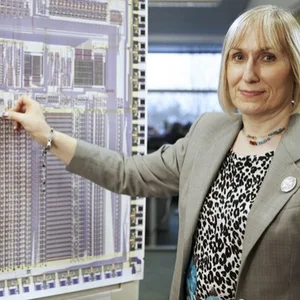

Sophie Wilson is a British computer scientist born in 1957, who designed the instruction set of the ARM processor. Her architecture now powers nearly all smartphones and mobile devices worldwide.
Sophie Wilson(1957 — ?)
Sophie Wilson
Royaume-Uni
6 min read
Frequently asked questions
Key Facts
- Designs the BBC BASIC language for the BBC Micro computer at Acorn Computers in 1981
- Co-designs the instruction set of the first ARM processor with Steve Furber starting in 1983
- The first ARM processor is brought into service in 1985
- The ARM architecture powers tens of billions of mobile devices in the 21st century
- Completes her gender transition in the 1990s (born Roger Wilson)
Works & Achievements
One of Acorn's first computers, which she contributed to as soon as she joined the company.
A consumer microcomputer sold as a kit that established Acorn's reputation among hobbyists.
The programming language of the BBC Micro, which became a major learning tool in British schools.
An iconic educational computer in the United Kingdom, for which she designed much of the software and the system.
The simple and energy-efficient RISC processor architecture she designed, the basis of nearly all of today's smartphone chips.
A processor designed at Element 14 and later Broadcom, used notably in telecommunications equipment (ADSL).
Anecdotes
In 1981, the manufacturer Acorn had to deliver a working prototype to win the contract for the BBC's educational computer. Other engineers thought it was impossible to get it running in just a few days. Sophie Wilson and Steve Furber worked almost without sleep and presented a functioning machine just in time for the visit from the BBC executives: this was the famous BBC Micro.
When the very first ARM chip was powered up in 1985, the engineers measured a surprisingly low power consumption. They discovered that the main power pin wasn't even connected: the processor was running on the tiny leakage currents from the other connections. This unexpected energy frugality became ARM's great strength in mobile phones.
Sophie Wilson wrote BBC BASIC, the programming language shipped with the BBC Micro. Distributed to thousands of British schools, it taught a whole generation of children to program in the 1980s, many of whom went on to become engineers or video game creators.
The ARM architecture designed by Sophie Wilson now powers nearly every smartphone on the planet: more than 250 billion ARM chips have been manufactured. Sophie has said she never imagined, when designing that small, energy-efficient processor in the 1980s, that it would end up in the pockets of almost all of humanity.
Born Roger Wilson in 1957, the computer scientist transitioned in 1994 and has gone by the name Sophie ever since. Hailed as one of the most influential figures in British tech, she was appointed Commander of the Order of the British Empire (CBE) in 2019 for services to computing.
Primary Sources
Hermann Hauser told us that the BBC was arriving in a few days and that the machine had to work. Everyone said it was impossible in that timeframe; we got it running on time anyway.
The power consumption was so low that we realized the chip was running even though its power pin wasn't connected: it was living off leakage currents. That's when we understood the value of such low power consumption.
BBC BASIC gives students a complete structured language, with named procedures and direct hardware access, designed for learning programming at school.
Key Places
Industrial city in the north of England where Sophie Wilson was born in 1957.
Where she studied and developed a passion for electronics, designing her first microprocessor systems.
The company where Sophie Wilson designed BBC BASIC, the BBC Micro, and then the ARM instruction set.
After Element 14, which was acquired by Broadcom, she continued designing processors such as the FirePath there.
Village near Cambridge where Sophie Wilson lives, having remained loyal to the region throughout her career.
Typical Objects

The first chip of the ARM architecture, designed by Sophie Wilson, famous for its simplicity and very low power consumption. Its descendants now power nearly all smartphones.

Educational microcomputer launched in 1981, the result of the contract between Acorn and the BBC. Sophie Wilson designed a large part of its software, including BBC BASIC.

Programming language written by Sophie Wilson for the BBC Micro. Highly structured and fast, it introduced thousands of British schoolchildren to computing.

The off-the-shelf processor that powered the BBC Micro before the arrival of ARM. Its limitations pushed Sophie Wilson and her team to design their own chip.

The engineer's basic tools for assembling and testing electronic circuits by hand on the first Acorn prototypes.

Microcomputer kit launched by Acorn in 1980, to which Sophie Wilson contributed. It paved the way for the success of the BBC Micro.
School Curriculum
Vocabulary & Tags
Key Vocabulary
Tags
Daily Life
Morning
During the Acorn years, her days often start late because the nights spent working on circuits run long. Mornings are devoted to reviewing the code and the diagrams designed the day before, coffee in hand, in the Cambridge offices.
Afternoon
Afternoons are spent in the lab, drawing processor architectures, discussing ideas with colleagues like Steve Furber, and testing electronic prototypes by hand, soldering iron and oscilloscope close by.
Evening
Evenings frequently spill over into the night during intense design phases, when a machine has to be made to work before a deadline. Sophie Wilson is known for her ability to power through long programming sessions.
Food
Like many engineers absorbed in their work, she eats simply and quickly between sessions, steeped in the British culture of tea, coffee, and meals grabbed on the go at the lab.
Clothing
She favours comfortable, informal attire, typical of Cambridge's computer engineering world, far from the formality of office suits.
Housing
She lives in the Cambridge area, notably in the village of Lode in Cambridgeshire, close to the technology companies where she spent her entire career.
Historical Timeline
Period Vocabulary
Liens externes & ressources
Références
Œuvres
Acorn System 1
1979
Acorn Atom
1980
BBC BASIC
1981
BBC Micro
1981
Jeu d'instructions ARM (ARM1)
1985
Processeur FirePath
2000