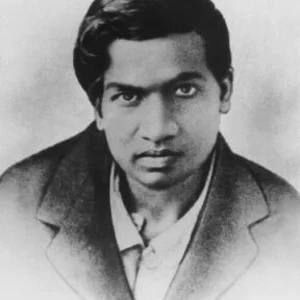

A self-taught Indian mathematician (1887–1920), Ramanujan discovered thousands of remarkable mathematical formulas with no formal university training. Recognized by mathematician G.H. Hardy, he made major contributions to number theory and modular functions before dying prematurely at the age of 32.
Srinivasa Ramanujan(1887 — 1920)
Srinivasa Ramanujan
Raj britannique
8 min read
Frequently asked questions
Key Facts
- 1903: Enrolled at Government Arts College in Kumbakonam but dropped out
- 1913: Began a correspondence with mathematician G.H. Hardy at Cambridge
- 1914–1919: Worked at Trinity College, Cambridge — the most productive period of his life
- 1918: Became the first Indian elected Fellow of the Royal Society, at age 31
- 1920: Returned to India and died in Madras at age 32, leaving behind notebooks containing around 3,900 mathematical formulas
Works & Achievements
Ramanujan developed a complete theory of highly composite numbers and established asymptotic formulas for their enumeration. This contribution opened new directions in number theory and remains foundational in the study of the multiplicative properties of integers.
Ramanujan discovered extraordinary properties of modular functions, including the celebrated Ramanujan congruences for the partition function. His work laid the foundations of the modern theory of modular forms, which has become crucial in contemporary number theory.
Ramanujan discovered several rapidly converging formulas for computing π, including a series that converges so quickly that only a few terms are needed to achieve very high precision. These formulas are still used in computing today for calculating π.
Ramanujan established remarkable congruences for the partition function, showing that certain properties repeat in regular patterns. His conjectures inspired decades of research and were later confirmed by subsequent mathematicians.
The exchange of letters between Ramanujan and British mathematician G.H. Hardy led to Ramanujan's international recognition and produced major mathematical results. This remarkable collaboration demonstrated Ramanujan's self-taught mathematical genius.
Ramanujan discovered astonishing properties of continued fractions and established complex functional equations linking various special functions. This work enriched the theory of elliptic and hyperbolic functions.
Anecdotes
In 1913, Ramanujan wrote a letter to the English mathematician G.H. Hardy listing 120 mathematical formulas he had discovered on his own. Hardy, deeply impressed, immediately recognized him as a genius and invited him to come to Cambridge. This letter became one of the most famous pieces of correspondence in the history of mathematics.
Ramanujan had an extraordinary memory for the properties of numbers and could instantly recall detailed information about complex figures. During a hospital visit, Hardy mentioned he had arrived in taxi number 1729, calling it 'a rather dull number.' Ramanujan replied at once: 'No, it is the smallest number expressible as the sum of two cubes in two different ways.' That number became known as the Hardy–Ramanujan number.
Ramanujan developed his mathematical formulas without access to a university library and without any formal advanced training, working in the Indian town of Kumbakonam. He relied on his remarkable mathematical intuition, filling entire notebooks with results that often anticipated the later discoveries of Western mathematicians.
At Cambridge, Ramanujan struggled constantly with homesickness and found it difficult to adapt to English food and daily life. Although he produced groundbreaking mathematical work in just a few years, his health deteriorated and he returned to India in 1919. He died in 1920 at only 32 years old, leaving behind hundreds of formulas that mathematicians continue to study to this day.
Ramanujan's notebooks, filled with mathematical discoveries but lacking complete proofs, kept mathematicians busy for decades after his death. Researchers spent years verifying his seemingly magical formulas, finding that nearly everything he had written was correct — a testament to a mathematical intuition that remains difficult to explain.
Primary Sources
During the years 1914-1919 Ramanujan was in England, and his notebooks were largely filled with results in the theory of partitions, the theory of modular forms, and allied subjects.
I was extremely interested by your letter and by the theorems which you state. You will see that I am returning the letter you sent me; and I should be very much obliged if you would send me proofs of some of your outstanding theorems.
The formulas discovered by Ramanujan in his notebooks reveal an extraordinary mathematical intuition, notably identities concerning theta functions and infinite series.
Your letter put me at once in a state of great suspense, for very slowly I prime began to see that the letter was far more in the nature of a remarkable document.
Key Places
City in Tamil Nadu where Srinivasa Ramanujan was born on December 22, 1887. It is the starting point of his life and his remarkable journey in mathematics.
City in Tamil Nadu where Ramanujan grew up and attended school. It was here that he developed his passion for mathematics from a very young age.
Institution where Ramanujan briefly studied and where he was recognized for his exceptional mathematical talents before receiving financial support to continue his research.
Prestigious university where Ramanujan worked alongside mathematician G.H. Hardy from 1914 to 1919. It was the heart of his international recognition and his major contributions to number theory.
The British capital where Ramanujan stayed during his years in England, attending conferences and engaging with the British mathematical community.
City in Kerala where Ramanujan returned in 1919 after his time in England, weakened by illness. He died there on April 26, 1920, at the age of 32.
Typical Objects

Ramanujan filled notebooks with complex mathematical formulas, documenting his self-taught discoveries. These notebooks, preserved at Cambridge, bear witness to his natural mathematical genius without any formal academic training.

Essential tools of the early 20th-century mathematician, used by Ramanujan to write his formulas and correspondence. The fountain pen was the primary writing instrument of that era.

A central teaching tool in Cambridge's university lecture rooms, where Ramanujan worked alongside G.H. Hardy, enabling the demonstration and exchange of abstract mathematical concepts.

An indispensable reference work for any mathematician of the 19th–20th century before the computer age. Ramanujan used them for complex numerical calculations and his discoveries in number theory.

This essay by the mathematician who discovered Ramanujan reflects on their collaboration and the importance of recognizing raw mathematical talent. It illustrates the profound impact their meeting had on the history of mathematics.

In 1913, Ramanujan wrote to Hardy sharing his mathematical discoveries, sparking a correspondence that would change his life. This exchange marks the starting point of his international academic recognition.

A symbol of his integration into the University of Cambridge, though Ramanujan had to adapt to Western academic culture. His clothing reflects the contrast between his Indian origins and his English university surroundings.

The infinite series discovered by Ramanujan are among his most celebrated contributions. They visually embody his creative genius and his remarkable ability to perceive complex mathematical patterns.
School Curriculum
Vocabulary & Tags
Key Vocabulary
Tags
Daily Life
Morning
Ramanujan wakes up early, as is customary in South India. He devotes the first hours to ritual ablutions and prayer, practices essential to his life as an orthodox Brahmin. He then begins his mathematical work, a time when his mind is sharpest and his intuitions most acute.
Afternoon
In the afternoon, he continues his mathematical research, filling notebooks with formulas and theorems. He may also take part in discussions with other mathematicians or correspond with colleagues — especially after his arrival in England in 1914, where he works with G.H. Hardy at Cambridge.
Evening
Evenings are devoted to family and social life. Ramanujan shares meals with his loved ones and takes part in community life. Before sleeping, he often returns to his calculations, scribbling formulas by the light of an oil lamp or electric light depending on the period and place.
Food
As a strict vegetarian Brahmin, Ramanujan's diet consists mainly of rice, lentils (dal), fruit, and vegetables. In India, he eats regional South Indian dishes such as dosa and idli. In England, his vegetarian diet presents real challenges, limiting his food choices and affecting his overall health.
Clothing
Ramanujan wears the traditional South Indian costume: the dhoti and an upper garment (uttariya or mundu). In England, he partially adopts Western clothing while keeping his sartorial traditions. He maintains a neat appearance, reflecting his social standing as a respected scholar and mathematician.
Housing
In India, Ramanujan lives in a modest house in Kumbakonam, in South India, within a Brahmin family. At Cambridge, he resides in simple university accommodation, often sharing his quarters with other students or researchers. His living conditions remain humble, reflecting his modest social background despite his widely recognized mathematical genius.
Historical Timeline
Period Vocabulary
Visual Style
Un style fusion entre le portrait académique britannique de l'époque victorienne tardive et les traditions artistiques indiennes, enrichi de motifs géométriques et de formules mathématiques flottantes. L'ambiance est à la fois contemplative et mystique, baignée de lumières chaudes dorées évoquant la sagesse et l'illumination intellectuelle.
Sound Ambience
Une ambiance sonore immersive mêlant l'Inde du début du XXe siècle avec l'atmosphère contemplative d'un mathématicien génial : bruits de temple, pluies de mousson, sons de travail intellectuel intensif, créant un équilibre entre environnement culturel indien authentique et introspection mathématique profonde.
Liens externes & ressources
Références
Œuvres
Formules de nombres hautement composés
1915
Fonctions modulaires et formes modulaires
1916-1920
Formule de Ramanujan pour π
1914
Théorie des partitions
1918-1920
Correspondance avec G.H. Hardy
1913-1920
Fractions continues et équations fonctionnelles
1910-1920