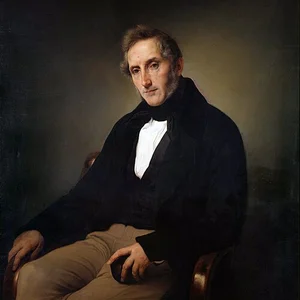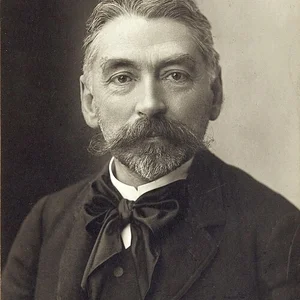

Stéphane Mallarmé (1842-1898) was a French poet and a major figure of Symbolism. An English teacher by profession, he transformed poetic language through his pursuit of suggestion and purity, paving the way for modern poetry.
Stéphane Mallarmé(1842 — 1898)
Stéphane Mallarmé
France
6 min read
Frequently asked questions
Famous Quotes
« To give a purer sense to the words of the tribe.»
« A throw of the dice will never abolish chance.»
« The world exists to end up in a beautiful book.»
Key Facts
- Born in 1842 in Paris, died in 1898 in Valvins (Vulaines-sur-Seine)
- Published *The Afternoon of a Faun* in 1876, which would inspire Debussy in 1894
- Hosted the famous “Tuesdays” on the rue de Rome, a hub of Symbolism
- Composed *A Throw of the Dice Will Never Abolish Chance* (1897), a poem that revolutionized page layout
- Regarded as the “prince of poets” after the death of Verlaine in 1896
Works & Achievements
A famous short poem expressing the longing to escape and a weariness of living; one of his best-known texts.
An eclogue of great musicality, illustrated by Manet, which later inspired Debussy's “Prelude.”
A women's fashion magazine that he wrote entirely on his own under several pseudonyms, blending whimsy and poetry.
French versions of “The Raven” (illustrated by Manet) and other poems by Poe, whom he deeply admired.
A great poem that remained unfinished, a long meditation on beauty and purity that he worked on throughout his life.
A collection of prose pieces and reflections on poetry, in which he develops the idea of suggestion over mere description.
A poem with a revolutionary layout, scattering the words across the page; it heralds modern, visual poetry.
A collection bringing together his essential poems, published shortly after his death and now a landmark of Symbolism.
Anecdotes
Every Tuesday evening, in his small apartment at 89 rue de Rome in Paris, Mallarmé welcomed young writers around the porcelain stove. Standing, pipe in hand, he would talk about poetry for hours. These “Tuesdays” saw the likes of Paul Valéry, André Gide, and Paul Claudel pass through: modern poetry was, in part, invented there.
Mallarmé loved writing verse on any surface at all: fans given to his wife and daughter, Easter eggs, pebbles, and even the envelopes of his mail. These rhymed addresses, gathered under the title “Les Loisirs de la poste” (The Pleasures of the Post), nonetheless reached their destination thanks to amused postmen.
For years, Mallarmé was an unenthusiastic English teacher who found his job exhausting but needed it to make a living. After a stay in London to master the language, he even wrote schoolbooks such as “Les Mots anglais” (English Words), all while composing his poems in the evening.
In 1884, the writer Joris-Karl Huysmans praised Mallarmé in his novel “À rebours” (Against Nature), and Verlaine ranked him among his “Accursed Poets.” Almost overnight, this discreet and long-misunderstood teacher became a master admired by an entire generation.
In 1897, Mallarmé published “Un coup de dés jamais n'abolira le hasard” (A Throw of the Dice Will Never Abolish Chance): the words are scattered across the double page, in characters of different sizes, like constellations. This revolutionary layout foreshadowed the visual poetry of the 20th century.
Mallarmé died suddenly in 1898 at his house in Valvins, on the banks of the Seine, suffocated by a spasm of the throat. The day before, he had written to his wife and daughter telling them to burn his papers, explaining that there was “no literary legacy” among them.
Primary Sources
The flesh is sad, alas! and I have read all the books. / To flee! to flee far away!
These nymphs, I would perpetuate them.
Such as into Himself at last eternity changes him, / The Poet rouses with a naked sword / His century terrified at not having known / That death was triumphing in this strange voice.
I say: a flower! and, out of the oblivion to which my voice consigns every contour, [...] there musically arises, idea itself and delicate, the one absent from all bouquets.
A THROW OF THE DICE WILL NEVER ABOLISH CHANCE
Key Places
Mallarmé's birthplace, where he returned to settle in 1871 and led his literary life until the end.
A modest Parisian dwelling where the famous “Tuesdays” were held, gatherings of young poets around the master.
Mallarmé stayed here in 1862–1863 to learn English, a language he would later teach and from which he would draw schoolbooks.
The first town where he taught English at the lycée starting in 1863; here he began “Hérodiade” and “The Afternoon of a Faun.”
A country house on the banks of the Seine, near Fontainebleau, where Mallarmé loved to row and where he died in 1898.
Typical Objects

The poet's writing instruments. He composed slowly, crossing out and reworking his lines in search of the exact word.

An everyday object of women's life on which Mallarmé inscribed short poems for his wife and daughter (“Éventail de Madame Mallarmé”).

A familiar object of the poet, which he smoked during his “Tuesdays” and which inspired his prose poem “La Pipe,” an evocation of reverie and memory.

A checked woolen blanket in which Mallarmé wrapped himself, which became almost an attribute of the poet in the portraits and photographs of the time.

Small gaming cubes marked with pips, which became the central symbol of his last great poem, in which the throw of the dice represents the chance that art strives in vain to master.

Periodical issues (“La Dernière Mode,” “La Revue indépendante,” “Cosmopolis”) in which his texts appeared; the main means of disseminating the poetry of his time.
School Curriculum
Vocabulary & Tags
Key Vocabulary
Daily Life
Morning
On weekdays, Mallarmé went to the lycée to teach his English classes, a profession he found tiring and unrewarding. There he graded papers and lessons, far from the poetry that filled his heart.
Afternoon
Back home, he devoted his free hours to writing, composing very slowly, sometimes only a few lines, which he polished tirelessly. He also kept up an abundant correspondence with writers and artists.
Evening
On Tuesday evenings, he transformed his small drawing room on the rue de Rome into a literary circle: standing near the stove, pipe in hand, he spoke of poetry before young admirers. The other evenings were devoted to reading and work.
Food
Mallarmé led the life of a modest middle-class teacher. His table was plain and bourgeois, without luxury, shared with his wife Maria and his daughter Geneviève.
Clothing
He wore the sober attire of the 19th-century teacher: frock coat, waistcoat, and high collar. In private and in winter, he liked to wrap himself in a checked woollen plaid that became his emblem.
Housing
In Paris, he lived in a narrow apartment on the fourth floor of the rue de Rome. In summer, he retreated to his country house at Valvins, on the banks of the Seine, where he rowed and wrote in peace.
Historical Timeline
Period Vocabulary
Liens externes & ressources
Références
Œuvres
Brise marine
1865
L'Après-midi d'un faune
1876
La Dernière Mode
1874
Traduction des poèmes d'Edgar Poe
1875-1888
Hérodiade
commencé en 1864
Un coup de dés jamais n'abolira le hasard
1897