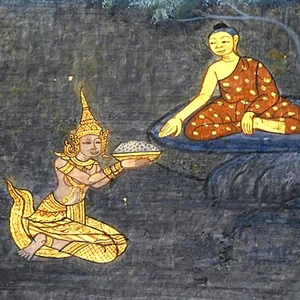

Sujata was a young village woman from ancient India who offered a bowl of rice pudding to Siddhartha Gautama, allowing him to break his extreme fast before attaining Enlightenment. This act of generosity is considered a founding moment of Buddhism.
Sujata
Sujata
9 min read
Frequently asked questions
Key Facts
- Around 528 BCE: Sujata offers a bowl of kheer (rice pudding) to Siddhartha Gautama near Bodh Gaya
- Her gesture puts an end to Siddhartha's years of extreme asceticism
- She is considered the first laywoman to have supported the future Buddha
- The episode is recounted in several canonical Buddhist texts
Works & Achievements
A founding act of the Buddhist tradition: by feeding the exhausted Siddhartha, Sujata enabled him to break from extreme asceticism and embrace the Middle Way. This act of generosity (dana) is celebrated in all Buddhist schools as a decisive moment in humanity's spiritual history.
Sujata became the symbol of perfect selfless giving. Her actions are taught in monasteries around the world as an example of the spiritual merit gained through generosity toward those seeking Enlightenment.
A commemorative monument erected at the presumed site where Sujata lived. British archaeological excavations in the 19th century uncovered this stupa, which local traditions have associated with her memory for two millennia.
Sujata is depicted in the bas-reliefs of the great stupa at Sanchi and in the wall paintings of the Ajanta Caves. These works portray the offering of rice milk as a pivotal episode in the life of the Buddha, attesting to Sujata's central place in Buddhist iconography.
The 547 Jataka stories (accounts of the Buddha's past lives) include several references to Sujata. In some versions, she is said to have been connected to the Bodhisattva in previous lives, reinforcing the karmic significance of their decisive encounter.
Anecdotes
According to Buddhist tradition, Sujata had made a vow to offer rice milk to the spirit of a sacred fig tree if her prayers were answered. On the morning of the Awakening, she prepared a rice porridge (kheer) in a golden bowl and went to the tree. Seeing Siddhartha Gautama — gaunt but radiant — she believed he was the tree deity come to claim her offering, and held out the bowl to him with sincere devotion.
After years of extreme asceticism, Siddhartha was so weakened that he could barely stand. Sujata's offering — a bowl of rice cooked in condensed milk — restored the strength he needed to meditate under the fig tree until the Awakening. His five ascetic companions, who witnessed the scene, judged him degenerate and abandoned him, convinced he had given up the spiritual path.
After eating Sujata's offering, Siddhartha went to the banks of the Niranjana river. He placed the golden bowl on the water, making this wish: “If I am to attain Awakening this day, may this bowl float upstream.” According to the Pali texts, the bowl did indeed travel upstream a great distance before sinking — an auspicious sign interpreted as confirmation of his destiny.
Sujata's act became in Buddhism the perfect illustration of *dana* (selfless generosity). By offering her food without knowing she was feeding a future Awakened One, Sujata unknowingly contributed to the birth of the “Middle Way” — neither extreme asceticism nor indulgence, but a balance that makes serene spiritual practice possible.
Mahayana versions of the story describe Sujata as having cooked for three days following very strict purification rituals. She is said to have reduced the milk forty-nine times before cooking the rice in it. This symbolic number corresponds to the forty-nine days Siddhartha spent under the Bodhi tree after the Awakening, suggesting a karmic link between the young woman's generosity and the duration of that founding meditation.
Primary Sources
Sujata, daughter of a wealthy farmer from Senani, had prepared an offering of milk-rice in a golden bowl. Seeing the Bodhisattva seated beneath the fig tree, radiant, she believed that the spirit of the tree had taken human form to receive her offering and approached him with devotion.
A young woman named Sujata approached the Bodhisattva with a golden vessel filled with fragrant milk-rice. She placed it before him with reverence. The Bodhisattva took the bowl, ate the milk-rice, and recovered the fullness of his strength.
A maiden of the village, Sujata by name, brought him a purified food, white as the autumn moon, which she had prepared with devotion. The sage accepted the gift of this pure-hearted young woman and was sustained by it before sitting on the bank of the Niranjana.
Sujata brought milk-rice in a precious bowl. She placed the offering before the ascetic without asking its price or his name, moved solely by the desire to do good and fulfill her vow.
Key Places
Sujata's presumed birthplace according to Pali texts. It is here that she prepared her offering of rice milk and from where she made her way to the sacred fig tree to fulfill her vow. A stupa at the site has been identified by archaeologists.
The site of the encounter between Sujata and Siddhartha, and of the Buddha's Enlightenment. The famous Bodhi tree (a descendant of the original tree) and the Mahabodhi Temple, a UNESCO World Heritage Site, are both located here.
The sacred river on whose banks Siddhartha bathed after Sujata's offering, and upon which he set the golden bowl afloat as an omen of his Enlightenment. It flows in the immediate vicinity of Bodh Gaya.
A great Buddhist sanctuary built on the site of the Enlightenment, housing the sacred Bodhi tree and bas-reliefs depicting Sujata offering the rice milk. A worldwide pilgrimage site for Buddhists of all traditions.
The site of the Buddha's first sermon after the Enlightenment, where the teachings of the Middle Way — discovered thanks to Sujata — were first expounded. A founding site of Buddhism, adorned with stupas and sculptures depicting key episodes from the Buddha's life.
Typical Objects

A ritual preparation of rice cooked in concentrated cow's milk, sweetened and spiced. This is the founding offering that Sujata brought to Siddhartha, allowing him to break his extreme fast and regain his strength before the Enlightenment.

According to many texts, Sujata served the offering in a precious golden bowl. After eating, Siddhartha placed the bowl on the Niranjana river as an omen of his Enlightenment: according to legend, the bowl floated upstream.

The tree under which Sujata placed her offering and under which Siddhartha attained Enlightenment. Sujata initially believed the tree was home to a divine spirit to whom she was dedicating her food.

A ritual vessel of purified water essential in Brahmanical and Buddhist ceremonies of the time. Sujata is said to have used one to purify the ingredients of her offering according to the appropriate rites.

A small clay lamp burning vegetable oil, used during ritual offerings. The light symbolizes knowledge that dispels ignorance — a central theme of Buddhism that Sujata's act helped inaugurate.

In traditional depictions, Sujata is dressed in a white or light-colored sari, a symbol of purity and devotion. This ritual attire signals her intention to make a sacred offering.
School Curriculum
Vocabulary & Tags
Key Vocabulary
Daily Life
Morning
Sujata rose before dawn, as did most women in her agricultural village in Magadha. The day began with ritual ablutions and prayers at the hearth. She would go to milk the cows — sacred animals whose milk formed the basis of religious offerings — before turning to her household chores and preparing the family's meals.
Afternoon
The afternoon was devoted to domestic tasks and the preparation of ritual offerings. In wealthy families like Sujata's (daughter of a prosperous landowner), servant women helped with the heavier work. Women learned household arts, the proper gestures of offering, and the prayers suited to the various deities of the Vedic pantheon of the time.
Evening
Evenings were marked by collective prayers and offerings to the domestic hearth (agni). Mythical tales and epics such as the Mahabharata were passed down orally by elders. In the villages of Magadha, inhabitants would often gather around sacred trees to listen to wandering ascetics share their wisdom.
Food
The staple diet in 5th-century BCE Magadha consisted of rice, legumes (lentils, chickpeas), vegetables, fruits, and dairy products. Rice pudding (payasam or kheer) was a festive and ceremonial dish, reserved for special occasions. The upper castes avoided meat during religious ceremonies and favored ritually pure foods.
Clothing
Women in northern India in the 5th century BCE wore the sari — a long cotton cloth draped around the body — or a two-piece outfit (antariya and uttariya). The color, quality of the fabric, and jewelry worn all signaled caste and social standing. Sujata, from a wealthy family, would have worn fine fabrics and gold ornaments for ceremonies.
Housing
Families of prosperous landowners lived in houses built of mud brick or wood, arranged around a central courtyard with a well and a space for domestic animals. The main room housed a sacred hearth (agni). Villages like Senani featured a central sacred tree — often a fig tree — around which community ceremonies took place.
Historical Timeline
Period Vocabulary
Liens externes & ressources
Références
Œuvres
L'offrande du riz au lait (Payasadana)
vers 528 av. J.-C.
Modèle du 'dana' (générosité) dans la tradition bouddhiste
Depuis le Ve siècle av. J.-C.
Stupa commémoratif de Sujata, Bakraur (Bihar)
vers IIIe siècle av. J.-C.
Représentations dans l'art bouddhiste (bas-reliefs de Sanchi, peintures d'Ajanta)
IIe siècle av. J.-C. — VIe siècle apr. J.-C.
Récits du Jataka mentionnant Sujata
IIIe siècle av. J.-C. — Ve siècle apr. J.-C.