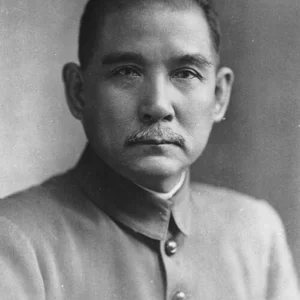

Chinese revolutionary and statesman, founder of the Kuomintang nationalist party and first president of the Republic of China in 1912. Regarded as the “father of the nation” by the Chinese for his role in overthrowing the Manchu Qing dynasty.
Sun Yat-sen(1866 — 1925)
Sun Yat-sen
dynastie Qing, république de Chine
6 min read
Frequently asked questions
Key Facts
- Born in 1866 in Guangdong province, died in 1925 in Beijing
- Co-founded the Tongmenghui (United League) in 1905, an anti-Manchu revolutionary organization
- The Xinhai Revolution of 1911 overthrew the Qing dynasty and ended the Chinese Empire
- Became the first provisional president of the Republic of China on 1 January 1912
- Formulated the “Three Principles of the People” (nationalism, democracy, the people's welfare)
Works & Achievements
Sun's first revolutionary organization, dedicated to overthrowing the Qing dynasty.
Union of China's revolutionary forces in Tokyo, the forerunner of the Kuomintang.
A political doctrine based on nationalism, democracy, and the people's welfare, the ideological foundation of the Republic.
As the first head of the republican state, he laid the institutions of the new regime after the fall of the Empire.
A major political party that would dominate Chinese life for decades, lasting in Taiwan to this day.
Sun restructured the party along Leninist lines and forged the first united front with the communists.
An officers' school founded in Canton to give the revolution a modern, disciplined army.
Anecdotes
In October 1896, during a stay in London, Sun Yat-sen was lured into and then held captive inside the Chinese legation, which was plotting to send him secretly back to China to be executed. He managed to smuggle out a message through an English servant; the British press seized on the affair and public pressure forced his release. This extraordinary episode made him famous around the world.
Trained as a physician in Hong Kong, Sun Yat-sen was one of the first two graduates of the College of Medicine for Chinese in 1892. Yet he soon abandoned the medicine of the body for that of the nation, declaring that he wanted to “heal China” rather than a handful of patients.
On 1 January 1912, Sun Yat-sen became the first provisional president of the young Republic of China. But he held the post for less than two months: to win over the powerful general Yuan Shikai and secure the abdication of the last emperor, he agreed to hand over the presidency to him as early as February 1912.
Sun Yat-sen spent most of his revolutionary life in exile — in Japan, Hawaii, Europe and the United States — to escape the imperial Qing police and raise funds among overseas Chinese communities. He cut off his queue (a sign of submission to the Manchu dynasty) and adopted disguises to travel incognito.
At his death in 1925, Sun Yat-sen left a political testament calling on his followers to continue the revolution “for the work was not yet complete.” Honored both in mainland China and in Taiwan, he remains one of the rare figures revered on both sides of the strait as the “father of the nation.”
Primary Sources
Autobiographical account in which Sun recounts his abduction at the Chinese legation in London and the dread of knowing that his repatriation and execution were being arranged.
Nationalism, democracy and the people's welfare: here Sun sets out the founding political doctrine intended to regenerate China and establish a republican government.
“Expel the Manchu Tartars, revive China, establish a republic and equalize land rights.” The founding oath of the revolutionary organization.
“The revolution is not yet finished; let all my comrades carry on the effort.” Last wishes dictated shortly before his death in Beijing.
Key Places
Sun Yat-sen's birthplace, near Canton, in southern China. He spent his childhood there before leaving to study in Hawaii.
City where Sun studied medicine and developed his revolutionary ideas through contact with Western institutions.
Site of his detention in 1896, an episode that made him famous worldwide.
Base of exile where Sun founded the Revolutionary Alliance (Tongmenghui) in 1905 and coordinated revolutionary action.
Capital of the provisional government where Sun was sworn in as President of the Republic in January 1912; his great mausoleum stands there on Purple Mountain.
City where Sun Yat-sen died of liver cancer on March 12, 1925, while negotiating the unification of the country.
Typical Objects

A jacket with a standing collar and four pockets that Sun helped popularize as a modern national outfit. In Chinese it bears his name (Zhongshan) and symbolizes the break with imperial dress.

A doctor's qualification earned in 1892, one of the first awarded by the College of Medicine for Chinese students. It reflects Sun's Western, scientific training.

A revolutionary emblem adopted by Sun's movement, which became the flag of the Kuomintang and then of the Republic of China. The sun's twelve rays symbolize the twelve hours and continuous progress.

Texts and lecture notes in which Sun set out his political doctrine. They served as the ideological foundation of the Kuomintang and the Republic.

A seal used by the provisional government in Nanjing in 1912 to authenticate official documents. It embodied the legitimacy of the new Republic.

The means of transport that carried Sun across Japan, Hawaii, Europe and America during his years of flight and fundraising. They illustrate a revolution led from abroad.
School Curriculum
Vocabulary & Tags
Key Vocabulary
Daily Life
Morning
During his years in exile, Sun often began his day by reading newspapers and mail from China and from Chinese communities abroad. Trained as a physician, he was methodical and would jot down his political ideas first thing in the morning.
Afternoon
His afternoons were spent in meetings with fellow revolutionaries, drafting manifestos, or raising funds from Chinese merchants and emigrants. He devoted a great deal of time to writing letters to coordinate uprisings from afar.
Evening
In the evening, Sun received supporters, delivered speeches, or continued writing his doctrinal works. Constantly watched by Qing agents, he had to remain discreet about his comings and goings.
Food
Sun ate modestly, blending southern Chinese cuisine (rice, vegetables, fish) with Western dishes he had discovered during his long stays in Hawaii, Hong Kong, and Europe. He also advocated simple, healthy food.
Clothing
He alternated between Western attire — suit and tie — during his travels and diplomatic contacts, and modernized Chinese garments. He helped popularize the high-collared tunic that today bears his name (Zhongshan).
Housing
A man constantly on the move, Sun lodged successively in rented houses, exile apartments, and residences offered by sympathizers in Japan, Hawaii, Europe, and China. He never owned a lavish home, living for the cause.
Historical Timeline
Period Vocabulary
Liens externes & ressources
Références
Œuvres
Fondation de la Société pour la régénération de la Chine (Xingzhonghui)
1894
Création de la Ligue jurée (Tongmenghui)
1905
Les Trois Principes du Peuple (San min zhuyi)
1905-1924
Présidence provisoire de la République de Chine
1912
Fondation du Kuomintang (Parti nationaliste)
1912
Réorganisation du Kuomintang et alliance soviétique
1923
Académie militaire de Whampoa
1924