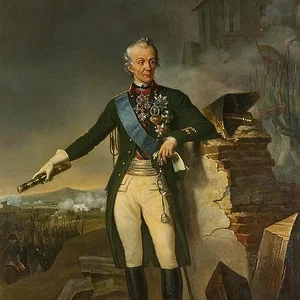

18th-century Russian generalissimo, considered one of the greatest military commanders in Russian history. Reputedly undefeated in more than sixty battles, he distinguished himself under the reigns of Catherine II and then Paul I, notably during the wars against the Ottoman Empire and Revolutionary France.
Suvorov(1730 — 1800)
Alexander Suvorov
Empire russe
6 min read
Frequently asked questions
Famous Quotes
« Train hard, fight easy»
« The bullet is a fool, the bayonet is wise»
Key Facts
- Born in 1730 in Moscow into a family of minor Russian nobility
- Capture of the Ottoman fortress of Izmail in 1790 during the Russo-Turkish War
- Raised to the rank of generalissimo in 1799 by Tsar Paul I
- Led the Italian campaign and the crossing of the Swiss Alps against the French armies in 1799
- Died in 1800 in Saint Petersburg, reputed to have never lost a battle
Works & Achievements
A daring raid on a Turkish fortress on the Danube, revealing his taste for swift offensives.
Victorious assault on an Ottoman fortress deemed impregnable, which became a symbol of Russian military power.
Suppression of the Polish uprising, consolidating Russian dominance over the region.
A military training manual distilling his doctrine of speed, the keen eye, and the assault.
Victory over the French army in Northern Italy during the campaign of the Second Coalition.
Another decisive victory against the French, completing the reconquest of Northern Italy.
An epic retreat across the Saint Gotthard and the Devil's Bridge, a logistical and tactical feat that remains legendary.
Anecdotes
Suvorov hated luxury and court manners: he slept on straw, rose before dawn, and bathed in ice-cold water even in winter. He took his meals with his soldiers and shared their living conditions, which earned him immense popularity in the ranks.
He summed up his military doctrine in a small handbook for soldiers, *The Science of Victory*, whose most famous maxim has remained proverbial in Russia: “The bullet is a fool, the bayonet is a fine fellow.” In it he championed speed, a keen eye, and the resolute assault.
In **1799**, nearly seventy years old, Suvorov led his army across the Swiss Alps to escape French encirclement. The crossing of the **St. Gotthard Pass** and the **Devil's Bridge**, through snow and without supplies, has remained one of the most celebrated military feats in Russian history.
Emperor **Paul I**, obsessed with Prussian discipline, imposed new powdered uniforms and rigid drills. Suvorov, who despised these parades, is said to have quipped: “Hair powder is not gunpowder, a curl is not a cannon, and I am not a German but a born Russian.” His mockery earned him a temporary fall from favor.
Reputedly undefeated, Suvorov liked to repeat that one must train hard in order to fight easily (“Hard in training, easy in battle”). He placed extreme importance on the instruction and morale of the troops, as much as on strategy.
Primary Sources
The bullet is a fool, the bayonet is a fine fellow. Fire once, but strike with the bayonet; throw the man to the ground with one blow.
Hard in training, easy in battle. The eye, speed, the assault.
We are crossing mountains that no one had ever crossed, driving back an enemy superior in number.
Key Places
Suvorov's birthplace, where he grew up in a family of the service nobility before joining the army.
An Ottoman fortress on the Danube, reputed to be impregnable, taken by storm by Suvorov in 1790. One of his most famous feats of arms.
A high mountain pass crossed by Suvorov's army in 1799 during the Swiss campaign, under extreme conditions.
Site of Suvorov's victory over the French in August 1799, during the Italian campaign of the Second Coalition.
The imperial capital where Suvorov died in 1800, shortly after returning from campaign. A museum is dedicated to him there today.
A rural estate where Suvorov was placed under house arrest during his disgrace under Paul I, before being recalled to take command in 1799.
Typical Objects

A blade fixed to the end of the musket, which Suvorov made into a decisive weapon of the assault. His maxim “the bayonet is bold” sums up his preference for close combat.

The standard firearm of the 18th-century Russian infantryman, loaded through the muzzle. Suvorov judged its fire unreliable and favoured the shock of the bayonet.

A bladed weapon carried by cavalry and staff officers. A badge of command as much as a fighting weapon.

A mobile piece of artillery drawn by horses, used to prepare assaults and support the infantry on the battlefield.

A short military instruction treatise written by Suvorov for his soldiers, blending maxims and training directives. A founding text of Russian military art.

Crosses and stars of the great Russian orders (Saint Andrew, Saint George) rewarding Suvorov's victories. Symbols of the prestige conferred by sovereigns.
School Curriculum
Vocabulary & Tags
Key Vocabulary
Daily Life
Morning
Suvorov rose before dawn, often around three or four in the morning. He began his day with physical exercise and a splash of cold water, true to his Spartan discipline, before inspecting his troops.
Afternoon
His afternoons on campaign were devoted to maneuvers, training the soldiers, and preparing plans. He insisted that the army drill hard in order to fight with ease.
Evening
In the evening, he often shared the bivouac of his men, dictating his correspondence and orders. He went to bed early so he could resume his day well before sunrise.
Food
Suvorov ate simply, refusing the refined dishes of the court. He gladly took the ordinary fare of the soldiers: soup (shchi), porridge (kasha), black bread, and kvass, out of a concern for setting an example and for frugality.
Clothing
He wore the Russian military uniform, which he wanted to be practical, and he loathed the fripperies imposed by Prussian fashion under Paul I. His unkempt appearance and his contempt for pomp were famous.
Housing
On campaign, he lodged in a tent or in modest billets, often sleeping on straw. Outside of war, he lived on his estates, as at Konchanskoye during his disgrace.
Historical Timeline
Period Vocabulary
Liens externes & ressources
Références
Œuvres
Prise de Turtukai
1773
Prise d'Izmaïl
1790
Campagne de Pologne et prise de Praga
1794
La Science de la victoire
1795-1796
Bataille de la Trebbia
1799
Bataille de Novi
1799
Traversée des Alpes suisses
1799