 flip
flipÇäk-çäk (fried honey pyramid)
Çäk-çäk (fried honey pyramid)
Why this dish? Çäk-çäk is the very symbol of Tatar celebration, present at every wedding and every festivity. At Söyembikä's wedding to Safa Giray, Khan of Kazan, a pyramid of çäk-çäk would have stood at the center of the banquet — a custom still alive today in Tatar weddings, directly linking this dessert to the sovereign's intimate life.
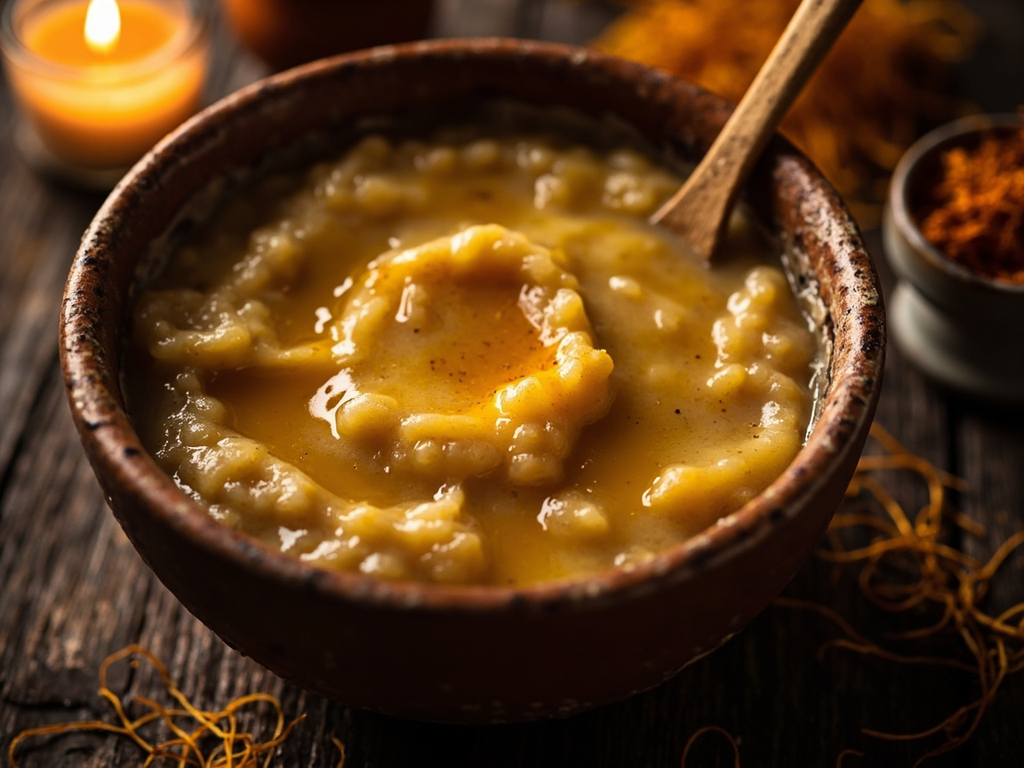
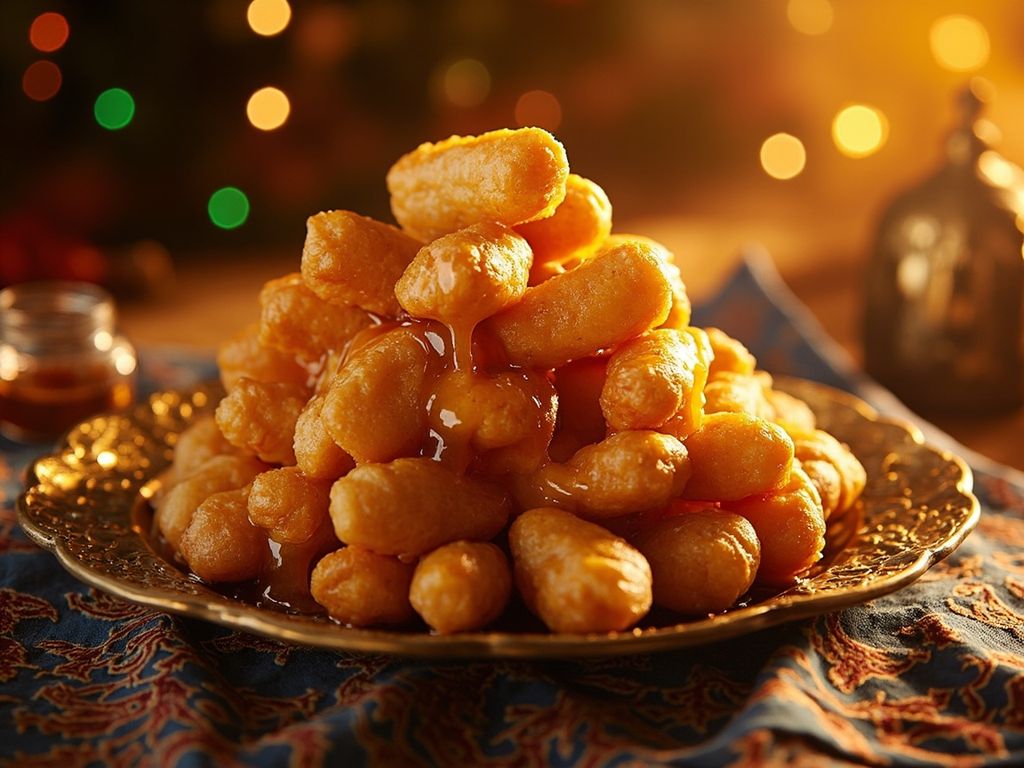
Small egg-dough sticks fried in oil then coated in hot honey, shaped into a pyramid or mound. The texture is crunchy on the outside, tender inside, and the whole shines with a golden honey glaze.
Çäk-çäk is the joy of my house when times are festive. When I married Safa Giray, may God have mercy on him, my women shaped a mountain of these little golden sticks, as high as a child's arm, and drenched it with honey from the Kama forests. The guests pulled off sticky pieces with their fingers, laughing. This is our custom for weddings — and even in exile in Kasimov, I have çäk-çäk prepared, for it reminds me of the happy days of Kazan.
- •Wheat flour — enough (dough)
- •Eggs — several (dough binder)
- •Forest honey — abundantly (coating)
- •Clarified butter or animal fat — for frying (cooking)
- •Salt — a pinch (enhance dough)
Çäk-çäk (fried honey pyramid)
Small egg-dough sticks fried in oil then coated in hot honey, shaped into a pyramid or mound. The texture is crunchy on the outside, tender inside, and the whole shines with a golden honey glaze.
Why this dish? Çäk-çäk is the very symbol of Tatar celebration, present at every wedding and every festivity. At Söyembikä's wedding to Safa Giray, Khan of Kazan, a pyramid of çäk-çäk would have stood at the center of the banquet — a custom still alive today in Tatar weddings, directly linking this dessert to the sovereign's intimate life.
Çäk-çäk is the joy of my house when times are festive. When I married Safa Giray, may God have mercy on him, my women shaped a mountain of these little golden sticks, as high as a child's arm, and drenched it with honey from the Kama forests. The guests pulled off sticky pieces with their fingers, laughing. This is our custom for weddings — and even in exile in Kasimov, I have çäk-çäk prepared, for it reminds me of the happy days of Kazan.
Ingredients (period version)
- Wheat flour — enough (dough)
- Eggs — several (dough binder)
- Forest honey — abundantly (coating)
- Clarified butter or animal fat — for frying (cooking)
- Salt — a pinch (enhance dough)
Ingredients
- All-purpose flour (T45) — 300 g (dough)
- Eggs — 3 (binder)
- Melted butter — 30 g (dough softness)
- Salt — 1 pinch (enhance)
- Sunflower oil — 500 ml (frying)
- Liquid honey — 250 g (coating)
- Sugar — 50 g (syrup with honey)
Method
- Beat eggs with salt and melted butter. Gradually incorporate flour to obtain a soft, non-sticky dough. Let rest 20 min.
- Divide dough into portions. Roll each portion into thin ropes (5-6 mm diameter), then cut into 2-3 cm pieces.
- Heat oil to 170 °C. Fry pieces in small batches until golden (2-3 min). Drain on paper towels.
- In a wide saucepan, heat honey and sugar over low heat until a fluid, frothy syrup forms (do not boil vigorously).
- Pour fried sticks into honey syrup. Gently mix with an oiled spatula to coat each piece evenly.
- On a lightly oiled serving plate, shape the sticky mass into a pyramid or dome with wet hands. Let cool and set for 1 h before serving.
How it was made : Çäk-çäk is considered the Tatar national dessert. Its origin dates back to the Volga Bulgars (ancestors of the Kazan Tatars). Traditionally prepared by the bride's family and offered to the groom's, it is inseparable from Tatar wedding celebrations (nikah tuyı). Honey from the Volga-Kama region was abundant and of high quality, the forests being rich in linden trees.
The contemporary twist : Serve as small individual pyramids on gold-rimmed saucers, topped with a flake of edible gold leaf.
Sources : Khalikov, N. Khozyaystvo tatar Srednego Povolzhya i Priuralya (Economy of the Tatars of the Middle Volga and Urals), Kazan, 1995 · Iskhakov, D. & Izmaylov, I. Etnopoliticheskaya istoriya tatar (Ethnopolitical History of the Tatars), Kazan, 2007
Söyembikä · Charactorium