 flip
flipManjar blanco — Capon Blancmange with Almond and Rice
Manjar blanco — Capon Blancmange with Almond and Rice
Why this dish? Manjar blanco is THE prestige dish of Aragon-Catalonia, the dish of great royal tables of Aragon: a Valencian who rose to the throne of Saint Peter had it served at his banquets to recall, even in Borgia Rome, the splendor of his native crown. Rice, almond, and sugar were costly goods: three words for power.
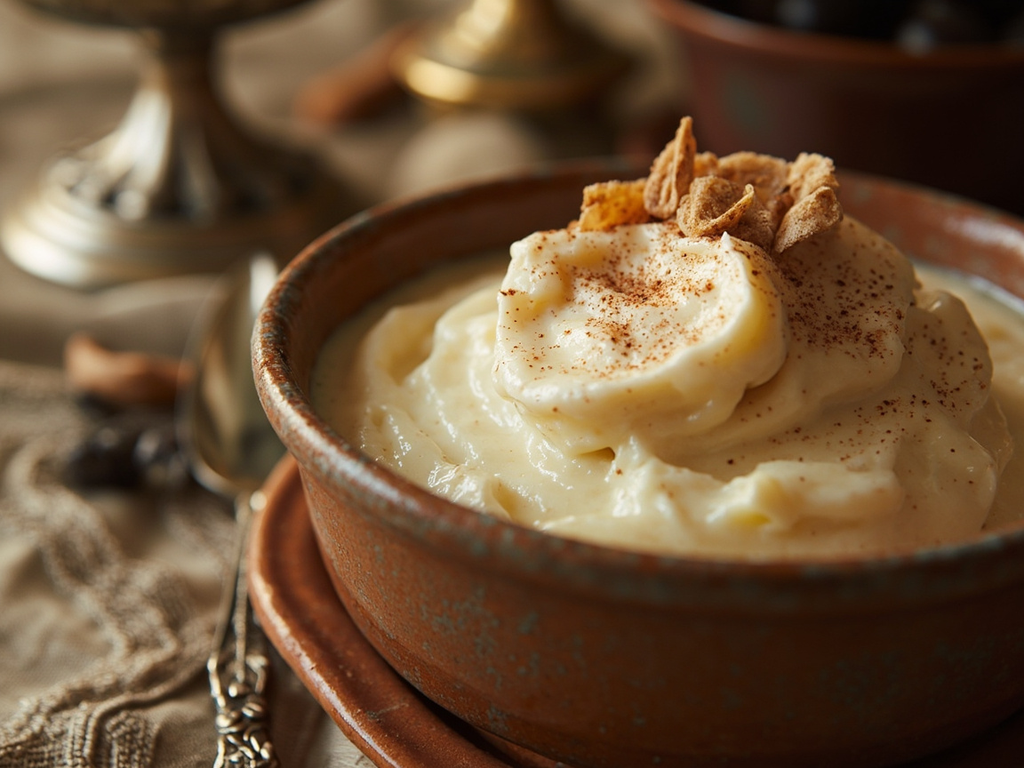
Shredded capon breast slow-cooked in sweetened almond milk, bound with rice and perfumed, until a white, silky, noble cream is obtained. The saltiness of the bird and the sweetness of the almond merge as medieval cuisine loved them.
Approach, and look upon this white so pure: in Xàtiva already, in the house of Borja, we held this manjar for the dish of lords, and We have brought it to Our table in Rome. Have the almonds ground until they yield their milk, shred the capon fine as silk thread, and let it simmer without haste — haste is the enemy of fine things, in cooking as in conclaves. Sweeten it with a generous hand: a pope does not skimp. And remember that a white dish, set before cardinals, is sometimes worth more than a long speech.
- •Capon (poultry breast) — the flesh of a plump capon (shredded savory base)
- •Sweet almonds — a good handful, ground in a mortar (almond milk, binder and flavor)
- •Rice (from Valencia or Lombardy) — a handful, or its flour (creamy binder)
- •Sugar — generously (prestigious sweetness)
- •Rose water — a few drops (noble perfume)
- •Salt — a little (seasoning)
Manjar blanco — Capon Blancmange with Almond and Rice
Shredded capon breast slow-cooked in sweetened almond milk, bound with rice and perfumed, until a white, silky, noble cream is obtained. The saltiness of the bird and the sweetness of the almond merge as medieval cuisine loved them.
Why this dish? Manjar blanco is THE prestige dish of Aragon-Catalonia, the dish of great royal tables of Aragon: a Valencian who rose to the throne of Saint Peter had it served at his banquets to recall, even in Borgia Rome, the splendor of his native crown. Rice, almond, and sugar were costly goods: three words for power.
Approach, and look upon this white so pure: in Xàtiva already, in the house of Borja, we held this manjar for the dish of lords, and We have brought it to Our table in Rome. Have the almonds ground until they yield their milk, shred the capon fine as silk thread, and let it simmer without haste — haste is the enemy of fine things, in cooking as in conclaves. Sweeten it with a generous hand: a pope does not skimp. And remember that a white dish, set before cardinals, is sometimes worth more than a long speech.
Ingredients (period version)
- Capon (poultry breast) — the flesh of a plump capon (shredded savory base)
- Sweet almonds — a good handful, ground in a mortar (almond milk, binder and flavor)
- Rice (from Valencia or Lombardy) — a handful, or its flour (creamy binder)
- Sugar — generously (prestigious sweetness)
- Rose water — a few drops (noble perfume)
- Salt — a little (seasoning)
Ingredients
- Chicken or capon breast — 300 g (shredded base)
- Ground almonds — 150 g (almond milk)
- Water — 600 ml (for almond milk)
- Rice flour — 40 g (binder)
- Sugar — 80 g (sweetness)
- Rose water — 1 tsp (perfume)
- Salt — 1 pinch (seasoning)
Method
- Poach the poultry breast in salted water, drain, and shred very finely by hand.
- Prepare almond milk: mix ground almonds with hot water, let infuse 20 min, then strain, pressing firmly.
- Dissolve rice flour in a little cold almond milk to avoid lumps.
- Gently heat the remaining almond milk with sugar and salt, add the dissolved rice flour, and stir until creamy and thickened.
- Fold in the shredded poultry and simmer on very low heat for 15-20 min, stirring, until a smooth cream forms.
- Perfume with rose water off the heat. Serve warm, mounded smooth.
How it was made : Manjar blanco / menjar blanc appears in major medieval collections (Catalan Llibre de Sent Soví, later Llibre del Coch). It was prepared over a wood fire in earthenware pans, grinding almonds and rice in a mortar — a long task, thus reserved for households that could employ multiple cooks. Sugar, imported and costly, made it a showy dish.
The contemporary twist : Serve as a glossy quenelle on a slate plate, topped with a toasted almond sliver and a dusting of cinnamon, like a black-and-white nod to the Borgia coat of arms.
Sources : Llibre de Sent Soví (XIVe s.) · Ruperto de Nola, Llibre del Coch (éd. 1520, recettes antérieures) · Maestro Martino, Libro de arte coquinaria (XVe s.)
Alexander VI · Charactorium