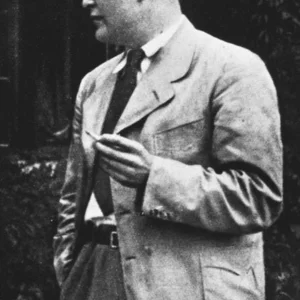

A Japanese thinker and scholar, D.T. Suzuki was the main figure who introduced Zen Buddhism to the West in the 20th century. Through his books and lectures in English, he made Zen thought known to European and American intellectuals and artists.
Suzuki(1954 — ?)
Masaaki Suzuki
Japon
5 min read
Frequently asked questions
Key Facts
- Born in 1870 in Kanazawa (Japan), died in 1966
- Practiced Rinzai Zen at the Engaku-ji monastery in Kamakura in his youth
- Stayed in the United States (1897-1909), where he worked on translating Buddhist texts
- Published 'Essays in Zen Buddhism' (beginning in 1927), a major work that spread Zen in the West
- Had a lasting influence on postwar Western culture (the Beat Generation, psychoanalysis, the arts)
Works & Achievements
Suzuki's first major work in English, introducing Mahayana Buddhism to Western audiences.
A major collection that revealed Zen to the intellectuals and artists of Europe and America.
An accessible introductory work, later prefaced by Carl Jung, which became a classic.
A detailed account of daily life and discipline in a Zen monastery.
A study of Zen's influence on Japanese art, poetry, theatre and the art of the sword.
A journal founded with his wife to spread Buddhism in English, still published today.
An essay comparing Christian and Buddhist mysticism, the fruit of his interfaith dialogue.
Anecdotes
At 27, the young Suzuki crossed the Pacific to settle in a small Illinois town, LaSalle, where he worked for eleven years for the publisher Paul Carus. There he translated Asian texts by day and meditated on Zen by night, becoming a living bridge between two worlds.
Before leaving for the West, his master Soyen Shaku gave him the Buddhist name “Daisetz,” which can be translated as “great simplicity” or “great clumsiness.” Suzuki liked to say with a smile that the nickname suited him very well.
In 1911, Suzuki married an American, Beatrice Erskine Lane, a Theosophist and a graduate of Columbia University. Together, in 1921, they founded the journal The Eastern Buddhist to introduce Buddhism to English-speaking audiences.
In the 1950s, when he was over 80, he taught at Columbia University in New York. His lectures drew famous artists and thinkers such as the composer John Cage and the psychoanalyst Erich Fromm.
Suzuki lived nearly 96 years and was still writing shortly before his death. It is said that, ill in the hospital, his last words were an expression of thanks and apology addressed to those caring for him.
Primary Sources
Zen, in its essence, is the art of seeing into the very nature of one's being, and it points the way from bondage to freedom.
Satori may be defined as an intuitive grasp into the nature of things, in contrast to the analytical or logical understanding of them.
Mahayana Buddhism is not a dead religion shut up in books; it is a living organism that is still growing.
Zen has deeply shaped the art, poetry, and even the swordsmanship of Japan, by teaching one to act without hesitation or calculation.
Key Places
Suzuki's birthplace, on the west coast of Japan, where he was born in 1870 into a family of physicians.
Great Rinzai Zen monastery where Suzuki practiced meditation and experienced awakening (satori) under his masters.
Small town where Suzuki worked for eleven years for the publisher Paul Carus, translating Eastern texts into English.
Buddhist university where Suzuki became a professor in 1921 and founded the journal The Eastern Buddhist.
University where Suzuki taught courses on Zen in the 1950s, influencing Western artists and thinkers.
Ancient capital and major center of Zen where Suzuki resided for many years and died in 1966.
Typical Objects

Suzuki wrote prolifically, in both Japanese and English, and valued calligraphy as connected to the Zen spirit. The brush and black ink were used to draw characters and ideograms.

A round cushion used to sit in the zazen meditation posture. It supports the long stillness of Zen practice.

Collections of sayings attributed to the Buddha and the Zen masters. Suzuki translated and commented on many of their passages for Western audiences.

Riddles or paradoxes used in Rinzai Zen to break the student's logical reasoning. Suzuki explained them to Western readers.

A bowl used in the tea ceremony, an art that Suzuki linked to the Zen spirit of simplicity and attentiveness. An emblematic object of the Japanese culture he described.

Suzuki was a tireless scholar, reading and writing into very old age. Glasses and pen symbolize his work as an erudite and translator.
School Curriculum
Vocabulary & Tags
Key Vocabulary
Daily Life
Morning
Suzuki began early, often with a period of silent meditation (zazen) and the reading of Buddhist texts. The morning was devoted to study and writing, which he pursued with great discipline.
Afternoon
In the afternoon, he wrote his books and translations, or prepared his lessons and lectures. He also received visitors, students, and scholars who came to question him about Zen.
Evening
In the evening, he often continued his reading and correspondence, which was abundant and international. He enjoyed quiet conversation and exchanges about spirituality.
Food
He followed a simple Japanese diet, based on rice, vegetables, fish, miso soup, and tea. The plainness of the meals matched the spirit of frugality of Zen.
Clothing
Depending on the circumstances, he wore the traditional Japanese kimono or the dark Western suit of the scholar. In the West, he often appeared in a jacket and tie, a small man with an attentive face.
Housing
He lived much of his life in Kamakura, near the Zen monasteries, in a house surrounded by gardens conducive to calm. His long stays abroad also led him to lodge in the United States and in Europe.
Historical Timeline
Period Vocabulary
Liens externes & ressources
Références
Œuvres
Outlines of Mahayana Buddhism
1907
Essays in Zen Buddhism (trois séries)
1927-1934
An Introduction to Zen Buddhism
1934
The Training of the Zen Buddhist Monk
1934
Zen and Japanese Culture
1938 / 1959
The Eastern Buddhist (revue)
1921
Mysticism: Christian and Buddhist
1957