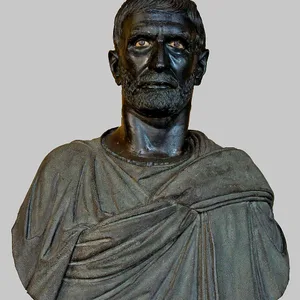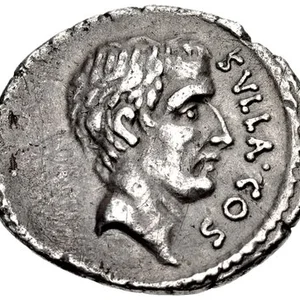

A Roman general and statesman, Sulla seized power by force in the aftermath of civil wars. Appointed dictator, he reformed the institutions of the Republic in favor of the Senate before stepping down.
Sulla(137 av. J.-C. — 77 av. J.-C.)
Sulla
Rome antique
6 min read
Frequently asked questions
Key Facts
- Victor of the First War against Mithridates VI of Pontus (88-85 BC)
- Marched on Rome in 88 BC, an unprecedented act of leading his army against his own city
- Rivalry and civil war against Marius and then his supporters (87-82 BC)
- Appointed dictator in 82 BC and established the proscriptions, lists of enemies condemned to death
- Voluntarily resigned the dictatorship in 79 BC and died in 78 BC
Works & Achievements
The first general to enter Rome under arms, Sulla set a precedent that upended the balance of the Republic and paved the way for the civil wars.
Sulla drove Mithridates VI out of Greece and the province of Asia, restoring Roman prestige in the East through the Peace of Dardanus.
Appointed “dictator legibus scribundis,” Sulla concentrated unprecedented powers in order to completely reorganize the Roman state.
He strengthened the authority of the Senate, expanded to 600 members, and sharply reduced the powers of the tribunes of the plebs.
Sulla reorganized the justice system by creating specialized permanent courts, a lasting foundation of Roman criminal law.
An autobiography in several books, now lost, in which Sulla recounted his life and justified his actions; a source used by Plutarch.
A gesture extremely rare in history, Sulla spontaneously gave up absolute power to become an ordinary citizen again.
Anecdotes
In 88 BCE, furious that command of the war against Mithridates had been taken from him and given to Marius, Sulla did something unheard of: he marched on Rome itself with his legions. It was the first time a Roman general had crossed the walls of his own city under arms, breaking a sacred taboo.
After his final victory, Sulla invented the “proscriptions”: he had lists of enemies marked for death posted in the forum. Anyone who killed a proscribed man received a reward, and the victim's property was confiscated. Thousands of Romans perished this way, and no one could feel safe.
Sulla took the surname “Felix,” meaning “the Fortunate,” convinced that the goddess Venus and Fortune protected him. He credited all his victories to this divine favour rather than to his talent alone.
At the height of his power, when he was dictator and no one dared resist him, Sulla did something astonishing: he voluntarily gave up all his powers in 79 BCE and retired to his villa in Campania to live there as a private citizen.
As a young man, Sulla is said to have spotted the danger posed by the young Julius Caesar and wanted to have him eliminated. It is reported that he claimed to see “many a Marius” in this ambitious teenager, foreshadowing the future conqueror of Gaul.
Primary Sources
It is said that his face was covered with red blotches sprinkled with white, which led a witty Athenian to compare him to a mulberry dusted with flour.
Sulla, having become master of Rome, posted lists proscribing to death forty senators and about sixteen hundred knights.
Lucius Sulla, having seized the Republic by force of arms, had a good beginning but a bad end.
No man before him had used victory with greater cruelty, nor relinquished power with greater moderation.
Key Places
Capital of the Republic, captured twice by Sulla at the head of his legions. It was there that he wielded his dictatorship and carried out his proscriptions.
Site of the decisive battle of 82 BC where Sulla crushed the Marian and Samnite forces at the gates of Rome.
Greek city allied with Mithridates that Sulla besieged and recaptured in 86 BC, plundering its riches to finance the war.
Kingdom where the young quaestor Sulla secured the surrender of Jugurtha in 105 BC, the beginning of his reputation.
Region of southern Italy where Sulla retired after his abdication and where he died in 78 BC.
Typical Objects

A short double-edged sword, the main weapon of the Roman legionary in close combat. A symbol of the military might on which Sulla built his power.

A bundle of rods surrounding an axe, carried by the lictors ahead of the magistrates. It symbolized the power to command and to punish, a sign of the imperium held by Sulla.

A white toga edged with a purple band reserved for the higher magistrates. An official garment marking Sulla's senatorial and consular rank.

A bronze or iron helmet protecting the soldier's head, often topped with a crest. Equipment of the legions devoted to Sulla during the civil wars.

Lists of names posted publicly in the forum designating the enemies to be put to death. A terrifying instrument of the repression organized by Sulla.

The highest Roman military honor, awarded to a general who had saved an entire army. Sulla is said to have received this extremely rare distinction during the Social War.
School Curriculum
Vocabulary & Tags
Key Vocabulary
Daily Life
Morning
As a Roman magistrate, Sulla received his clients at dawn during the “salutatio,” a crowd of supporters who came to seek favors and protection. He then handled affairs of state, read reports, and dispensed justice in the forum.
Afternoon
The afternoon was devoted to public affairs: Senate sessions, military audiences, and campaign planning. In times of war, he inspected his legions and directed operations from his command tent.
Evening
Renowned for his love of pleasure, Sulla enjoyed lengthy banquets surrounded by actors, musicians, and friends. These evenings mixed feasting, wine, and conversation, contrasting sharply with the harshness of his political conduct.
Food
The diet was based on bread, grain porridge, olive oil, water-diluted wine, vegetables, cheese, and fish. Aristocratic banquets also offered meats, game, and refined dishes seasoned with sauces.
Clothing
Sulla wore the linen or wool tunic and the purple-bordered toga of the senior magistrates. In battle, he donned the cuirass, the general's red cloak (*paludamentum*), and the insignia of imperium.
Housing
Born into a family that was at first modest, he lived in his youth in ordinary lodgings, then, once he had made his fortune, in a wealthy residence (*domus*) in Rome adorned with marble and mosaics. He ended his days in a luxurious villa in Campania.
Historical Timeline
Period Vocabulary
Liens externes & ressources
Références
Œuvres
Marche sur Rome (88 av. J.-C.)
88 av. J.-C.
Victoire dans la première guerre mithridatique
85 av. J.-C.
Dictature constituante
82-79 av. J.-C.
Réformes constitutionnelles (leges Corneliae)
81 av. J.-C.
Réforme des tribunaux (quaestiones perpetuae)
81 av. J.-C.
Mémoires (Commentarii rerum gestarum)
vers 79-78 av. J.-C.
Abdication volontaire
79 av. J.-C.