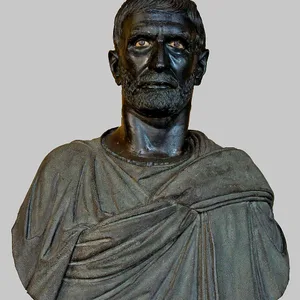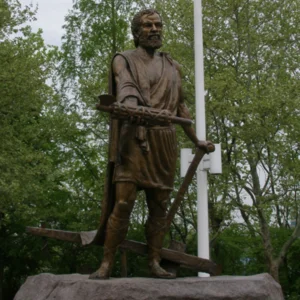

Roman patrician of the 5th century BC, appointed dictator in 458 BC to rescue an army surrounded by the Aequi. After his victory in sixteen days, he immediately renounced absolute power to return to tilling his field, becoming the model of Roman civic virtue.
Cincinnatus(518 av. J.-C. — 430 av. J.-C.)
Lucius Quinctius Cincinnatus
Rome antique
6 min read
Frequently asked questions
Key Facts
- Appointed dictator in 458 BC to relieve the consul Minucius, besieged on Mount Algidus by the Aequi
- Said to have defeated the Aequi in sixteen days, then abdicated immediately to return to his farm
- Recalled a second time as dictator in 439 BC during the affair of Spurius Maelius
- According to tradition (Livy), the Senate's envoys found him plowing his field beyond the Tiber
- Became the enduring symbol of the citizen who serves the State without personal ambition (a model invoked as late as George Washington and the city of Cincinnati)
Works & Achievements
Exceptional appointment to the supreme magistracy to rescue a Roman army. It illustrates the resort, in times of crisis, to a single and temporary power.
Rescue of consul Minucius's army through a nighttime encircling maneuver. The defeated Aequi were forced to pass under the yoke.
Surrender of absolute power after sixteen days, when he could have kept it for six months. A founding gesture of the Roman ideal of the citizen in service of the State.
Recalled to power in his old age to foil a plot threatening the freedom of Rome. Once again he immediately gave back his authority.
A figure cited by Livy, Cicero, and the moralists as an example of selflessness. He inspired figures as late as George Washington and the city of Cincinnati.
Anecdotes
In 458 BC, a delegation from the Roman Senate found Cincinnatus plowing his small four-acre field on the far side of the Tiber. He was asked to put on his toga to hear the Senate's message: he had been named dictator of Rome to rescue the consul Minucius and his army, who were surrounded by the Aequi.
Once appointed dictator, Cincinnatus raised an army in haste and ordered every soldier to bring twelve stakes and five days' worth of provisions. Under cover of night, his men encircled the enemy by digging a trench and raising loud cries to signal their presence to the trapped Roman army.
Cincinnatus defeated the Aequi and forced them to pass under the yoke, a humiliation in which the vanquished filed past bent low beneath three spears arranged as an archway. According to tradition, the whole operation lasted only sixteen days.
Although he could have held absolute power for six months, Cincinnatus gave up his office as dictator after only fifteen or sixteen days and returned to working his farm. This act made him the model of the virtuous citizen who serves the State without coveting power.
Tradition holds that Cincinnatus was called back a second time as dictator, around 439 BC, already very old, to foil the plot of Spurius Maelius, a wealthy plebeian suspected of wanting to make himself king. Once again, his mission accomplished, he handed back power.
Primary Sources
The sole hope of the Roman Empire, L. Quinctius, was at that time cultivating a four-acre field beyond the Tiber... The envoys greeted him and asked him to put on his toga to hear the orders of the Senate.
Cincinnatus, having fulfilled his mission in sixteen days, laid down a dictatorship that he was entitled to hold for six months and returned to his fields.
He was found working the land with his own hands, and it was in this condition that he received the announcement of his appointment to the highest magistracy.
It was while he was plowing his field that L. Quinctius Cincinnatus was told he had been made dictator.
Key Places
Capital of the young Roman Republic, seat of the Senate that appointed Cincinnatus dictator. His public life unfolded between the Forum and the Capitol.
A small four-acre estate beyond the Tiber, on the site of the future Prata Quinctia (“Quinctius's meadows”). It was there that he was ploughing when they came to fetch him.
A height in the Alban Hills, southeast of Rome, where the army of the consul Minucius was surrounded by the Aequi. There Cincinnatus won his decisive victory.
The political heart of Rome, where the assemblies met and the dictator exercised his authority. It was there that Cincinnatus laid down his power.
A mountainous region east of Rome inhabited by the Aequi, an Italic people in recurring war against the Republic. The setting of the 458 BC campaign.
Typical Objects

A large draped woolen garment worn by Roman citizens. It was by putting on his toga, at the senators' request, that Cincinnatus symbolically passed from farmer to magistrate.

A wooden ard drawn by oxen, used to till the fields. It is the emblematic attribute of Cincinnatus, who was summoned while in the middle of ploughing.

A bundle of birch rods bound around an axe, carried by the lictors. The dictator was attended by twenty-four of them, a symbol of his power to command and to punish.

The short sword of Roman foot soldiers, used for close combat. Cincinnatus armed with it the legions he hastily raised against the Aequi.

A wooden stake that each soldier had to carry to fortify the camp. Cincinnatus ordered his men to bring twelve each in order to surround the army of the Aequi by night.

An archway made of three spears under which defeated enemies were forced to pass, stooped, as a sign of submission. Cincinnatus subjected the Aequi to it after his victory.
School Curriculum
Vocabulary & Tags
Key Vocabulary
Daily Life
Morning
As a peasant-citizen, Cincinnatus rose at dawn to work his own small plot of land beyond the Tiber. He guided his ox-drawn plough, dug, and sowed, sharing the harsh life of Rome's small landowners.
Afternoon
His afternoons were spent in the fields or settling the affairs of the estate and the *familia*. When he held a magistracy, he sat in the Forum, dispensed justice, and deliberated with the Senate.
Evening
In the evening, the family gathered for a simple meal by the light of oil lamps. They honored the household gods (the Lares and Penates) before going to bed, early after nightfall.
Food
The diet of Romans in this period was frugal: grain porridge (*puls*), bread, vegetables, beans, olives, and cheese. Meat remained rare, and wine, often diluted with water, accompanied festival days.
Clothing
At work, he wore a simple wool tunic belted at the waist. For public affairs, he put on the white toga, the official garment of the citizen, which the senators begged him to don.
Housing
His home was a modest rural farmhouse of stone and wood, arranged around a central room (the *atrium*) with a hearth. There they lived as close as possible to the fields and livestock, far from the later luxury of wealthy Romans.
Historical Timeline
Period Vocabulary
Liens externes & ressources
Références
Œuvres
Dictature de 458 av. J.-C.
458 av. J.-C.
Victoire du mont Algide sur les Èques
458 av. J.-C.
Abdication volontaire de la dictature
458 av. J.-C.
Seconde dictature contre Spurius Maelius
vers 439 av. J.-C.
Modèle de la vertu civique (exemplum)
Antiquité et postérité