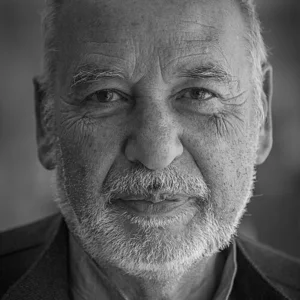

Tahar Ben Jelloun is a French-Moroccan writer and poet born in 1944 in Fès. A French-language author, he explores exile, immigration, and the condition of Maghrebi societies. He received the Prix Goncourt in 1987 for The Sacred Night.
Tahar Ben Jelloun(1947 — ?)
Tahar Ben Jelloun
France, Maroc
6 min read
Frequently asked questions
Famous Quotes
« Racism means placing the other, the stranger, beneath oneself.»
« Friendship is a religion without God or Last Judgment.»
Key Facts
- Born December 1, 1944, in Fès (Morocco)
- Publishes his first novel Harrouda in 1973
- Receives the Prix Goncourt in 1987 for The Sacred Night
- Publishes Racism Explained to My Daughter in 1998, translated into many languages
- Elected member of the Académie Goncourt in 2008
Works & Achievements
His first novel, poetic and bold, revealing his singular voice that blends Fez, Tangier and the French language.
An essay drawn from his doctoral thesis, giving voice to the emotional distress of North African immigrant workers.
A novel about a girl raised as a boy, which brought him recognition and explores identity and the condition of women.
A sequel to L'Enfant de sable, this novel earned him the 1987 Prix Goncourt.
A short educational book born from his daughter's questions, translated around the world and used in classrooms.
A novel about the secret prison camp of Tazmamart, which won the International IMPAC Dublin Literary Award in 2004.
A novel about young Moroccans' longing to emigrate and the illusions of a European eldorado.
Anecdotes
In 1966, as a young student, Tahar Ben Jelloun was sent to a disciplinary camp of the Moroccan army for taking part in demonstrations. During eighteen months of punishment, he secretly wrote his first poems on scraps of paper. It was there, deprived of his freedom, that his vocation as a writer was born.
In 1987, he became the first writer from the Maghreb to receive the Prix Goncourt, France's most prestigious literary award, for his novel The Sacred Night. A Moroccan author writing in French thus entered the grand history of French letters.
In 1997, his daughter Mérième, about ten years old, went with him to a demonstration against an immigration law and asked him: “Tell me, Papa, what is racism?” From these questions came the book Racism Explained to My Daughter (1998), translated into dozens of languages and read in schools the world over.
When he arrived in France in 1971, Ben Jelloun worked as a psychotherapist with North African immigrant workers. He listened to their silences and their solitude, an experience that would feed into his essay La plus haute des solitudes.
The writer is also a painter: he wields the brush as well as the pen and has exhibited his canvases. For him, painting and writing are two ways of giving voice to the world and to memory.
Primary Sources
“— Tell me, Daddy, what is racism? — Racism is a fairly widespread behavior, common to all societies, that has sadly become commonplace in certain countries.”
“For a long time I searched for the black stone that cleanses the soul of death.” — the opening line of the novel inspired by the secret prison of Tazmamart.
An essay drawn from his thesis, subtitled “The Emotional and Sexual Misery of North African Emigrants,” it gives voice to the silent distress of immigrant workers.
A father, disappointed at having only daughters, decides to raise his eighth child — a girl — as a boy named Ahmed: the novel questions identity and the condition of women.
Key Places
Birthplace of Tahar Ben Jelloun in 1944, a major cultural and spiritual city of Morocco.
City where his family settled when he was a teenager; he attended a French high school there. He still lives there part of the year today.
Here he studied philosophy before becoming a teacher and then leaving for France.
Military camp where he was interned for eighteen months in 1966-1968 for taking part in protests; it was there that he wrote his first poems.
He settled here in 1971, pursued his studies, and built his career as a writer and columnist.
Typical Objects

The writer's and poet's primary tools, with which he composes novels, poems and articles.

The emblematic tool of the writer in the second half of the 20th century, before the arrival of the computer.

Ben Jelloun is also a painter; his brushes extend through color what writing says through words.

A long traditional hooded tunic from Morocco, a sign of the writer's attachment to his culture of origin.

Mint tea, a Moroccan ritual of hospitality, recurs often in his world between Tangier and Paris.

A platform where Ben Jelloun publishes columns and articles, taking a stand on immigration, racism and the Maghreb.

His many novels, collections and essays, translated into more than forty languages, spread a Franco-Moroccan body of work across the entire world.
School Curriculum
Vocabulary & Tags
Key Vocabulary
Daily Life
Morning
A contemporary writer, Tahar Ben Jelloun often devotes his mornings to writing, the time when the mind is clearest. He composes novels, poems, and columns by hand or on a typewriter. Coffee and reading the newspapers accompany this steady work.
Afternoon
The afternoon may be set aside for painting, another passion that extends his writing through color. He reads a great deal, meets publishers and journalists, and prepares his public appearances. Literary events and travel give rhythm to his life as a renowned author.
Evening
In the evening, it is time for lectures, book signings, and exchanges with readers, in France as well as abroad. He also enjoys dinners with friends and conversation, which are sources of ideas. Reading often brings the day to a close.
Food
His table reflects his dual roots: Moroccan cuisine (tagines, couscous, pastries with honey and almonds) and French gastronomy. Mint tea, a ritual of hospitality, holds a place of honor. Shared meals are an opportunity to pass on culture.
Clothing
He most often wears modern city clothes, a suit or the attire of a Parisian intellectual. In Morocco, he may put on the traditional djellaba. His look thus blends European elegance with Maghrebi heritage.
Housing
He divides his life between Paris and Morocco, especially Tangier. His living space is that of a writer: a study filled with books, manuscripts, and sometimes painted canvases. Two countries, two homes, which nourish his writing with the dialogue between East and West.
Historical Timeline
Period Vocabulary
Liens externes & ressources
Références
Œuvres
Harrouda
1973
La plus haute des solitudes
1977
L'Enfant de sable
1985
La Nuit sacrée
1987
Le Racisme expliqué à ma fille
1998
Cette aveuglante absence de lumière
2001