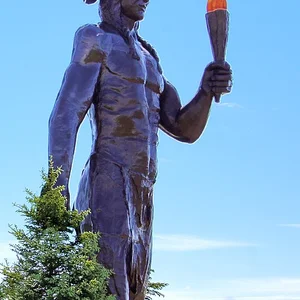

Tangaroa is the god of the sea and oceans in Polynesian mythology, venerated across the Pacific (Māori, Samoa, Tahiti, Hawaii). Son of Rangi (sky) and Papa (earth), he rules over the ocean depths and is often regarded as the creator of many islands and living beings.
Tangaroa
Tangaroa
9 min read
Frequently asked questions
Key Facts
- Tangaroa is one of the major deities of the Polynesian pantheon, venerated throughout Oceania
- He is associated with the creation of the oceans, fish, and many marine beings
- In Māori mythology, he is in conflict with Tāne, god of the forests, symbolizing the opposition between sea and land
- His worship extends from New Zealand to Tahiti, Samoa, Tonga, and Hawaii under different names (Kanaloa in Hawaii)
- The canoe and Polynesian navigation are often associated with him as the protector of sailors
Works & Achievements
In Tahitian cosmogony, Ta'aroa breaks his own cosmic shell (pū) and fashions it into the sky, the earth, and the ocean depths. This founding act makes him the first and greatest of the gods, preceding all other Polynesian deities.
Tagaloa hurls rocks into the boundless ocean, causing the Polynesian archipelagos to rise one by one. This myth gives a divine foundation to each island and explains the sacred geography of the Pacific according to Samoan tradition.
Tangaroa peoples the seas with fish, shellfish, and marine creatures drawn from his own descendants. This myth establishes a relationship of reciprocity between the Māori and the ocean — a sacred source of sustenance that demands respect and ritual observance.
The confrontation between Tangaroa (sea) and Tāne (forest) over sovereignty of natural resources organizes a dualistic vision of the natural world in New Zealand. This myth explains why driftwood belongs to the sea and gives sacred justification to the ritual tensions between fishermen and foresters.
Tangaroa is credited with passing on to humans the secrets of navigation: reading the stars, the waves, and the ocean currents. This divine attribution honors and sacralizes the extraordinary mastery of long-distance seafaring developed by Polynesian peoples.
Anecdotes
In Tahitian mythology, Tangaroa — known as Ta'aroa — existed alone before the creation of the world, enclosed within a cosmic egg called pū. Breaking through its shell from within, he shaped it into the vault of the sky and the floor of the sea. This vision of the cosmos, in which the ocean precedes all things, makes Ta'aroa the absolute founding deity of French Polynesia.
In New Zealand, Tangaroa and Tāne, god of the forests, share an eternal cosmic rivalry. When a tree falls into the sea, Tangaroa claims it and turns it into fish. Māori fishermen, who use canoes carved from Tāne's wood to sail across Tangaroa's domain, unknowingly play the role of arbiters between the two gods — every catch is a symbolic victory of the sea over the forest.
In Samoan tradition, Tagaloa is the supreme creator god: he hurls rocks into the boundless ocean, calling forth the islands of Polynesia one by one. This myth gave a sacred character to every archipelago, seen as the direct handiwork of the god. Samoans regarded their land as literally divine — born from the hands of Tagaloa.
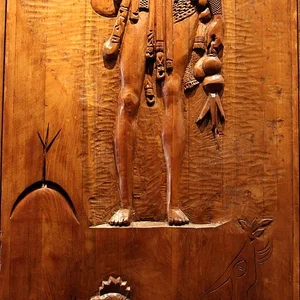
The symbol of Te Wheke, the giant octopus, is closely associated with Tangaroa in certain Māori traditions. Its eight tentacles represent the invisible connections between all sea creatures and humanity. Māori carvers often depicted Tangaroa with small creatures emerging from his body, illustrating his nature as the creator god of all marine life.
In Hawaii, Tangaroa's equivalent is known as Kanaloa. Companion of Kāne, god of light, he travels across the oceans and creates freshwater springs wherever he sets foot. Hawaiian navigators invoked Kanaloa before any great voyage, asking him to calm the waves and guide their canoes across thousands of miles of the Pacific.
Primary Sources
Ta'aroa was the principal deity of the Society Islanders… He was self-created, and existed before the formation of the world; the ocean was his dwelling-place. He made the world for his dwelling, and when men disobeyed his laws, he overturned it.
Tagaloa was the great god of Samoa. He lived in boundless space, and made the islands of the Pacific by throwing rocks into the primeval ocean. He was the father of gods and men, and the source of all authority.
Tangaroa was the ruler of the sea and all its creatures. He was one of the principal offspring of Rangi the Sky Father and Papa the Earth Mother, and his realm encompassed all the waters of the world, from the deepest ocean to the smallest stream.
This is the source of the darkness, the night of Kanaloa, the great sea of Kanaloa. The light, the sun, the day arose from the depths of the primordial ocean, breathed into being by the divine.
Tangaroa: the god of the ocean throughout Polynesia, known as Tagaloa in Samoa, Ta'aroa in Tahiti, Kanaloa in Hawaii. He is universally acknowledged as lord of the sea and of all creatures dwelling therein.
Key Places
Considered the religious center of all Polynesia, this great coastal marae was the principal place of worship of Tangaroa in the central Pacific. It was also the mythical departure point for the great migrations to Hawaii and New Zealand, inscribed on the UNESCO World Heritage List in 2017.
The cradle of Polynesian culture, Samoa is the territory where Tagaloa (Tangaroa) is venerated as the supreme and absolute creator god. Samoan oral traditions are among the richest sources on the origins and founding deeds of the deity.
Tangaroa is venerated by the Māori as the god of all ocean waters. The coastlines of New Zealand, with their often harsh marine conditions, were places where his worship was especially intense, marked by fishing and navigation rituals.
Ta'aroa (Tangaroa) was the supreme deity of Tahiti before the arrival of missionaries in the 18th century. The great marae of Tahiti, particularly at Papara and Mahaiatea, were major centers of his worship, and have since been partially excavated by archaeologists.
In Hawaii, Kanaloa (the Polynesian equivalent of Tangaroa) was especially venerated along the western coast of the Big Island. Fishermen performed maritime rituals there before each voyage, and *heiau* (temples) dedicated to him were built along the shoreline.
The legendary homeland of all Polynesians, often identified with Raiatea, from which the great ancestors are said to have set out under the protection of Tangaroa. Though mythical, Hawaiki underpins the entire Māori cosmology of migration and divine origins.
Typical Objects

This fish-hook-shaped pendant carved from bone or stone is the most direct symbol of the bond between Tangaroa and humans. Worn as an amulet by Māori fishermen and navigators, it represents prosperity, good fishing, and the god's protection during ocean crossings.

A double-hulled vessel enabling the great Polynesian voyages across thousands of kilometres. Every journey was placed under Tangaroa's protection; precise rituals were performed before departure to gain his favour and avoid his wrath on the open waters.

A triton shell transformed into a ritual trumpet, used during ceremonies dedicated to Tangaroa. Its powerful sound evokes the rumbling of the ocean and serves to summon the divine presence at coastal marae; in Tahitian myth, pū also refers to the cosmic shell whose outer layer Ta'aroa breaks open to create the universe.

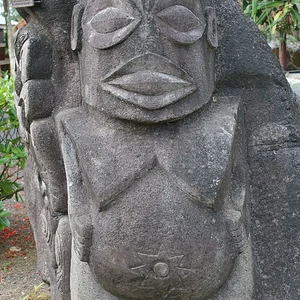
Wooden sculptures depicting Tangaroa with small beings emerging from his body, symbolizing his creative power over marine life. The most famous examples come from the Society Islands and are now housed in Western museums, testaments to the genius of Polynesian artistic tradition.

The making and use of nets were governed by strict rituals under Tangaroa's protection. Only men in a state of ritual purity (tapu lifted) could handle certain sacred nets, and their first catches were offered to the god.

Dark stones were placed on coastal marae as offerings to Tangaroa. They symbolized the rocks that Tagaloa had hurled into the ocean to create the islands, according to Samoan cosmogony, recalling the god's founding act of creation.
School Curriculum
Vocabulary & Tags
Key Vocabulary
Daily Life
Morning
According to Polynesian traditions, Tangaroa awakens with the first tides. The priests who serve him recite karakia (ritual prayers) at dawn facing the ocean, invoking his goodwill for the day's fishing. A calm sea at sunrise was interpreted as a sign of his contentment and his favor granted to the fishermen.
Afternoon
In the middle of the day, Tangaroa reigns over the turbulent depths. This is the time when fishermen cast their sacred nets, after reciting precise invocation formulas. Any incident — a broken line, a torn net, a sudden storm — was read as a sign of the god's anger, immediately requiring a ritual of reparation and appeasement.
Evening
At sunset, when the waters changed color, Tangaroa was said to return to the depths. Fishermen returning to shore would thank the god with offerings: the first fish caught were often thrown back into the sea or placed on the coastal marae. The nocturnal swell was associated with the god's movements through his vast kingdom.
Food
As a deity, Tangaroa feeds on the ritual offerings consecrated to him by his followers: first fishing catches, sacred shells, sometimes animals sacrificed on coastal marae. In myths, he draws his sustenance from the mana (spiritual power) of the ocean itself, an inexhaustible source of vital and divine energy.
Clothing
In Polynesian carved representations, Tangaroa often appears naked, covered with small marine beings emerging from his body, symbolizing his creative power. His priests wore shell ornaments, seabird feathers, and tattoos depicting waves — visible signs of their sacred bond with the god of the ocean.
Housing
Tangaroa resides in the depths of the ocean, in a mythical palace that traditions describe as made of coral and volcanic rock. On land, he is symbolically present in coastal marae — open-air sacred spaces delimited by standing stones — where his statues are kept and his rituals performed by priests.
Historical Timeline
Period Vocabulary
Liens externes & ressources
Références
Œuvres
La création du monde depuis la coquille cosmique (mythe tahitien de Ta'aroa)
Époque mythique primordiale
La création des îles du Pacifique (mythe samoan de Tagaloa)
Époque mythique primordiale
Le peuplement de l'océan par les créatures marines (mythe maori)
Époque mythique
Le conflit cosmique avec Tāne (mythe maori)
Époque mythique
L'enseignement de la navigation aux humains (traditions orales polynésiennes)
Époque mythique et historique